
A year after Floyd protests became chaos in Raleigh, what has changed — if anything?
A year ago Sunday, a middle-school teacher from Raleigh crouched on Davie Street rubbing her burning eyes while a stranger poured milk over her face, trying to wash away the tear gas.
Nearby, a father of two watched the chaos through the broken window of an outdoors store on West Hargett Street, determined to protect it from looters.
And a restaurant owner hunkered down at home, wondering if her restaurant on South Wilmington Street would survive the night.
Raleigh has never seen two nights like May 30 and May 31, 2020, when a downtown already hobbled by the pandemic saw a peaceful protest fall to chaos.
More than a thousand marched through the streets chanting “George Floyd!” just days after he died May 25, 2020, when a Minneapolis police officer knelt on his neck. By the end of May 30, dozens in Raleigh were arrested as the crowd’s dynamic shifted.
Nearly every window within a few blocks of Fayetteville Street was broken, and a fog of tear gas hung in the air. Police officers were pelted with rocks and water bottles, 14 were injured, and they responded with rubber bullets.
Raleigh’s peaceful protesters rallied out of common outrage. They wanted to add their voices to the nationwide call for an end to violent policing that targets Black citizens.
After a year, they see little progress — if any.
Plywood nailed over broken windows has largely come down. But the streets are only beginning to refill with people, and many of the businesses that thrived there could not survive the twin blows of pandemic and riot. The hopeful gestures they offered in the wake of those nights last May have yet to yield many positives.
Raleigh has drawn dozens more demonstrations since then, but none of them led to anything close to the level of damage from the two nights in May. Most involved only marches and picket signs. Raleigh officers have not used tear gas or rubber bullets since then.
On the one-year anniversary of last year’s demonstrations, these people captured in memorable photographs from those two nights in May reflect on the discord they saw and the changes still don’t see.
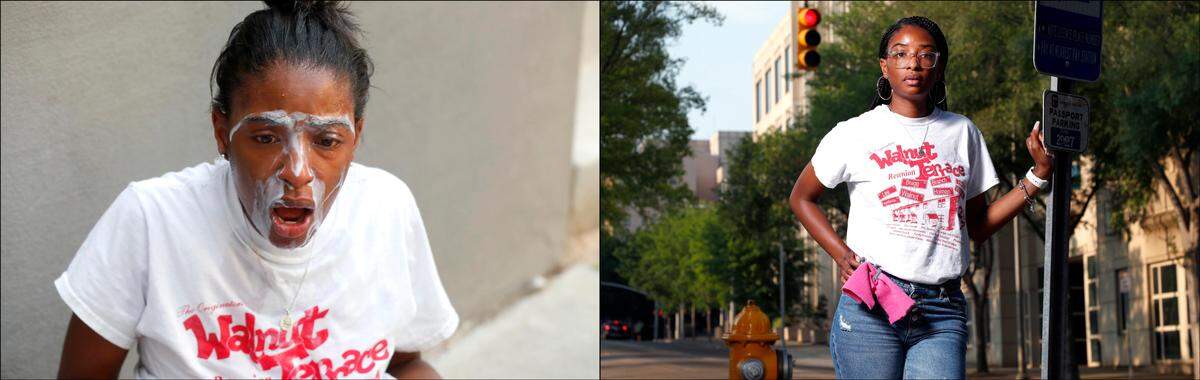
Jessica Peacock: ‘Stories are being amplified’
What she witnessed
Jessica Peacock, 28, teaches sixth grade at Alston Ridge Middle School in Cary, and she looked forward to the May 30 march as a chance to join other educators who were activists.
She had lunch downtown, listened to speakers for two or three hours and then walked back to her car, parked in the deck near the Raleigh Sheraton.
“The next thing you know, my face, my eyes, my nose, my throat are all on fire,” she said. “It even hurt to call for help. It even hurt to, like, scream out in agony.”
Police used smoke bombs, tear gas and pepper spray to quell protesters they reported were throwing rocks and trying to enter the sally port that leads into the Wake County jail. Peacock didn’t know what hit her, only that her eyes were burning and officers were crowded around her. Everyone was yelling, including her.
“I had some good Samaritan run over and pour milk all over my face,” she said. “I am now enclosed. I’m on a street corner where I can no longer move. Now there’s a SWAT team blocking the intersection. At the time, because there was not a lot of protesters or marchers or people left from the march, I’m just like, ‘What in the world brought this on?’”
After a year
Peacock has not rejoined any downtown protests. She avoids the crowd for “safety reasons.” But, she added, “I was so enraged, if me taking pepper spray is what needs to happen for police brutality to come to an end, I would do it every day.”
The only change Peacock sees is a shift in the national conversation. People are now paying attention to stories like hers, she said, many of them for the first time. For a Black person in Raleigh, she said, her experience downtown is nothing new.
“I think we’re still in a place where we were a year ago,” she said. “What has shifted is the amount of people who are looking and listening. That is what has shifted. Not so much people’s actions. Kind of our understanding and awareness. Stories are being amplified.”
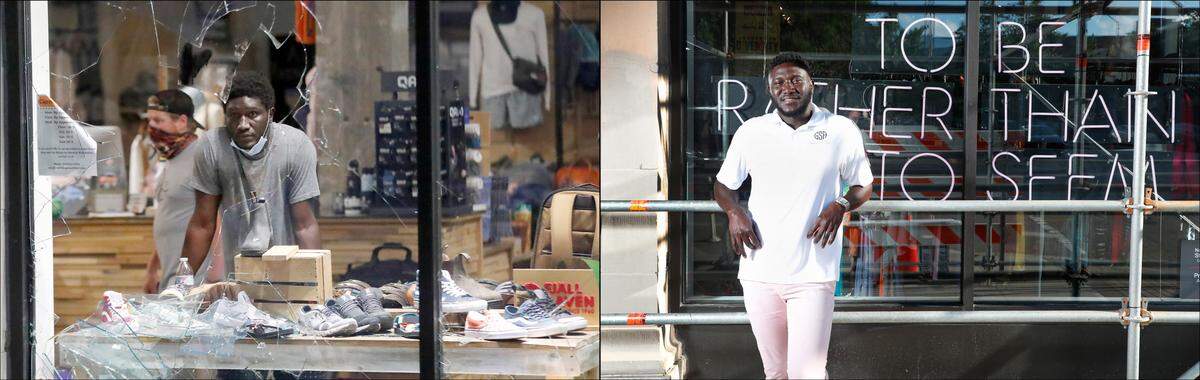
Pa Gai: ‘I don’t have a solution’
What he witnessed
Pa Gai has long been a soccer fanatic, growing up across the street from the national stadium in his native Gambia. His life as a coach and player’s agent has taken him around the United States, including a stint in Minneapolis.
Floyd’s death moved Gai deeply, especially since he knew the neighborhood where police killed him. So Gai came to downtown Raleigh on May 30 to publicly grieve.
Once the streets turned dark, he headed for home with his brother-in-law, and they passed Apex Outfitters on West Hargett Street. The windows were smashed, and looters were ransacking the store. Gai rushed in to protect it from further damage.
“One thing that stood out when I read the sign was ‘locally owned,’” said Gai, who now runs his own sports agency. “I felt like that’s my neighbor.”
Gai wasn’t the only one defending the property. Another half-dozen people joined him as he stood at the window, looking out through a hole in broken storefront windows. He tried to reason with people coming in, bent on destruction, talking them out of it.
“These are our neighbors,” he said. “These are our friends.”
He wanted to get home to his wife, son and daughters. But as he looked out on the street through the broken window, he felt another motivation for staying inside.
If he left, he said, police might mistake him for one of the looters.
“I was more scared of the riot police,” he said.
After a year
The store he defended has since closed on Hargett Street, with the owner telling The News & Observer that the costs of repairing the store, coupled with the pandemic’s loss of business, were too great to recover.
Gai sees no change in the national climate since he marched last May.
“Absolutely not,” he said. “I just think it’s sad the George Floyd bill is still pending in Congress,” he said, noting the legislation that would address police misconduct, excessive force and racial bias. “Even after (Minneapolis police officer) Derek Chauvin was convicted, we’re still struggling to pass the bill.
“And then everything in Elizabeth City.”
On April 21, sheriff’s deputies in Pasquotank County shot Andrew Brown Jr. in the back of the head as he was fleeing a drug-related arrest. Brown’s death took away any momentum Gai said he might have felt after Floyd’s killer went to prison.
“I don’t have a solution,” he said. “These things continue to happen.”
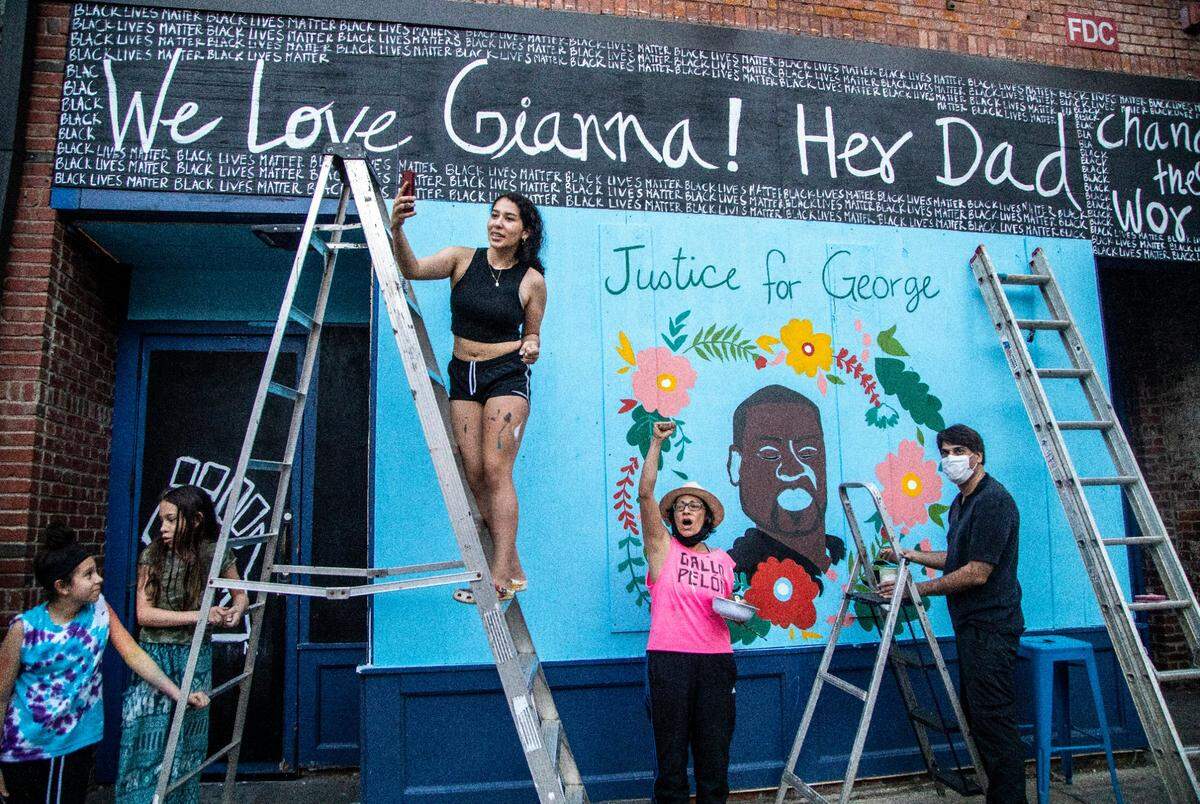
Angela Salamanca: ‘We are still in transition’
What she witnessed
Angela Salamanca took her children to the May 30 protest, marching peacefully during the early hours and then going home. And when the night turned ugly, she stayed up late calling the city, checking on friends downtown, distraught over being powerless.
She woke early to find Centro, her popular Mexican fusion restaurant on Wilmington Street, wrecked along with its neighbors. But volunteers quickly showed up with brooms, sweeping up the glass and scrubbing graffiti off stone walls.
When she placed the plywood boards over Centro, already closed by the pandemic, she wanted to send a hopeful message. She and her family painted Floyd’s face surrounded by doves and olive branches.
When new protesters passed a few days later, they all waved.
After a year
Before the pandemic and protests, Centro had a staff of 40 working three shifts seven days a week.
Now, Salamanca said, she is back to 10 employees serving dinner four days a week.
Her mural was meant to make downtown feel more inviting, and to stave off people’s fears about safety. But recovery has been spotty.
“I am not the most optimistic person, as an immigrant, by default,” Salamanca said. “I think that we are still in transition. I do feel a lot more hopeful. Good friends of mine working very hard to pull this thing back together. But we’re not out of the woods.”
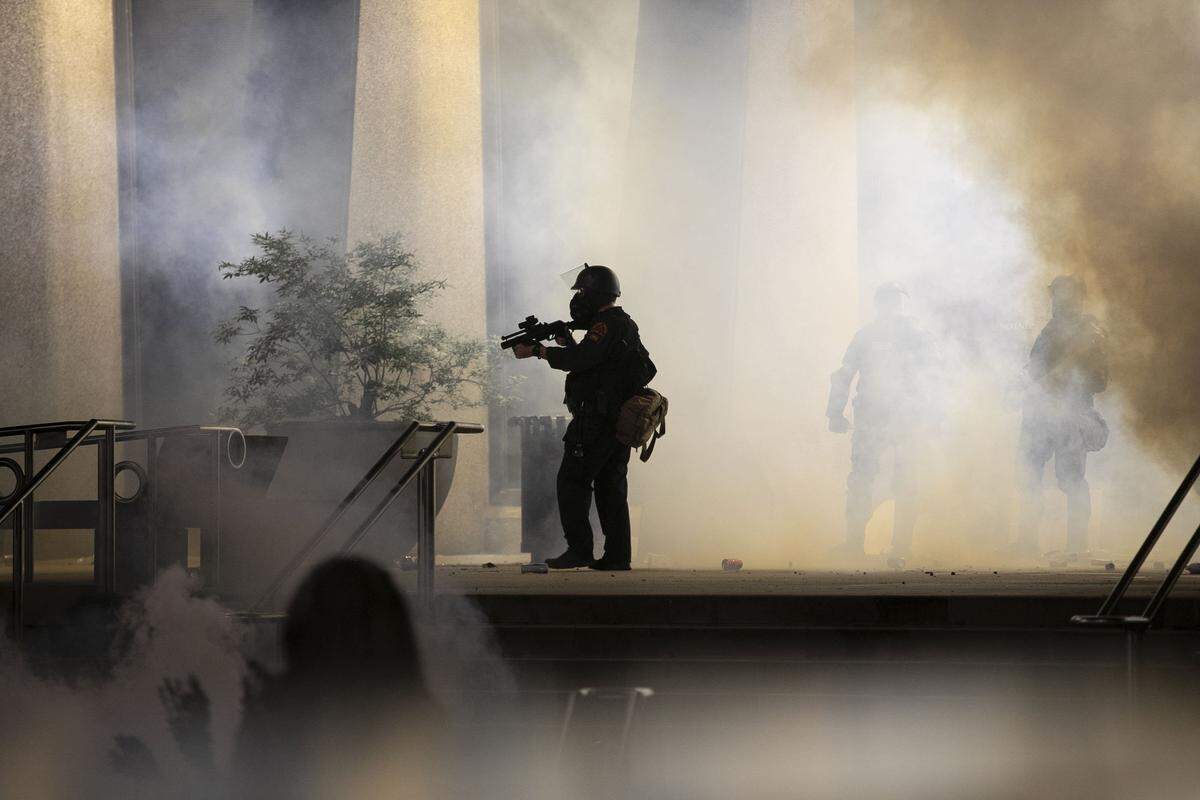
How police have responded since
In Raleigh’s after-action report published after the protests, police described the period as “civil unrest unlike anything experienced.”
It cited communication with businesses and residents as an area for needed improvement, and also rebuilding trust. Since then, Raleigh has begun sending text message alerts when protests are expected.
Retiring Police Chief Cassandra Deck-Brown, though, wrote that her officers “conducted themselves with the highest levels of professionalism, decorum and dignity.”
“We will not turn a blind eye to the despicable and outright criminal behavior that occurred on the heels of yesterday’s peaceful protests,” Deck-Brown continued. “We will not tolerate the unlawful acts nor those who seek to sew discord where we seek to build bridges, strengthen partnerships, and maintain a safe, vibrant and healthy community.”
A consultant, 21CP Solutions, issued a list of 39 recommendations, including:
▪ enforcing city laws requiring protesters to get permits before they picket;
▪ using “soft” under-uniform protective gear that looks less militarized;
▪ deciding with city leaders about when or whether to use tear gas; and
▪ inviting the public to a community debriefing session following large protests.
Last year, the city announced it would begin sending mental health workers on some police calls. Those employees have not yet been hired, but Mayor Mary-Ann Baldwin described Raleigh as “embracing a change.”
The city has also discussed adding $5 million to the police budget rather than cut it, as activists have advocated. Both Raleigh and Durham are hiring new police chiefs, widely seen as an opportunity for new policies.
In Durham, a majority of council members support moving money for 20 police positions to a new city department.
Earlier this week, Durham County Sheriff Clarence Birkhead sent this message publicly:
“As a citizen of this community and as sheriff,” he asked, “what could I do here in Durham? As the Sheriff of Durham County, I reviewed and edited our policies and procedures, in direct response to community concerns, related to use of force, over-policing and impartial policing, and how we treat those incarcerated in our detention facility. ... Moving forward, I am introducing racial equity training to ensure my staff has the knowledge and understanding of systemic racism, how it works, and to learn the skill set to dispel attitudes and actions that perpetuate racism.”
This story was originally published May 28, 2021 at 3:02 PM.