Police officer shortages across NC are causing problems but may force needed change
READ MORE
Police staffing crisis, or chance for change?
An officer shortage that started before the COVID pandemic has worsened significantly over the past year, leaving some departments with a fourth of their positions vacant. In some places, the shortages may be enough to delay call responses or require officers to work longer-than-normal hours. Are the staff shortages a signal for change? This is The N&O’s special report.
Expand All
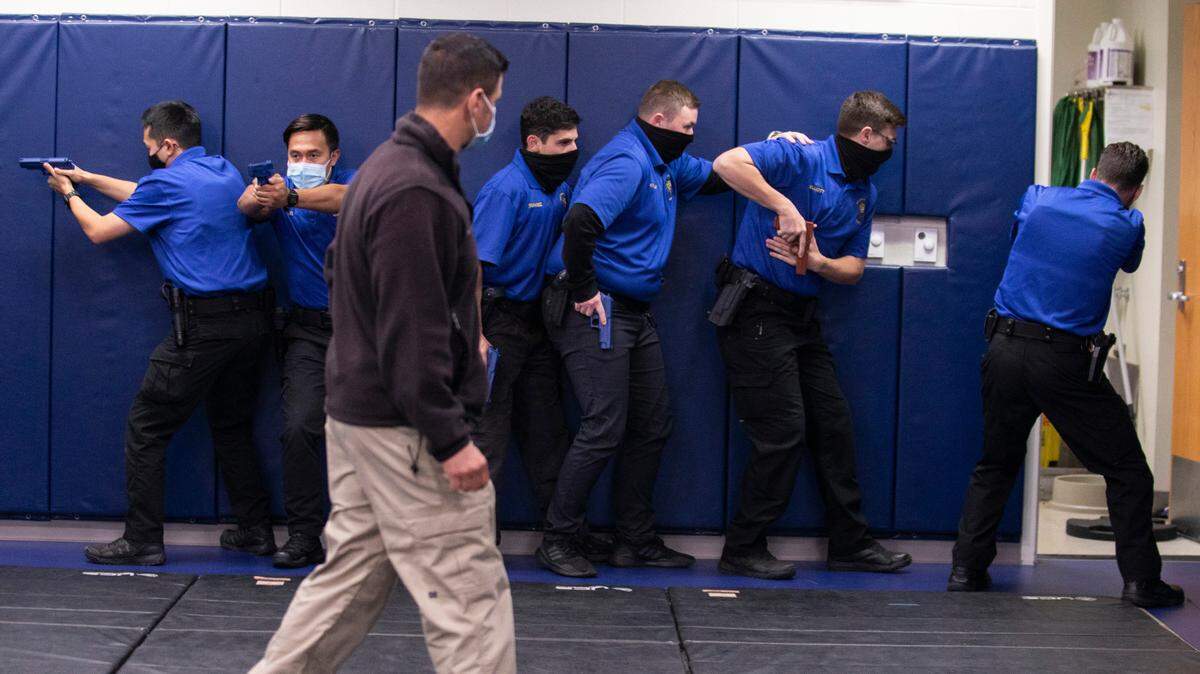
The call was vague: Wake Technical Community College needed a team of officers to search two rooms of a building on its Public Safety Education Campus to make sure no one inside was dangerous or injured.
A half-dozen uniformed young men responded, entering quietly through a ground-floor door, easing up two flights of stairs in a human chain — no one too far ahead or behind — then breaking the silence to announce their presence.
POLICE!
In formation, they poured into the room, guns drawn.
Waiting there was not a suspect, but Jon Gregory, director of Basic Law Enforcement Training, Corrections and Detention Training for the school, along with instructors James Atkins and Sayed Naqwe. They were evaluating their cadets’ performance.
It was a role-playing exercise, but maybe also a metaphor for the precarious spot in which many police agencies across North Carolina find themselves at the moment — not sure what lies around the corner or whether they’ll have enough manpower to properly respond.
An officer shortage that began before the pandemic has worsened significantly over the past year, leaving some departments with a fourth of their positions vacant. In some places, the shortages may be enough to delay call responses and to require officers who are on the job to work longer-than-normal hours, creating stress and morale problems that threaten to further deplete the ranks.
The shortages come as the FBI reports a historic rise in murder rates nationwide during 2020, and a rise in violent crimes in general in North Carolina.
“In some communities, it’s becoming an increasing problem,” said state Attorney General Josh Stein, whose office reports that just 758 students passed the state’s BLET exam and became eligible for law enforcement certification during the first six months of 2021. That’s down from 990 students who passed the exam in the first half of 2020.
The number of BLET courses offered across the state, which is based on student demand, dropped from 77 to 66 in that same window of time.
What’s behind the vacancies?
In addition to the drop in the number of people applying for jobs at the 534 law enforcement agencies in the state, the profession is seeing the regular retirement of the baby boom generation, along with an increase in officers retiring early or leaving the profession for other lines of work.
In a June survey by the Police Executive Research Forum, agencies were currently filling only 93% of their available positions.
Online job-search sites show openings for entry-level and experienced officers in cities and towns across the state, along with county sheriff’s departments, university and community colleges, hospitals, transit authorities, tourist attractions and corporate campuses.
The reasons are varied.
For Stein, two big issues are:
▪ officer salaries, which average from $37,000 to $50,000 in North Carolina, according to the U.S. Bureau of Labor Statistics.
▪ expectations, which have expanded as the nation’s mental health care system has failed to keep up with treatment needs.
“I think that we put too much on law enforcement, and don’t pay them enough for the important role they play in our communities,” Stein said. “If you look at what we ask law enforcement to deal with today, it’s not only fighting crime.
“Where we have had failures in our healthcare system, whether that’s the delivery of mental health care or substance abuse treatment or social services dealing with family issues, all of those problems don’t go away,” Stein said. “They simply land in the lap of law enforcement. But we don’t pay them well enough.”
Triangle shortages and salaries
In Raleigh, the police department is contending with a shortage of more than 100 officers. Out of approximately 800 sworn positions, 108 were vacant as of Nov. 4, according to department spokesperson Donna-maria Harris.
That’s a vacancy rate of more than 13%.
The starting salary for a police recruit in Raleigh is $41,068. Upon completion of the academy, pay is increased to $42,300, the minimum salary for a police officer with less than two years of experience, according to the department’s website.
In Durham, recruits make $38,511, which is increased to $40,342 when they are released into full duty, according to the Durham Police Department.
By contrast, in Wake Forest, just 30 minutes north of Raleigh, the starting salary for a police officer beginning their career is $50,243, according to the town’s website.
Some other nearby towns also start officers at salaries higher than Raleigh’s and Durham’s:
▪ Fuquay-Varina, $45,252.
▪ Knightdale, $45,751.
▪ Cary, $51,000.
Some departments, such as Fayetteville, offer hiring bonuses to lure new officers. Others promise to pay for extra education and certifications that can lead to higher pay down the road.
Rick Armstrong, vice president of the Raleigh Police Protective Association, said vacancies in the Raleigh department are “a huge problem” and that the full scope of the issue is greater considering that 47 officers who are counted as having filled a sworn position are still in the training academy, “not on the streets fighting crime and protecting the city.”
‘The Great Resignation’
Like nearly every other employment sector in the U.S. economy, law enforcement also has been affected by what’s been called “The Great Resignation” or the “Big Quit,” which began in spring 2021 and has seen millions of people across the country voluntarily leave their jobs or get laid off.
There is also the pandemic.
According to the Fraternal Order of Police, COVID-19 has become the leading cause of death among police officers. Nationwide, the group says, news reports have attributed at least 786 law enforcement deaths to the coronavirus as of Nov. 5, including at least 32 in North Carolina.
Numbers on the Officer Down Memorial Page indicate that police officers throughout the country have been five times more likely to die of COVID-19 during 2021 than as the result of gunfire.
Many officers have resisted getting vaccinated against the virus, and a recent story by the Associated Press reported that departments issuing vaccine mandates have met pushback by officers or their unions. Some agencies worry the standoffs will result in additional staff departures.
Finally, say those who try to recruit and train new officers, there is the pall hanging over police work cast by the revelations of police brutality, especially against people of color such as George Floyd, who was killed by an officer in Minneapolis in May 2020.
That’s the main reason cited by Chief John C. Tippett of the Scotland Neck Police Department in northeastern North Carolina when asked why he struggles to recruit new officers.
“Ain’t nobody beatin’ the doors down to be the ‘PO-lice’ this day and time,” Tippett said. “I believe it’s probably just the fact that the nation’s current view on law enforcement is not too good right now, owing to events across the country.”
Criminal Justice Fellows Program
When he needed a couple of officers for his eight-man force, Tippett turned to the new Criminal Justice Fellows Program in Stein’s state Department of Justice.
The program, which has asked for but not yet received funding from the N.C. General Assembly, recruits high school seniors and graduates into law enforcement jobs in rural counties. Through the program, a limited number of students each year can get loans to pay for their associate’s degree in criminal justice or related field at any community college in the state.
Students have five years to repay the loans or, if they go to work in law enforcement after graduation in any N.C. county with a population of fewer than 75,000 people and stay for four years, the loans will be forgiven.
One of the Fellows who came to Tippett’s department has since left to join the force in Chapel Hill, Tippett said. The other is still in Scotland Neck, has been promoted to corporal and recently took on additional duties as a canine officer.
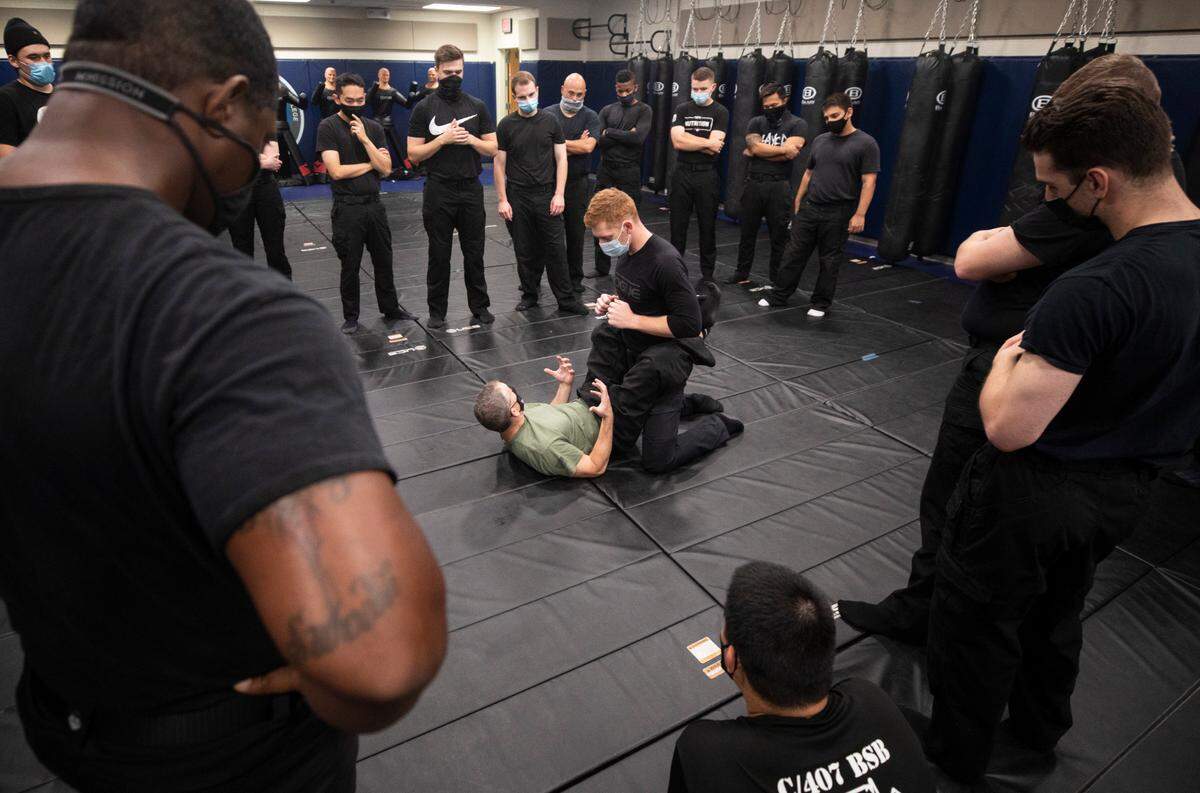
Police officers across North Carolina must meet minimum professional standards, which are taught in the BLET courses and tested before cadets can be certified.
The North Carolina Sheriffs’ Education and Training Standards Commission and the North Carolina Criminal Justice Education and Training Standards Commission are in the final stages of reviewing the standards and updating the BLET curriculum. They are factoring in specifications from Senate Bill 300, which orders criminal justice reform, and survey responses from police leaders about what skills officers need to be effective.
When Wake Tech pilots the new curriculum next year ahead of its full rollout in 2024, it will include added training in de-escalation, crisis intervention and procedural justice, all designed to build problem-solving skills and reduce the likelihood of injury to both citizens and officers.
“As policing has evolved over the years, the candidate you’re looking for now is a person who has interpersonal skills, who can build good relationships with the people they serve,” said Trevor Allen, director of the N.C. Justice Academy, which oversees BLET across the state.
“You want someone who has the ability to be a problem solver, a bridge-builder in a sense. Those skills sets were always present in some sense, but now you really need more people who can be independent, critical thinkers, who can look at a situation and say, ‘How can I solve this problem?’”
It’s a move away from the militaristic mindset, Allen said, in favor of a guardian approach.
“It’s more of a return to that idea that police can’t come into every situation and fix it,” Allen said. “You have to have that relationship with people, where you can work with the community to identify solutions, especially with everything that has happened in this country in the past couple of years.”
Starting salary struggle
Raising salaries for police officers is a complicated process, dependent on the finances of a city or county, the availability of outside government grants and the political will of the members of town councils and county boards.
Despite a recent increase, the current starting salary for an officer in the city of Goldsboro is $38,505, around 9% below the average for the area about an hour southeast of Raleigh, Police Chief Michael West said.
Some Goldsboro officers end up pursuing second jobs while they are off-duty, “to survive financially,” West said, and the Wayne County town has had difficulty filling its 108 allocated positions for sworn officers.
Currently, about one of every four sworn officer positions in the department are vacant.
The officer shortage results in a “significant additional workload” for existing officers, who receive little, or in some cases, no time off, West said.
Some communities in North Carolina are working to improve working conditions for law enforcement by providing officers with additional resources on certain kinds of calls. Chapel Hill, for example, developed a 24-hour crisis-response team in 1973 whose members can augment police help with social services in a range of situations such as psychiatric emergencies and domestic violence cases.
In Durham, the county has taken a public-health approach to crime, trying to prevent shootings and killings by helping at-risk individuals get help with conflict resolution, substance-abuse treatment and job training. Bull City United, part of the county health department, is in the process of expanding from a staff of seven to 25, thanks to additional funding from the City of Durham that allows the program to work in a broader geographic area.
Despite the problems in law enforcement — in fact, because of them — Will McIntosh, BLET director at Johnston Community College, believes this is a promising time for his profession.
McIntosh, who worked for 18 years as an officer and is still certified as a reserve member of the Clayton Police Department, said he believes the public’s outrage over the police killing of George Floyd; training reform already underway; increased scrutiny of even routine interactions between police and citizens; and the widespread officer shortages all indicate that policing has to improve.
“While there are a lot of people who think right now is a bad time to get into law enforcement, I believe the opposite is true,” McIntosh said, and not just because his students have multiple job offers before they finish training.
“I think it’s a great time to get into law enforcement. Because the folks that are getting in now are getting in on the ground floor of change, on the ground floor of rebuilding.
“They get to be a part of that.”
This story was originally published November 10, 2021 at 6:00 AM.