How much affordable housing is enough? Chatham Park plan could face a vote Monday.
Pittsboro’s Board of Commissioners could consider a developer’s offer Monday to add 1,650 affordable homes and apartments to the 7,068-acre Chatham Park development or donate 93 acres of land to the town.
The board also is expected to decide the fate of the North Chatham Parkway, which is routed through a neighborhood outside of Chatham Park’s boundaries but surrounded by the development.
The meeting begins at 7 p.m. Monday and will be available online at tinyurl.com/ez768kre.
Chatham Park developer Preston Development anticipates bringing 60,000 people, 22,000 homes and 22 million square feet of business, medical and commercial construction to Chatham Park and Pittsboro by 2045. Construction started several years ago.
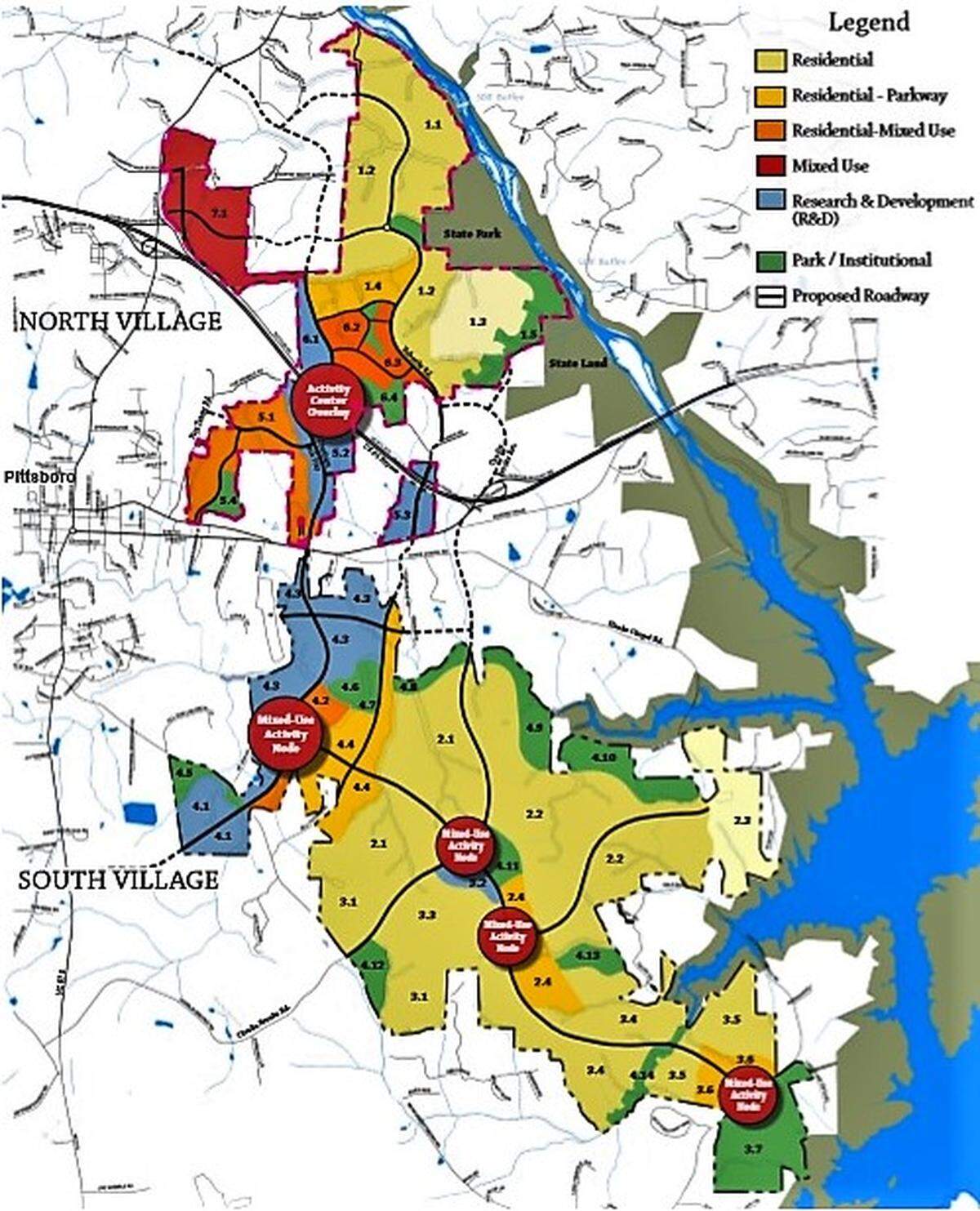
The development covers land between U.S. 15-501 and the Haw River, both north and south of U.S. 64, and will dramatically alter Pittsboro, which the U.S. Census reported had a population of 4,195 in 2019.
In 2015, the commissioners approved a master plan — a very high-level view of what could be built and where — and in October, they approved a development agreement with more details about how construction will proceed over the next 25 years.
The remaining piece is affordable housing, one of 12 “additional elements” that address specific issues, such as tree protection, lighting and development phasing.
The town rejected a plan in 2016 that would have let Preston Development build more housing if it provided 1% of the 22,000 planned units as affordable housing for 30 years. In September, Preston submitted a second offer with 5% affordable housing.
The third offer, which could be decided Monday, calls for 7.5% affordable housing, an increase of 1,430 units since 2016.
The town’s other option is to accept a 93-acre land donation, which could be in Chatham Park or up to a half-mile away and annexed into the town if necessary.
Preston would not pay development-related fees or provide park and recreation space for the affordable homes. It could build eight more market-rate homes for every affordable home that’s built within or on its borders.
Pittsboro would have to create a nonprofit housing trust that would spend 2.5% of the town’s property tax revenues from Chatham Park for 30 years on affordable housing. The trust’s board also could donate or sell a Chatham Park land donation to meet those goals.
Affordable housing, sewer needs
That’s not enough housing, Pittsboro Commissioner John Bonitz said in last week’s board work session and in a Chatham News and Record letter to the editor asking residents to join him in asking the commissioners to do the right thing, rather than rush to a deal.
Bonitz cited a shortage of affordable housing in Chatham County, along with soaring home prices and property values. Data presented to the board last week shows Pittsboro already needs 510 affordable units to serve residents earning up to $50,000 a year.
That’s just a portion of the 2,247 affordable housing units needed across the county, according to a December 2020 report.
Nonprofit housing developers have said at least 15% of all new housing needs to be affordable, but most Chatham Park homes would be out of reach for lower-income residents, Bonitz said. In an interview Friday with The News & Observer, he also questioned the plan’s “presumptuous” allocation of property taxes.
The developers “are men of good intent,” but they also have an obligation to the community, just as mill owners historically provided for housing to serve their workforce, Bonitz said. Instead of stick-built, single-family affordable homes, he suggested modular housing that is built more affordably in a factory and dropped on site, as well as townhouses, apartments and quadplexes.
“Each of those $600,000 to $900,000 houses is going to need people to attend to those properties and the wealthy folks who live here, and that means that those people are going to have to commute from afar, and that’s not acceptable in a place that claims to be live, work, play,” Bonitz said.
The land donation is not a good option either, he added, because the town doesn’t know which land and if it can be served by public utilities. Chatham Park’s sewer permit uses the town’s remaining capacity, he said, calling it a “giveaway” potentially worth $5 million.
Mayor Jim Nass also called the housing plan a “great improvement” over previous offers. But the vote is not certain yet, he told The N&O in an interview Friday.
Nass disagreed with Bonitz’s contention that the town doesn’t have any more sewer capacity, noting that the town and Chatham Park are working to get more sewer capacity from Sanford that also would serve the Moncure supersite, south of Pittsboro.
The town will study its long-range sewer capacity needs over the next few months, he said. It’s been working with Sanford for a few years on the sewer plan, and also on a plan to provide Pittsboro with a second water source after Jordan Lake, he noted.
Sanford is noted in the draft affordable housing plan as one of the “assignees or affiliates” of Chatham Park Investors LLC. The plan also requires water and sewer lines to be available to serve any donated land.
The plan requires residents to pay Chatham Park sewer rates if the affordable homes are served by Sanford or the Chatham Park Water Recovery Center. It was not immediately clear how those sewer rates would differ from Town of Pittsboro sewer rates.
Growing population, income gap
Pittsboro’s population grew 89% between 2000 and 2019 — a trend that is expected to intensify over the next 30 years. The related development, largely between Pittsboro, Chapel Hill and Cary, has widened the gap between haves and have-nots, according to a 2019 Chatham County affordable housing plan.
Renters now comprise more than 30% of Pittsboro’s residents, and over half struggle to pay their housing costs, Brown said. That compares to 46% of renters in the Durham-Chapel Hill metro area, she added.
Experts generally describe affordable housing as costing roughly 30% of a household’s annual income. For commuters, the definition includes transportation costs, for a total of 45% of a household’s annual income.
Preston Development’s plan offers housing that is affordable at up to 80% of the area median income, which in Pittsboro is based on the Durham-Chapel Hill Metropolitan Statistical Area. That’s a single person earning up to $48,400 a year or a family of four earning up to $69,120 a year.
Pittsboro’s incomes and its actual area median income are lower than in Chapel Hill and Durham, according to Erika Brown, the Triangle J Council of Governments housing program manager who spoke to the commissioners last week.
In Pittsboro, 80% of AMI for a family of four is actually $44,399, she said, making an affordable rent or mortgage payment just over $1,100 a month and out of reach for service workers and lower-income residents.
“It’s interesting because actually other parts of the Durham MSA have higher costs — higher rental costs, higher homeownership costs — but that also means that they might have higher incomes,” Brown said.
Chatham County created an Affordable Housing Advisory Committee and a housing trust fund in 2018, and voters last year approved a quarter-cent sales tax to raise money for affordable housing, agricultural preservation, schools, and parks and recreation.
Earlier this year, the county allocated $209,000 in grants and low-interest loans to three affordable housing projects. The county also worked previously with Third Wave Housing LLC to build affordable housing projects in Pittsboro and Siler City.
This story was originally published November 21, 2021 at 10:48 AM.