Jim Grant is remembered for decades of NC civil rights advocacy and labor organizing
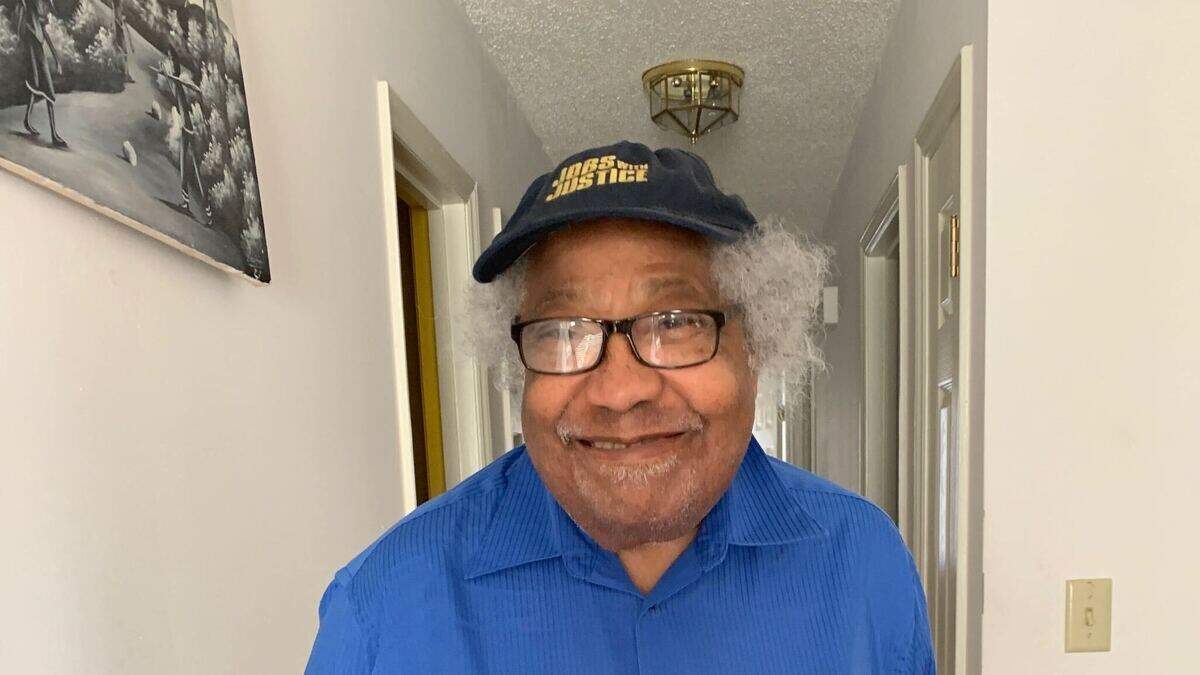
James Earle Grant Jr., a social justice activist and labor organizer who participated in his first sit-in at age 13 and never stopped pushing for the civil rights of minorities and immigrant workers in North Carolina and across the nation, has died.
Jim Grant, 84, of Wilson, was known for his intellect, his ability to listen to and understand the needs of people who felt oppressed or endangered, and his commitment to helping improve others’ lives even when it made him a target of state and federal law enforcement.
Among other things, “He was a protector,” said the Rev. Dr. William J. Barber II, co-chair of the national Poor People’s Campaign, pastor of Greenleaf Christian Church in Goldsboro and also a lifelong civil rights advocate.
Growing up in Eastern North Carolina in the 1960s and ‘70s, Barber often attended community meetings with his pastor-educator-activist father. A group might be gathered to talk about school desegregation — an effort still met with sometimes violent resistance more than a decade after the Supreme Court’s Brown-v-Board of Education decision — when the elder Barber would nod toward a man who had quietly entered the room and was watching over the proceedings.
“That’s Jim Grant,” Barber remembers his father telling him. Years later, when Barber was planning events himself where there was a potential for violent interference, he would often get a call from Grant, who would promise, ‘I’ll be there. I’ll be watching.’” Barber said.
“You know if Jim Grant is coming, you can count on him. He’s not going to run. He’ll stick with you,” Barber said. In Grant’s lifetime, Barber said, “He faced violence. He would go in places and stand beside people and with people when other people and even other organizations wouldn’t.”
‘He was so private’
North Carolina historian and author David Cecelski said it was a challenge to gather information for the tribute he wrote following Grant’s Nov. 21 death.
“Talking about Jim is a new thing for anyone who knew him because he was so private,” Cecelski said in a phone interview. “He was involved in so many things, and he worked for so many different organizations and with so many people, but he was never one to seek the limelight.”
Grant was born Oct. 5, 1937, in Beaufort County, S.C. Cecelski’s research found that Grant moved with his family to a town near Hartford, Conn., where, in 1949, at age 13, Grant joined with some other teenagers in a sit-in at a local department store lunch counter that served only white patrons. They succeeded, Cecelski said, in integrating the lunch counter. That was 11 years before the sit-ins at the Greensboro Woolworth store that set off a movement to integrate lunch counters throughout the South.
.jpeg "jim grant obit photo (1).jpeg")
After graduating high school, Grant went to the University of Connecticut and then to grad school at Penn State, where he earned a doctorate in chemistry in 1968, Cecelski said.
“He could have become a professor of chemistry or a research chemist,” Cecelski wrote, “but he took a different path. Jim instead gave himself heart and soul to the African American freedom struggle.”
Grant came to North Carolina that same year, Cecelski said, working for VISTA — Volunteers in Service to America — part of President Lyndon Johnson’s War on Poverty and a kind of domestic parallel to the Peace Corps. But VISTA had assigned Grant to work in the Charlotte area, where the U.S. military was trying out a program of aggressively recruiting poor Black men to join the service and go to Southeast Asia.
Though the military had been desegregated in the 1950s, African Americans reported they still faced discrimination in training, assignment, promotions and in the administration of military justice, according to the Congressionally authorized America Vietnam War Commemoration.
Grant’s work in opposition to the military’s recruitment efforts didn’t fit with VISTA’s mission and he soon lost his funding from the organization.
Working for dozens of groups
But he remained in North Carolina and in the struggle for civil rights, working for dozens of different groups, formally or informally, over the next 50-plus years.
What made him so effective, Barber said, was his scientific mind, which instead of applying to chemistry problems he used to analyze social problems.
“Math, science, chemistry, these are about dealing with problems,” Barber said. “Jim Grant saw that one of the greatest problems was racism and how it undermines society, how it is used by design to deliberately keep people down based on class or race. Jim and others like him brought their analytical minds and their tenacity to that problem. He knew intuitively that you have to pay attention to the smallest detail. It’s not just what is obvious that matters; it’s what you don’t automatically notice.
“He wouldn’t just dismiss somebody over here because they didn’t have the right name or somebody there because they didn’t have the right money. If they were in trouble, they were part of the equation, part of the formula necessary to create the kind of community that would be just and transformative for all.”
Though his strength was in organizing people and inspiring them to act on their own behalf and for others in their community, Grant didn’t completely escape notoriety.
In February 1971, some 75 civil rights activists gathered at Gregory Congregational Church near downtown Wilmington to plan how to protest inequalities that persisted in local schools. White supremacist groups began patrolling the area, threatening people on the streets. The situation escalated; over several days, several businesses were firebombed, one white man and one Black youth were shot and killed. The National Guard was summoned.
Grant, who Cecelski said was known as a “capable advocate of armed self-defense,” was with the group in the church and was credited with helping protect them when white supremacists surrounded the building and fired on it.
Grant was not among the group that later became known as “The Wilmington 10,” charged with burning down a white-owned store during the siege. But by that time, Cecelski and other researchers said, Grant had been identified by state and local police as one of North Carolina’s top “Black radicals.” He was charged the same year with setting fire to a stable in Charlotte three years prior. He was convicted and sentenced to 25 years in prison in 1972 despite his claims of innocence.
Human rights organization Amnesty International said Grant and his two co-defendants in the stable-burning case were “political prisoners,” convicted on false evidence. Under continued pressure, Gov. Jim Hunt paroled Grant in July 1979.
While in prison, he helped prison workers organize for better pay and working conditions.
Once released, Grant went back to work with groups advocating for public housing tenants, farm workers, slaughterhouse workers, sanitation workers — all kinds of marginalized people, Cecelski said.
‘He listened more than he spoke’
Ajamu Dillahunt is a longtime civil rights worker in North Carolina who, with Grant and others, founded Black Workers for Justice in Rocky Mount in 1981 in response to a local Kmart store’s treatment of Black women employees. The group is still active around Black workers’ issues.
Dillahunt, who lives in Raleigh and officiated Grant’s private memorial service on Dec. 1, remembered Grant as a gentle soul by nature, an attentive listener and a trusted community builder.
“He listened more than he spoke,” Dillahunt said. “In so doing, he got a deep understanding of what the issues were, who the people involved were and what their strengths and weaknesses were. As he was listening, he was taking in the problems and trying to figure out ways to work through them: who might help, whom to build coalition with, what court case would help us out, what attorney would be good, who could help us with funding.
“He was not a public speaker who could arouse people, but he could move people because they saw the genuineness of his work and his commitment. He might travel three or four hours to a meeting that might be only an hour long and then travel three or four hours back home. Or he might drive through the night — or stay up all night — to make sure people were safe. Those kinds of things endeared him to people.”
Dillahunt’s grandson, Ajamu Amiri Dillahunt, a graduate student in history at Michigan State University, plans to write his dissertation on Black Workers for Justice and is launching an oral history project to collect stories about Grant’s life that will be used in a biography later. Though he knew of Jim Grant through his grandparents, Dillahunt said he didn’t grasp Grant’s contributions to the movement until he began studying history as an undergraduate at N.C. Central University. There he began to learn the depth and breadth of Grant’s involvement in the movement.
Early in his days as a student as NCCU, Dillahunt attended a protest in the mid-2010s in response to several UNC Board of Governors’ decisions, including one to close down UNC’s Center on Poverty, Work and Opportunity.
Campus officials rounded up a number of protesters, and Dillahunt remembers seeing Grant in the crowd.
“Here he was, in his late 70s, [risking] getting arrested,” Dillahunt recalled. “I said, ‘OK, that’s who he is, going to an action opposing what the UNC System was doing to students and faculty, ready to put his body on the line for a better tomorrow.
“I said, ‘If Jim Grant is here, I must be doing something right.’”
Grant is survived by a daughter, grandchildren and great-grandchildren; a brother and nephew.