Why Durham says it must abandon a century-old name for its rails-to-trails project
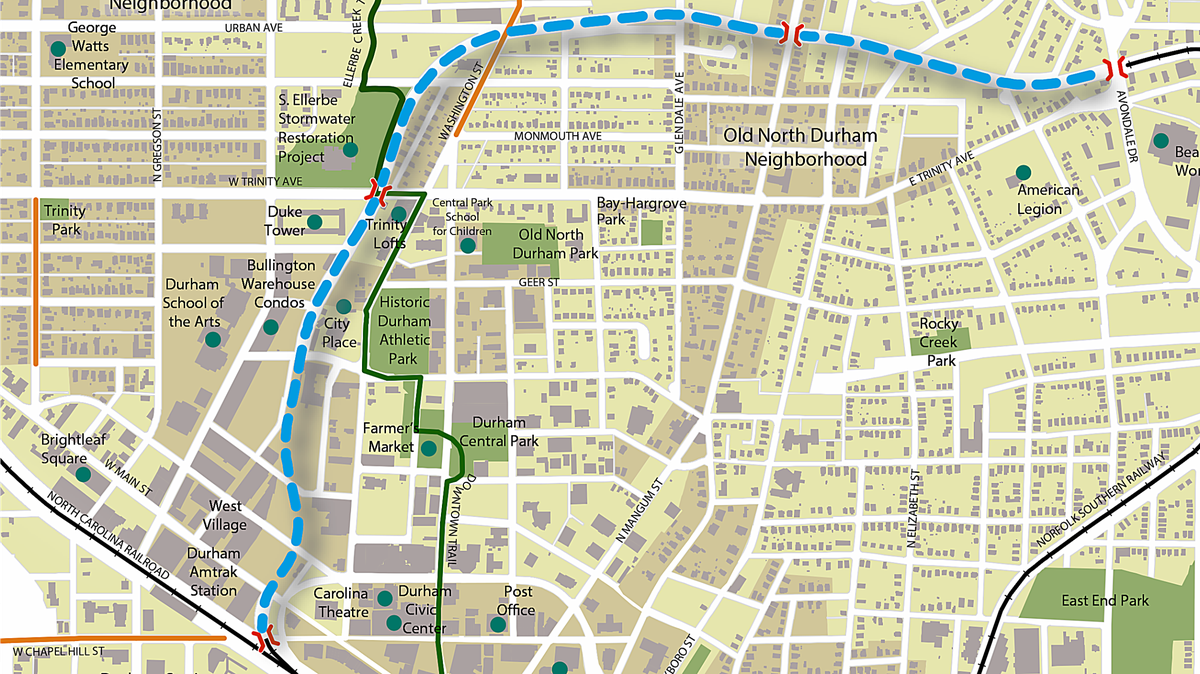
For years, as the city and residents planned to turn an old railroad line into a bike and walking trail, they called it by a name rooted in its history and geography: the Durham Belt Line.
When the city won a $9 million federal grant late last year to buy the 1.75-mile rail line, politicians and community and business leaders celebrated the coming of the linear park in a video touting its potential impact on the city. Former mayor Steve Schewel and others used its longstanding name, Durham Belt Line.
Now Durham has decided that it needs a new name for its trail. The primary reason, says Sean Egan, the city’s transportation director, is to eliminate any confusion with the Raleigh Beltline, the interstate that circles the city in neighboring Wake County.
“When people in our community hear ‘belt line,’ they think giant circular highway,” Egan said. “So we’re trying to kind of move away from that and give the project its own identity.”
But there’s another reason Durham is abandoning a name it has used for years: It wants to avoid a legal fight with the nonprofit group that oversees a much larger rails-to-trails project in Atlanta.
Atlanta BeltLine Inc. has trademarked the terms “Beltline” and “Atlanta Beltline” and guards against their use by others. In 2019, attorneys for the nonprofit sent a letter to the city attorney asking that Durham come up with another name for its trail.
“While ABI applauds and supports the City of Durham’s vision and efforts, the use of the wording ‘Belt Line’ in the name of the project is likely to cause confusion and/or a mistaken impression that the City of Durham’s Belt Line project and related services are affiliated with, sponsored by, or are otherwise associated with ABI, when that is not the case,” the lawyers wrote.
“In order to address this issue, ABI respectfully requests that the City of Durham change the name of its Durham Belt Line Trail project to not refer to ‘Belt Line,’” they continued. “ABI reserves all rights and claims pending resolution of this matter, including the right to take further action to protect and enforce ABI’s rights.”
The city has taken to calling its project the “Durham Rail Trail,” the name that now appears on its website. That name is a placeholder, Egan said, until the community can settle on a permanent one.
Meanwhile, many people continue to refer to the Durham Belt Line, the name on the master plan for the project that the city adopted in 2018 and on official maps.
‘That name has been around a long time’
The railroad that will become the Durham trail was laid out in 1890. Brodie Duke built the line, mostly on land he owned, so trains from the Lynchburg & Durham Railroad, which his family partly owned, could reach Duke tobacco warehouses and factories on the west side of downtown without using the North Carolina Railroad.
The tracks arced over the north side of Durham like a belt.
“I’ve seen old maps from the late 1800s where it is called Duke’s Belt Line,” said Dale McKeel, the city’s bicycle and pedestrian planning coordinator. “That name has been around a long time.”
The Atlanta BeltLine also follows an abandoned railroad corridor known as the Atlanta Belt Railway that circled the city. The Atlanta BeltLine project involves not only a 22-mile all-purpose trail but also the development of affordable housing and small businesses along the corridor.
Atlanta BeltLine Inc. registered “Beltline” as a trademark about a decade ago because it uses the term as a brand for a variety of products and services, including maps, apparel and stationary, said spokeswoman Jenny Odom. The group’s website is beltline.org.
“We monitor third party uses of BeltLine and regularly notify people of violations as we become aware of them,” Odom wrote in an email.
Using the word to describe a highway or railroad line would not violate the trademark, she added, because no product or service is provided.
“However, the use of ‘BeltLine’ in connection with the services and amenities described in the Master Plan for the Durham project would go beyond that,” Odom wrote.
“Given ABI’s use of BELTLINE as a mark in connection with the same types of services and amenities...., it would be likely to create the mistaken impression that there is some affiliation, sponsorship or association with ABI and its project, playing off of the goodwill and recognition that ABI has built for the BELTLINE mark at great effort and expense over nearly two decades.”
Finding a new name will take time
Egan said there’s a leading candidate for a new name for the Durham trail, but it may depend on some clever engineering.
That’s because the trail known as the Belt Line ends on the north side of the North Carolina Railroad tracks. Meanwhile, south of the tracks and the American Tobacco Campus is the terminus of the American Tobacco Trail. The city is looking for a way to connect the two, Egan said.
“The new trail then essentially becomes a northern extension of the American Tobacco Trail,” he said. “We’re not at a point right now where we can really make that promise that this will be a smooth and seamless connection, but that’s the task that we’ve given to our design team to work through.”
Capitol Broadcasting Co., which owns the American Tobacco Campus, is interested in finding a way to extend the trail through its campus, Egan said.
But the bigger challenge may be getting over or under the railroad tracks. The Chapel Hill Street underpass is one option, as is the Blackwell Street crossing, though the North Carolina Railroad is not enthusiastic about directing more people to an at-grade crossing, Egan said.
Another option would be to build a new tunnel for pedestrians and cyclists under the tracks, though that might prove too difficult or expensive.
In the meantime, the city will continue to use the generic Durham Rail Trail for its new linear park. Egan said it eventually wants to make a clean break from Durham Belt Line.
“And since we’re working through some of these challenges,” he said, “we thought it would be best to kind of hold off on a full-scale renaming campaign until we were sure that we had the name that we want to stay with.”
This story was originally published June 10, 2022 at 11:28 AM.