Protesters arrested in Alamance County, NC win cash settlement in lawsuit — again
Alamance County and city of Graham officials have agreed to a settlement after a federal lawsuit accused officers of violating several people’s constitutional rights by blocking and arresting them during a protest.
And it’s not the first time.
City and county officials cut checks recently totaling $120,000 to five people who were arrested during a Nov. 23, 2019, protest in the city of Graham, the county seat of Alamance County, said Jaelyn Miller, an attorney with civil rights organization Emancipate NC. Miller and others represented the protesters.
In recent years, the city’s downtown has repeatedly been swarmed by protesters opposed to Sheriff Terry Johnson housing federal immigration detainees; the Confederate statue outside the historic courthouse; and the city’s policies restricting protests, which have been accused of violating demonstrators’ constitutional rights. In some cases, those protesters drew counter-protesters.
City and county officials have faced repeated lawsuits as protesters have objected to now-revoked permit policies and other steps that local officials have used to hinder demonstrations near Alamance County’s detention center and courthouse in downtown Graham.
The $120,000 settlement agreement stems from a lawsuit filed in U.S. District Court after a 2019 demonstration. The 2022 lawsuit contended that local officials, Graham police and county deputies violated the constitutional rights of several people attempting to hold a traditional Jewish mourning service in front of the Alamance County Detention Center.
The jail, which Johnson oversees, is also a temporary detention center for people charged with violating federal immigration crimes in addition to holding people charged with local crimes.
Protest ordinance adopted in wave to limit civil rights protest
On Nov. 24, 2019, hundreds of demonstrators met at the Center for Spiritual Living in Graham, planning to march about two miles along the sidewalk to the jail and courthouse.
Organized by a Jewish-led coalition called Never Again Action, demonstrators planned to sit shiva in front of the jail for those who had died in federal immigration custody, according to the lawsuit.
At the time of the protest, the town had a decades-old ordinance that required protest groups of two or more to get a permit from the police department at least 24 hours in advance, according to the lawsuit.
Adopted in 1967, town officials approved the change among a broader wave of legislation across the South seeking to stop civil rights protests, The News & Observer and ProPublica have reported.
The now-repealed ordinance allowed the police chief to limit protests, denying requests contending it might cause “a public disturbance,” according to the lawsuit.
Protesters surrounded, arrested
According to court documents in the recently settled lawsuit, Never Again Action organizers didn’t seek a permit as speeches were made at the Center for Spiritual Living, which is on private property. The group then planned to march on the sidewalk to the jail and historic courthouse.
Local law enforcement had heard about the planned march and took steps to stop it, according to a Sheriff’s Office report included in the lawsuit.
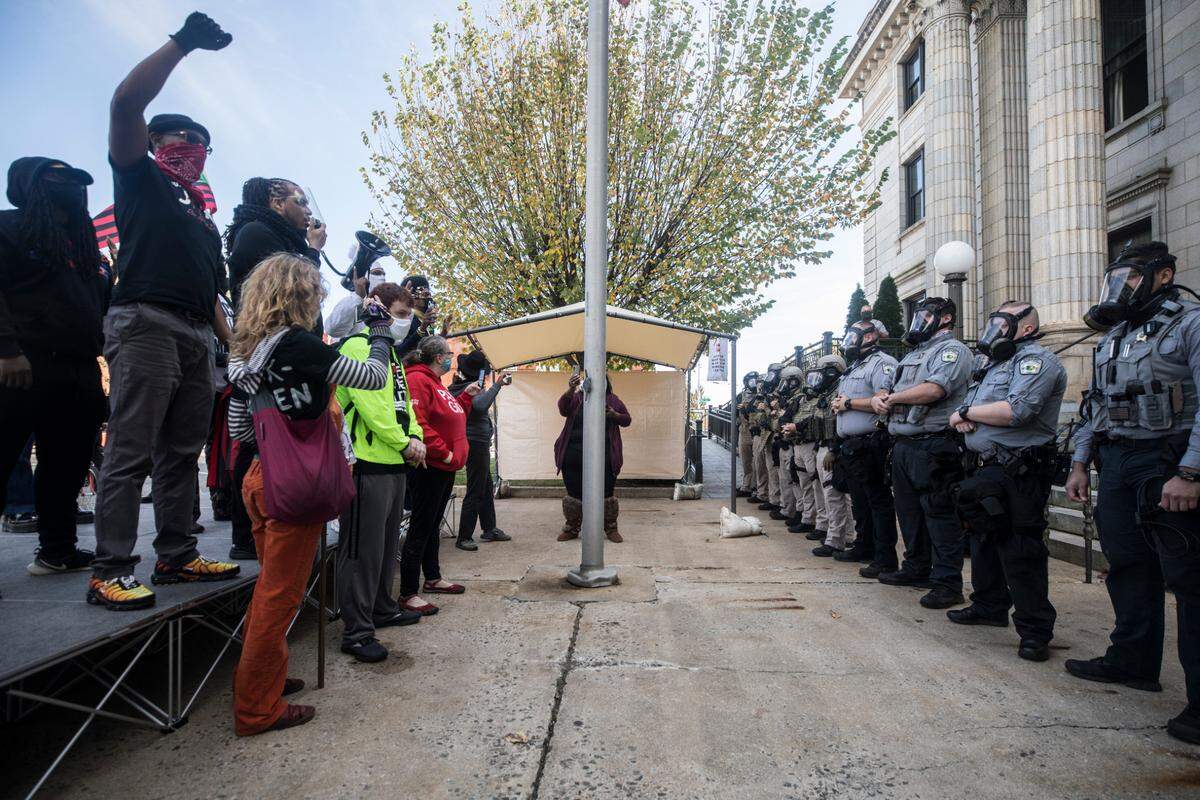
Officers formed a line, shoulder to shoulder, across the roadway and sidewalk, acting as a barrier to prevent the group from reaching the jail, the report said. Over a patrol car’s PA system, officers warned the group that they were breaking town law and may be arrested, the report said.
The group then sat down and began singing Jewish prayers, and then turned around and tried to go down another street. Another line of officers stopped them.
More officers arrived, and vehicles and lines of law enforcement surrounded the protesters, blocking the sidewalks and roadway, and forcing protesters into the road, the lawsuit states.
“Law Enforcement began to use sound cannons and physically push protesters onto the private property of the Center for Spiritual Living, refusing to allow protesters to walk on the public sidewalks to the Courthouse and Jail because they were engaging in political speech,” the lawsuit states.
Officers then went on to arrest a number of individuals who were not doing anything wrong, the lawsuit said.
Officials’ action that day violated the protesters’ constitutional rights to freedom of speech, to assemble and not to be unlawfully searched and detained, the lawsuit contends.
In court documents, Johnson, city officials and the officers denied they violated the plaintiffs’ constitutional rights, saying any injuries were caused “by their own improper actions.”
Local officials said that the participating plaintiffs failed to get a permit before they were unjustifiably violent, blocked the roadway and ignored officers’ orders.
Other law enforcement related settlements
City and county officials have settled a number of other law-enforcement related lawsuits in recent years.
In 2024, city officials agreed to a $725,000 settlement in a wrongful death claim after an officer shot and killed Jaquyn Light, 20, in 2020, The Alamance News reported.
In June 2022, Graham and the sheriff’s office agreed to pay $336,000 to individuals and community groups who participated in a Oct. 31, 2020, Black Lives Matter rally in which officers pepper-sprayed and arrested individuals participating in the protest, The News & Observer has reported.
In April 2021, protesters settled with Alamance and Graham officials, with the sheriff’s office agreeing to allow protesters on the historic courthouse grounds and that use of swear words or indecent language isn’t lawful ground to arrest someone. It also requires county officials to take implicit bias training.
Virginia Bridges covers criminal justice in the Triangle and across North Carolina for The News & Observer. Her work is produced with financial support from the nonprofit The Just Trust. The N&O maintains full editorial control of its journalism.