
Durham greenlights $44M bond for redevelopment in the heart of Hayti
For 16 years, nearly 20 acres in the heart of Durham’s Hayti neighborhood have sat vacant, cut off from the community by a chain-link fence.
As weeds and tall grass grew over the foundations of the former Fayette Place public housing complex, the Durham Housing Authority in recent years has been drafting plans to breathe new life into the site. On Monday night, those plans cleared a major financial hurdle, though not without questions from a community advocate.
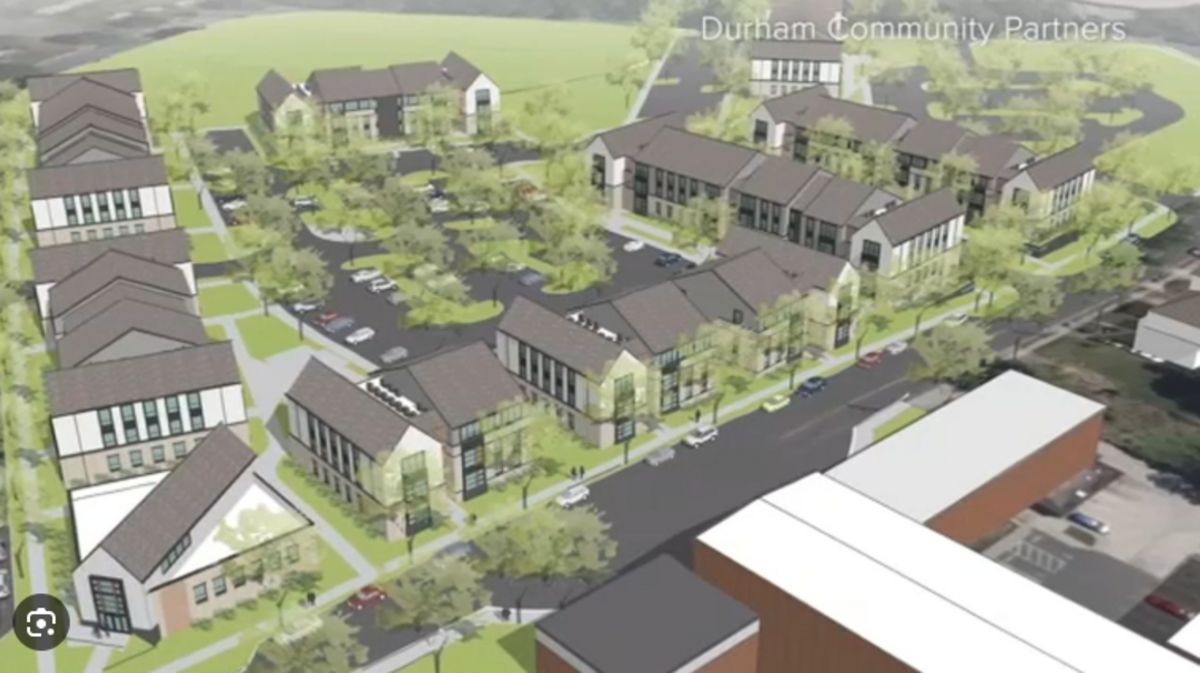
The Durham City Council unanimously agreed to support the housing authority’s issuing a $44 million tax-exempt bond to build the first phase of redevelopment, The Villages of Hayti, at 1103 Merrick St. The new housing project will bring 252 affordable rental units for families earning 30% to 80% of the area median income.
In Durham, 30% AMI is $23,850 for a one-person household or $33,950 for a household of four. Eighty percent AMI is $64,800 for a one-person household and $92,480 for a household of four.
The apartments will be spread across nine, three- and four-story buildings with 81-one bedroom units, 113-two bedrooms and 58-three bedrooms. There will also be plazas, a playground, playing fields and a grilling pavilion. A resident community center will have a gym, laundry room, computer room and a multipurpose space.
In the end, the Durham Housing Authority and Development Ventures, Inc., will transform the 19.8 acres in a $90 million project. The efforts come as the city is seeing rising housing costs and residents are paying more for apartments. Typically, Durham renters are paying over $1,300 a month for a one-bedroom apartment and $1,888 a month for a three-bedroom.
Diversity in hiring sought
The $44 million bond is just one source of funds for the $90 million total project cost, said Matthew Walker, the city’s community development manager.
The financing resolution was initially on Monday’s consent agenda, scheduled for routine passage, but Anita Scott Neville, the director of the Hayti Reborn advocacy group, requested it be pulled for more discussion.
She questioned two sections of the resolution: why a review by Durham’s Underutilized Business Compliance Division was not required and why obtaining information on contractor workforce diversity and hiring practices was deemed not applicable.
Neville, who has advocated for including local contractors in development projects in Hayti, said community members fear none of the project’s profit will benefit Durham.
“Would you please say more about these two determinations for redevelopment in a historically Black community? And about not taking an opportunity to employ local contractors and others who would diversify the workforce for this project?” she asked city staff.
Walker clarified that the City Council’s role was only to approve the bond under the federal TEFRA (Tax Equity and Fiscal Responsibility Act of 1982) law requirement. To make the $90 million project financially feasible, the housing authority must issue a “Multifamily Housing Revenue Note” and the City Council must sign off to make the bond tax-exempt.
The housing authority has recently used such revenue notes and bonds to finance other affordable housing projects, like the $32 million bond for the 160-unit Page Road Apartments. The bonds aren’t a debt to the city but, according to federal law, require city approval after a public hearing.
The revenue notes are a type of bond used to finance the construction or rehabilitation of affordable housing projects. They are backed by the revenue the project is expected to generate, not by taxpayers.
Anthony Snell, interim president of the housing authority, said the group is discussing “shared prosperity” to “ensure that there is diversity in our program with the utilization of contractors and labor.”
“That was a commitment that we made as part of the Request for Proposal process,” Snell said. As the federal government moves to reverse diversity efforts within agencies, including the Department of Housing and Urban Development, Snell said the housing authority will still comply with the city’s requirements for diversity when the city’s involvement comes in.
On Thursday, the City Council will discuss approving a loan of $17 million from the Forever Home, Durham affordable housing bond program to support the first phase of the redevelopment.
Snell said the project is also subject to “Section 3 monitoring” under federal guidelines that ensure employment and training opportunities are provided to low-income and poor people, particularly those who get government assistance for housing.
Construction on The Villages of Hayti is expected to be completed by 2027. The housing authority has not said how residents will be chosen for the new community.
This story was originally published November 4, 2025 at 1:34 PM.