Mary-Dell Chilton, NC biochemist who revolutionized agriculture, dies at 87
AI-generated summary reviewed by our newsroom.
- Mary-Dell Chilton's team designed the first genetically modified plants in 1982.
- Chilton received the National Medal of Technology and Innovation and the World Food Prize.
- Chilton died in her home in Carrboro on Wednesday, June 24.
Mary-Dell Chilton was determined to challenge a prevailing scientific theory: that a bacterium could alter the genes of trees.
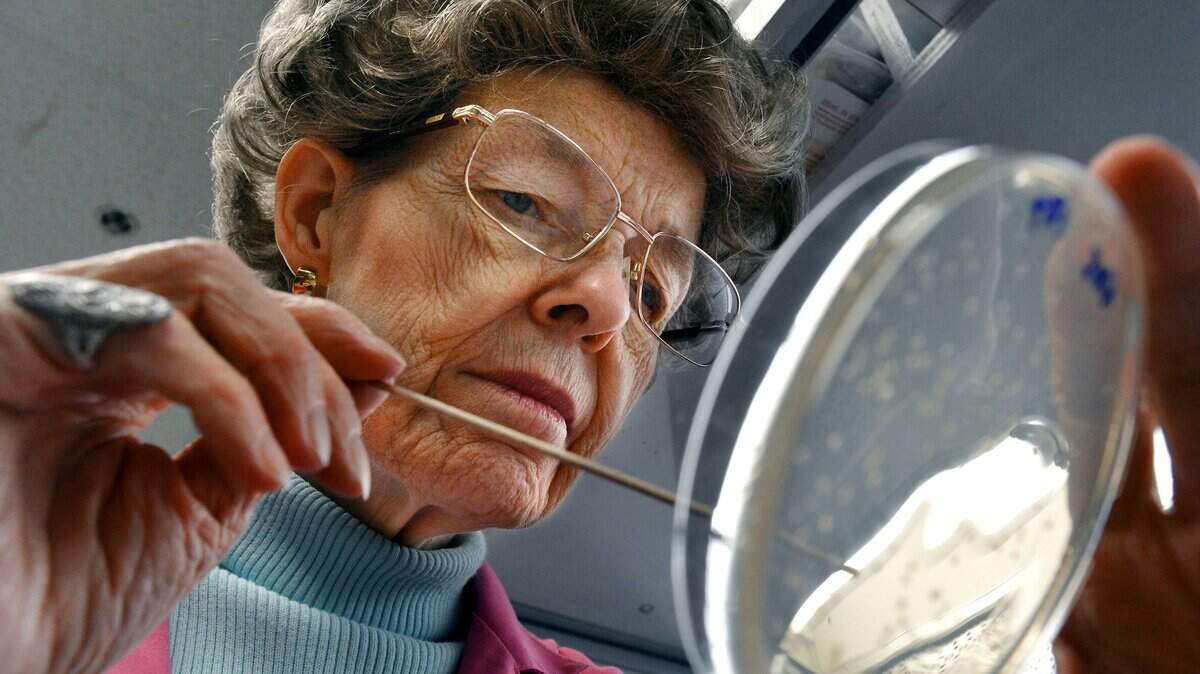
But as she set out to prove the theory wrong, she instead discovered its truth — and in the process, helped turn science fiction into reality. Chilton, who died at 87 on Wednesday, June 24, at her home in Carrboro, led the team that created the first genetically modified plants, a breakthrough that would eventually lead to crops with increased yields and drought resistance.
Born in 1939 in Indianapolis, Chilton grew up in Southern Pines with her grandmother, Henrietta Dell Hayes. Mark Chilton, Mary-Dell Chilton’s son, calls Hayes “probably the single biggest influence” of his mother’s life.
Hayes was a successful businesswoman in the 1940s and 50s, selling high-end ladies’ clothing to women drawn to the prominent local golfing scene.
Hayes’ example inspired Chilton to dream bigger, even as science was still largely inaccessible to women.
“My mother always said that (Hayes) showed her by her actions that women do things,” Mark Chilton said.
After earning her B.S. in chemistry from the University of Illinois, Urbana-Champaign, Chilton completed her PhD in chemistry at the same university in 1967.
By the early 1970s, while a professor at the University of Washington, she was determined to disprove a theory that a bacterium, Agrobacterium tumefaciens, causes a disease in trees by modifying their DNA.
“She thought that this was obviously wrong and would be easy to disprove,” Mark Chilton said. “She thought it was wrong, because well, it’s kind of hard to believe the implications … and yet here we are. It changed agriculture forever.”
Mary-Dell Chilton showed that the bacterium actually does insert its DNA into the trees. Then in 1979, she developed a way to remove the harmful DNA the bacterium inserts and replace it with desirable DNA, such as genes that promote drought resistance.
This led Chilton and a team of researchers to design the first genetically modified plants in 1982 after she became a professor at Washington University in St. Louis.
Bayer scientist Cami Ryan, whose work relies on Mary-Dell Chilton’s advancements, highlighted their importance.
“Mary-Dell Chilton didn’t just advance plant science; she rewrote the playbook,” Ryan said. “She turned a plant tumor bacterium into a workhorse for traits that help keep harvests coming. Her legacy lives in every field that grows a little stronger because she refused to accept ‘that’s impossible’ as an answer.”
That persistence in overcoming “the impossible” was evident throughout her life.
“You can’t stop me,” Chilton said when she was inducted into the National Inventors Hall of Fame in 2015. “When I’m after something, I work on it endlessly until I get it.”
For instance, she was an avid canoer and made her last trip through Stillwater Canyon on the Green River in Utah at age 76, entirely under her own power, according to Mark Chilton.
“She did wind up in the hospital, but she made it all the way,” Mark Chilton said. “I tried and tried to get her to stop paddling and let me just paddle the canoe, but she would not. But … that’s a part of who she is, too, you know. She wasn’t about to be chauffeured, even if she was 76.”
After her breakthroughs in the 1980s, she moved to the private sector at Syngenta Biotechnology in Research Triangle Park, eventually becoming vice president of agricultural biotechnology and principal scientist.
In 2013, she was named the Tar Heel of the Year by The News & Observer, recognizing her as one of the most significant contributors to North Carolina and the Triangle.
Mark Chilton, reflecting on his mother’s love for intellectual challenge, described her passion for unraveling mysteries — both scientific and personal.
“My mother really loved all kinds of puzzles, and she would do many of the News & Observer’s daily puzzles every day, keeping big notebooks full of them,” he said. “I think the mysteries of DNA were just like that to her … it was a puzzle, and she wanted to figure it out.”
Chilton received the National Medal of Technology and Innovation from President Joe Biden; the Golden Goose Award from the American Association for the Advancement of Science; and the World Food Prize, which recognizes the individual who has most improved the quantity or quality of food worldwide.
Chilton is survived by her sons, Mark and Andrew, and two grandchildren. Throughout it all, her relationship with her grandmother never faltered.
“I’ve got stacks of handwritten letters back and forth between the two of them through college and up through my grandmother’s death,” Mark Chilton said. “If you want to know who my mother really was … she was the teenager who watched her grandmother do what no other women in town were doing, and learned … that there was no reason she couldn’t be a PhD in chemistry.”