
Durham city leaders told activists they’d cut police force. Now they’re getting sued.
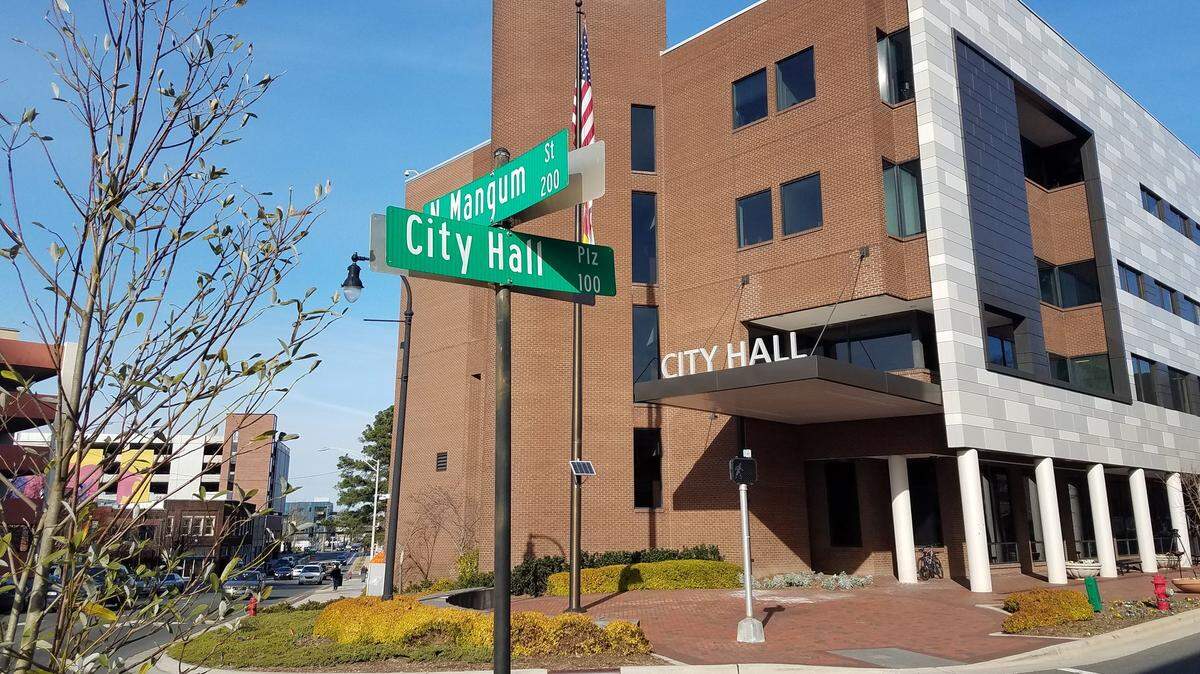
Two residents are suing the city of Durham and four City Council members, saying they broke the state’s Open Meetings Law during a meeting about the police budget with community groups last month.
In a lawsuit filed Tuesday, Deborah Friedman and Mark Rodin claim the council members, who constitute a majority, violated North Carolina statutes by pledging to vote for more cuts to the police department at a Zoom conference with Durham For All and Durham Beyond Policing.
Attorneys Daniel Meier and Jonathan Jones, representing the plaintiffs, claim the online gathering meets the state’s definition of an official meeting and that the city did not follow legal requirements for public access under the Open Meetings Law.
Meier said the main goal of the lawsuit is to hold the city accountable.
“These laws do exist for a reason,” he said. “And if people, you know, just simply flout the laws, and no one ever does anything, nothing ever happens.”
City Attorney Kimberly Rehberg told The News & Observer her office received the complaint and will review the allegations.
“My response to the lawsuit is the same as it is for any litigation filed against the City, City officials, employees, or agents — which is to say that we take all filed litigation seriously,” she wrote in an email to The N&O. “Our litigators will thoroughly review the complaint as they do for any case, and, after that review, I fully expect that we will put forward a vigorous defense against this lawsuit.”
Council members Charlie Reece, Javiera Caballero, Pierce Freelon, and Mayor Pro Tem Jillian Johnson are defendants, in addition to the city of Durham.
Reece, Caballero and Johnson declined to comment about the litigation and deferred questions to the city attorney’s office. Freelon did not respond to an email and a phone call from The N&O on Wednesday.
Prior Open Meetings lawsuit
The Durham City Council has been sued for allegedly violating the Open Meetings Law before.
Friedman sued Durham in 2018 over two emails Mayor Steve Schewel sent from his personal account to other City Council members about police training. In both emails, each sent to three council members, Schewel described a plan to issue a statement opposing militarized policing that included a reference to Israel, The Herald-Sun reported.
Friedman’s lawsuit claimed the two emails were an “electronic meeting” and that no public notice was given, The Herald-Sun reported. A superior court judge dismissed the lawsuit in 2019, The N&O reported.
Pledging to community groups
At the May 20 meeting, a spokesperson for Durham For All asked individual council members one-by-one if they would advocate and vote for a budget that reallocates 60 vacant police officer positions to a new Community Safety Department.
Johnson, a co-founder of Durham For All, responded first, and suggested a plan to move 20 vacancies annually for three years.
Reece, Caballero and Freelon expressed support for her plan and explained their reasoning.
Council member DeDreana Freeman also attended the meeting, but declined to commit. Schewel and Council member Mark-Anthony Middleton did not attend.
The lawsuit refers to a statement Reece made at the meeting, in which he thanked his colleagues “for being on this call and to committing to this model of co-governance.”
“We don’t have co-governance with special interests,” Meier told The N&O, referring to the community groups.
“I mean, that’s why we have open meetings. So the special interests can’t bring, you know, a majority together and do God knows what, hidden from public view, and then have them go out and do it.”
Friedman and Rodin are seeking a court order to prohibit the City Council from any future actions that might violate the Open Meetings Law.
“I would like to see whatever Superior Court judge that hears the case strongly admonish the City Council members involved and also the groups that are involved and say, ‘this is public, so business is conducted in the open,’” Rodin said.
Rodin worked as a newspaper reporter covering government and politics in the 1970s, he said, and is now retired. He isn’t happy that the council members met with Durham For All and Durham Beyond Policing without notifying the public, and without the entire City Council and the mayor present, he said.
“You just don’t do that if you want to be out front with the public,” he said.
The City Council discussed the police budget at a scheduled meeting a week later. There, Johnson reiterated her plan, and Reece proposed transferring 15 vacancies from the police department to the new department at mid-year, in addition to the five transfers the city manager proposed to start the fiscal year.
Open Meetings Law expert weighs in
Frayda Bluestein, a professor of public law at the UNC School of Government, told The N&O in an email the gathering with the two community groups would not fall under the legal definition of an official meeting if each council member decided to attend the Zoom conference individually and just listened to the groups.
“But if they joined the meeting individually and then engaged in a discussion about their intents and proposals about the budget and policing, that is transacting public business, and without notice, a violation,” wrote Bluestein, who co-authored a book about open meetings and local government in North Carolina.
The format the groups followed on May 20 — in which a member asks one elected leader at a time if they would commit to a policy decision — is similar to what other Durham organizations have done in the past, particularly at candidate forums, where elected and aspiring politicians meet with groups on the campaign trail and respond to their demands.
In a blog post about whether the Open Meetings Law applies to candidate forums, Bluestein wrote that North Carolina’s statute does not explicitly address or exempt campaign-related gatherings.
But in the neighboring state of Virginia, a court ruled that campaign events are an exception to the rule, because elected officials can participate without being involved in transacting public business, she wrote.
“As such, it would be reasonable for a North Carolina court to interpret such meetings as being outside the scope of our open meetings law, simply because they do not involve any of the activities included in the definition of an official meeting,” she wrote.
Whether the council members’ individual responses to Durham For All meets the legal definition of a discussion or a deliberation may be a trickier question.
“If they each came on their own, and they each answered individually, perhaps not,” Bluestein wrote. “But it seems that the question came amidst a broader discussion among the four members who were there, in which case, I think a court would see that as the group transacting public business, again, without notice.”
Meier said he will see what the judge says about it.
What’s next?
The city has 30 days to respond to the complaint and could request a 30-day extension, Meier said.
This story was originally published June 3, 2021 at 12:27 PM.