
‘A city in pain.’ Durham mayor offers ways to reduce crime in first State of City address
Durham Mayor Elaine O’Neal presented her top priorities Monday in her first State of the City address since taking office: reducing crime, developing small businesses and enhancing transportation.
O’Neal, who was elected in the fall, campaigned on promises of reducing gun violence. But after being in office for three months, she has not offered details about how she and the council would tackle the rising crime.
Monday, O’Neal provided some of those details on her initiative to quell the gun violence in Durham, which saw a record number of homicides in 2021 and is on track to set a new record in 2022.
“Gun violence is taking the lives of far too many of our residents and our young Black men,” O’Neal said. “We are a city in pain, and we are struggling to make sense of the violence we continue to witness.”
This year, the city has reported 17 homicides, including six dying in shootings over an 8-day period this month, prompting Police Chief Patrice Andrews to form a new unit to focus on gun violence.
O’Neal also spoke in her address about how giving more money to small businesses and receiving millions in federal funding for transportation projects would help Durham residents.
Crime
O’Neal, a Durham native and former Chief District Court judge, has hinted in recent months about how she might tackle the city’s crime.
She is working with current and past city leaders to establish a program that will provide opportunities to Durham youth and young adults and begin offering mentoring, therapy and after-school programming. The program would also aim to expunge the records of previous offenders through the new sustainable justice movement program under the Hayti Reborn organization.
“We are engaging those closest to the pain. They have to be closest to the power, and that’s what we are doing to turn our city around,” O’Neal said.
In February, the mayor spoke about the lack of trust between the government and “residents that she deals with.” She said then she would not speak publicly about how she would address gun violence in an attempt not to compromise those trust-building relationships.
“My interactions with some of the young men in this city ... has come under scrutiny,” O’Neal said Monday.
“And it pains me to think that we should not talk or interact with these young men, to get their perspective on Durham and have them be a part of the solution,” she added.
O’Neal introduced about eight former gang members to the public during her speech Monday and explained she was “invited” to speak with them and other current and past local leaders before being elected.
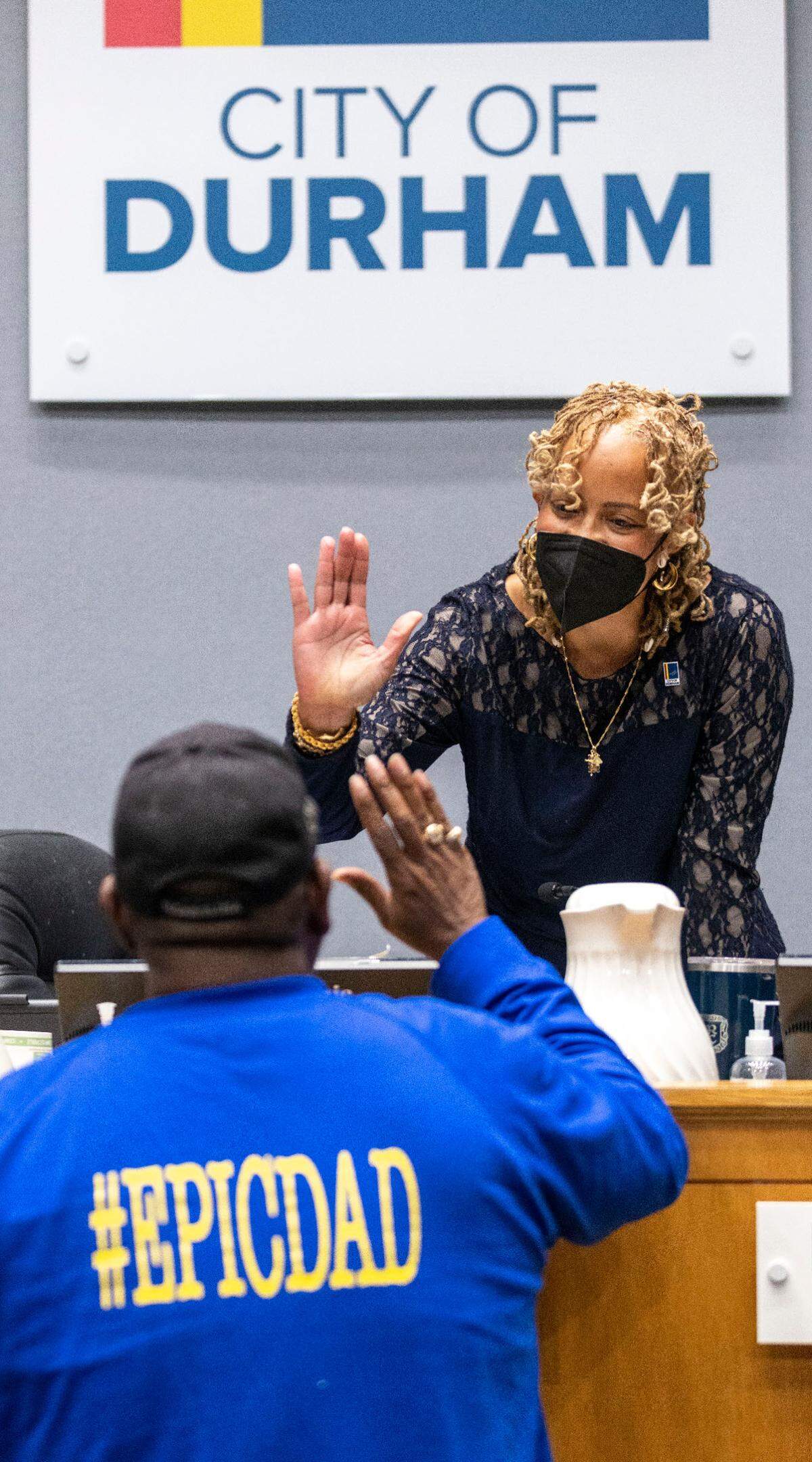
Dennis Garrett, a Durham native who served time in prison, was one of those men. He said he has tried to help curb gun violence in Durham by orchestrating a ceasefire among gang members.
“What we do is [help people] transition, we stop the violence — prevention,” said Garrett.
Garrett is part of a group that has been brainstorming ideas to address violence. That group also includes council members Mark-Anthony Middleton, DeDreana Freeman and Leonardo Williams.
Former Durham Police Chief Steve Chalmers will lead the program proposed by O’Neal. This initiative also includes District Court Judge Patricia Evans, Durham County Sheriff Clarence Birkhead and N.C. Central University business professor Henry McKoy.
In conjunction with County Commissioner Chair Brenda Howerton, O’Neal has resumed Durham Crime Cabinet meetings in March. The meetings consist of strategy development to addressing crime.
Business Expansion
O’Neal also announced how the city will assist small business owners, more specifically rebuilding Black-owned companies.
“Everybody that calls Durham home, needs to share in [its] prosperity,” said O’Neal. “Part of this rebalancing has to include — let’s be real — investing in our areas of our city that has been negatively impacted by urban renewal and decades of neglect.”
“The Black community, and thus Durham at-large, we’ve never recovered from the loss of the businesses at Hayti,” said O’Neal, referring to Durham’s former Black Wall Street located downtown in the early 20th century.
The city is supporting a partnership between Hayti Heritage Foundation and the Urban Land Institute to explore the redevelopment of the Fayetteville Street corridor with a “community-centered mindset, according to O’Neal.
“Hayti will come back,” she said.
McKoy attempted to centralize the Hayti Reborn movement on the Fayetteville Street corridor by submitting one of the five proposals for Fayette Place in September 2021 as a future hub for Black business and equity research. But it was rejected by the housing board.
In January, the Durham Housing Authority approved $470 million in redevelopment plans for three properties, including the long-vacant Fayette Place site in Durham’s historic Hayti community.
O’Neal also said the Durham Small Business Opportunity Loan Fund will be used to expand its reach beyond disaster recovery and offer loans between $5,000 to $35,000. Initially, only Durham small businesses in need of financial assistance as a result of the pandemic could apply for the program.
The fund, which is administered by the Carolina Small Business Development Fund, will provide approximately $1 million in loan funds.
Between city and county funds and contributions from Duke University, the recovery aid has distributed about $800,000 in loans to 38 small business owners in Durham since the summer of 2020.
Transportation
On Monday, Congressman David Price presented O’Neal and Transportation Director Sean Egan with a mock $19.8 million check from the U.S. Department of Transportation (USDOT) for two major projects: the 1.8-mile Rail Trail and the main Durham Station improvements and upgrades.
“This morning, I held the biggest check in my life ... because of the folks in our transportation department that wrote those [grant applications],” O’Neal said.
The trail will run from West Village north across West Trinity Avenue, then turn east, where the rail corridor divides the Duke Park and Old North Durham neighborhoods, The N&O reported.
About $10.8 million of the funds will go towards renovating Durham’s main bus station. Durham Station will continue to operate while construction is done in phases over a year, beginning in the summer of 2023.
“We need these new and innovative transportation ideas. We need energy-efficient buses that serve communities from downtown to developing neighborhoods, where many residents live without cars,” said O’Neal.
In February, O’Neal requested a report on the millions spent on the city’s failed Light Rail project. As planning moves forward to connect the region’s largest cities with Research Triangle Park, the mayor emphasized the need of transparency during the upcoming project.
“We need to take a hard look at a Commuter Rail system, but there must be accountability and transparency,” she said.
This story was originally published April 19, 2022 at 2:30 PM.