
By split vote, Durham rejects annexation for development in Falls Lake watershed
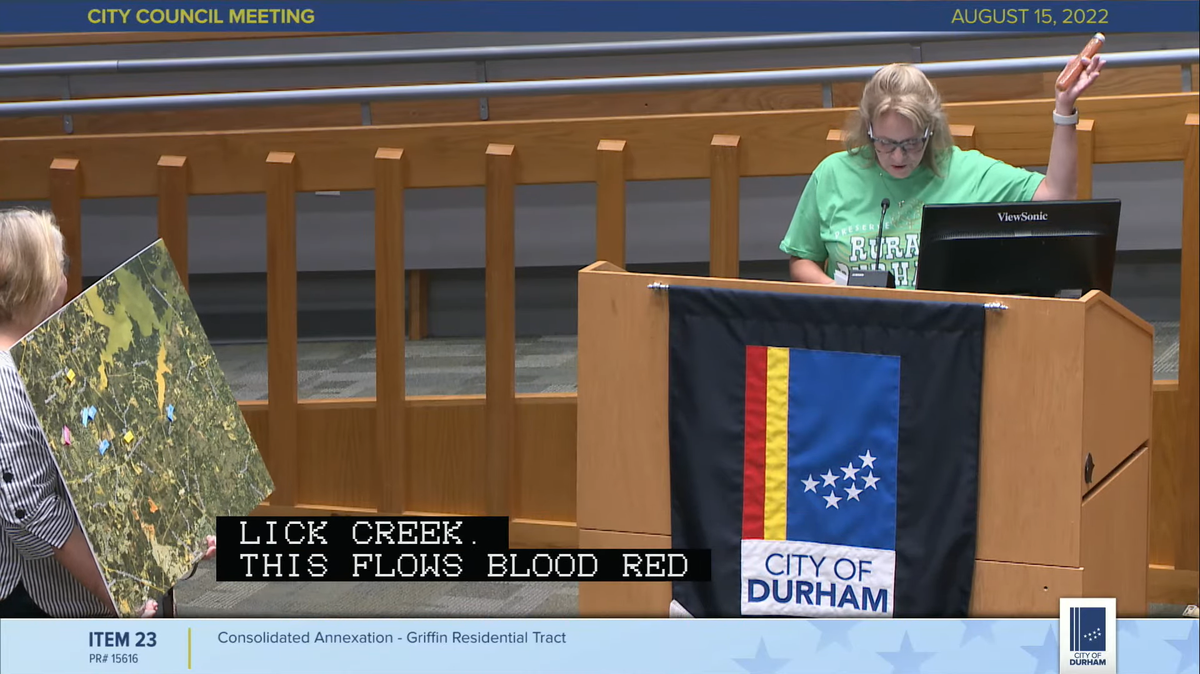
After a months-long debate, the Durham City Council rejected annexation and rezoning for a proposed 655-unit housing development in southeast Durham near Kemp Road.
The McAdams Co. first proposed the project in 2020. Since then, residents of southeast Durham have asked city leaders to prevent construction at the property, citing environmental and safety concerns.
Ten members of Preserve Rural Durham, a grassroots environmental group, presented citizen-collected data and images of nearby development, saying the Kemp Road project would harm the local ecosystem.
According to residents like Donna Stainback, other builders have already begun clearing and grading similar properties in the area. Water run-off from these nearby developments has left Lick Creek looking like “tomato soup,” causing increased E. coli bacteria and turbidity in the creek, which flows into Falls Lake. The lake is a major source of drinking water for Raleigh.
Samantha Krop, the Neuse River Keeper for Sound Rivers, said further damage to Lick Creek could harm the Neuse River and the surrounding Falls Lake watershed.
Wanda Allen, another member of Preserve Rural Durham, asked the council for an environmental impact study before developers build homes at the property.
“I think we have to step up and take another look,” Allen said. “Are we going to continue down this road, or are we going to take another path?”
Although the developer has offered several concessions, including widening N.C. 98 and including a bigger tree buffer zone than is required, it was not enough to sway the majority of the council members at Tuesday’s meeting.
Council members Monique Holsey-Hyman and DeDreana Freeman supported further environmental investigation before the project can move forward.
“This is becoming an increasingly problematic situation where we’re allowing developers to lead us in this,” Freeman said.
Fire safety concerns
In the past two years, more than 3,000 housing units have been approved in southeast Durham.
Planning Director Sara Young said in November the Leesville Road area is an attractive location because it is close to downtown, Research Triangle Park and major highways.
The uptick in housing units has residents fearful that emergency services will not be able to keep up with the growing population.
In November, the Durham Planning Board unanimously voted against the project.
Preserve Rural Durham also argued that Durham fire, EMS and police do not have the resources to serve these areas during an emergency.
However, Durham Fire Chief Robert Zoldos, when asked by Council member Leonardo Williams if the city could keep up with southeast Durham’s growing needs, said he was confident in his department’s ability to access this area in under 10 minutes.
Nil Ghosh, the attorney representing the property developers, said they had also offered the Durham Fire Department 10 acres as a potential home for a new fire station in the area.
However, after being questioned by the council, Ghosh said the fire department had refused the land because it crossed a stream, making it unusable for the fire department.
When asked by Freeman why the developer would offer unusable land to the fire department, Ghosh replied, “A free 10 acres is a free 10 acres.”
Housing Crisis
Williams and Mayor Pro Tem Mark-Anthony Middleton said the need for more housing in Durham far outweighed the environmental concerns.
“I don’t mean to sound insensitive in any way,” Williams said. “But we have a housing crisis, and if I have to choose between a deer and a person, then that’s what I’m going to do.”
“Some of us are concerned with losing our trees, and looking out our windows and seeing townhomes,” Middleton said. “Others of us are concerned about packing up a U-Haul truck and leaving Durham altogether.”
In addition to the environmental debate, Freeman also expressed concern about the number of affordable units proposed by the developer.
According to Ghosh, the developer is committed to making 3% of the units in this complex affordable. Of the 655 proposed units, which would be single-family homes and townhouses, only 18 would be affordable housing under Durham’s guidelines.
While Freeman deemed this number far too low, Middleton and Williams saw any housing development as a victory.
“I’m supporting this project because, as it’s been said, it’s a good project,” Middleton said. “We cannot issue a moratorium on development.”
Final vote
Ultimately, the council rejected the proposal for annexation and rezoning 4-2.
Council members Freeman, Holsey-Hyman, Javiera Caballero and Jillian Johnson voted against. Middleton and Williams voted for the annexation.
This story was originally published January 18, 2023 at 12:12 PM.
CORRECTION: This story was corrected on Jan. 20, 2023, to report that construction has not yet begun on the Kemp Road area property.