Durham rejects annexing 132 acres near Falls Lake. Why project might get built anyway.
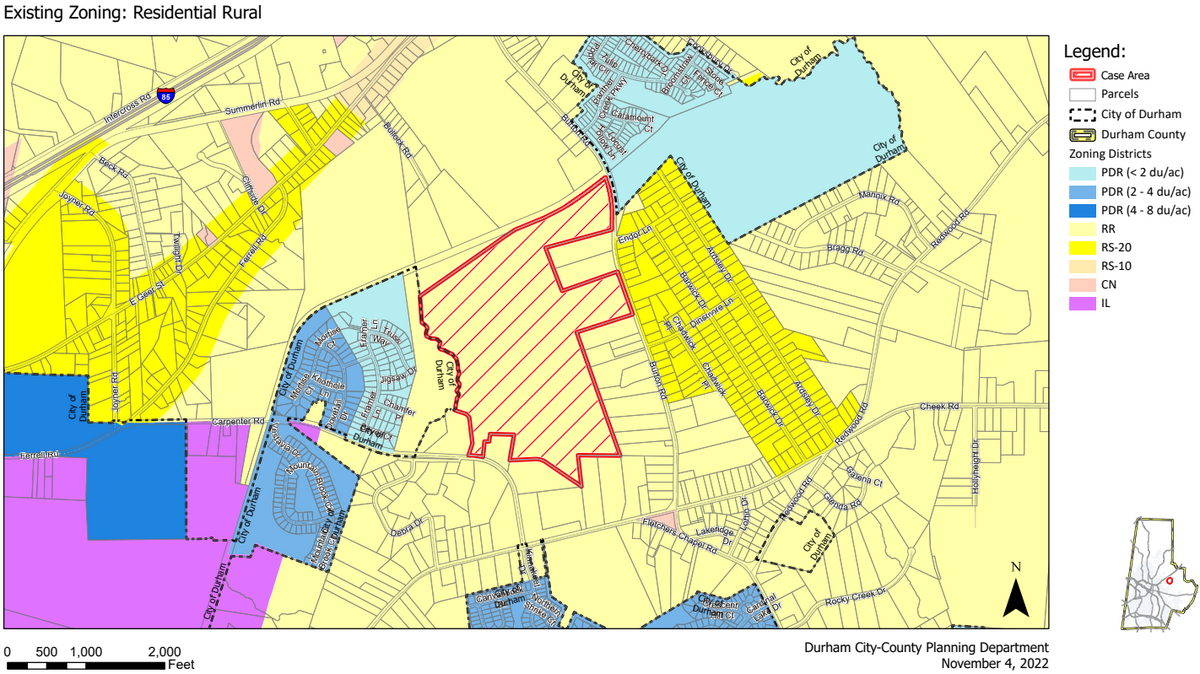
In a split vote Monday night, the Durham City Council declined to annex property on which a local developer had hoped to build 235 homes, though their vote won’t necessarily prevent the neighborhood from getting built.
Jarrod Edens, president of Durham-based Edens Land, had requested 132 acres be annexed into the eastern city limits so he could connect a proposed subdivision to city water and sewer lines.
The zoning — rural residential — would be left unchanged. It’s a maneuver called direct translation zoning, which Mayor Pro Tem Mark-Anthony Middleton likened to a “lay-up.”
“It’s so perfunctory that the Planning Commission doesn’t even take a vote on it,” Middleton said. “Whatever can happen after this vote can happen before it. It’ll just be on wells, probably, as opposed to connected to our city water and sewer.”
The property, tentatively named Carpenter Falls, is situated on rural land between downtown and Falls Lake at 2621 Burton Road.
Suburban-style developments surround the acreage on three sides. Several are in the city limits.
Raising questions about conservation subdivisions
Preserve Rural Durham, a group that regularly shows up in City Hall to fight development several miles south, weighed in against the proposal Monday night.
“What is the rush?” founder Pam Andrews asked. “Please protect our water sources.”
The group said Panther Creek, which crosses Edens’ property, bears many similarities to Lick Creek, the water body that prompted them to action. Both are in the Falls Lake watershed.
Both creeks are located in the Triassic Basin, home to fine red clay soils. The activists became concerned by the orangeish color of runoff from construction sites as building accelerated in southeast Durham amid the COVID-19 pandemic.
“These best management practices are not effective. Take a look,” southeast Durham resident Thomas Freeman said while showing images of orange-red water pouring off a job site and into Lick Creek, which is a dramatically more muted shade of brown.
Edens sat on the front row and donned his glasses, taking notes and occasionally shaking his head as the opponents’ testimony stretched on for half an hour.
“Triassic soils? That’s Durham. If we didn’t develop in Triassic soils, we just wouldn’t develop,” Edens eventually responded.
Edens said they planned to develop the community as a conservation subdivision to help protect the creek. Conservation subdivisions allow for higher density if at least half the land is permanently preserved as open space, like forests, streams, trails or even farmland.
“It also allows us to keep the density up near the road,” Edens said. “As you go down near the creek, the open space is in that area.”
But not everyone is sold on the concept.
“What was proposed in the Unified Development Ordinance decades ago, when it was first passed, as something that would protect the resources of Durham County has over decades across the nation been titrated by the development community writ large to become a loophole by which developers can gain quick and ready access to approval,” said attorney and north Durham resident Robin Barefoot.
Council member Javiera Caballero said the site was ideal for a conservation subdivision.
“I don’t particularly want that many single-family homes. I would love more density, but because of the ecological nature of the site, the streams that I saw on the property myself, I understand why this is a good tool,” Caballero said.
The vote was tied 3-3, meaning it failed. Mayor Elaine O’Neal and Council members DeDreana Freeman and Monique Holsey-Hyman voted against it. Leonardo Williams joined Middleton and Caballero in voting in favor.
Council member Jillian Johnson, who could have broken the tie in Edens’ favor, had an excused absence.
Zoning allows 264 homes to be built by-right, meaning Edens wouldn’t need to come back before the City Council or Board of Commissioners for permission. The homes just wouldn’t be on city water and sewer.
“We financially try to hit singles and doubles on our projects. We’ve had a lot of projects and not all of them make it to fruition. There’s a lot of money spent, and that’s our risk and that’s on us,” Edens said. “Sometimes they fall through and they don’t get zoned. Things happen.”