
NC Appeals Court sides with neighbors against Durham County in development case

AI-generated summary reviewed by our newsroom.
- NC Court of Appeals reversed Durham County's approval of a 141-home project.
- Judges ruled the county violated its own development ordinance requirements.
- Plaintiffs will receive legal fee reimbursement; case returns to trial court.
The N.C. Court of Appeals has reversed the approval of a subdivision project in rural Durham County, saying the county failed to follow its own development rules.
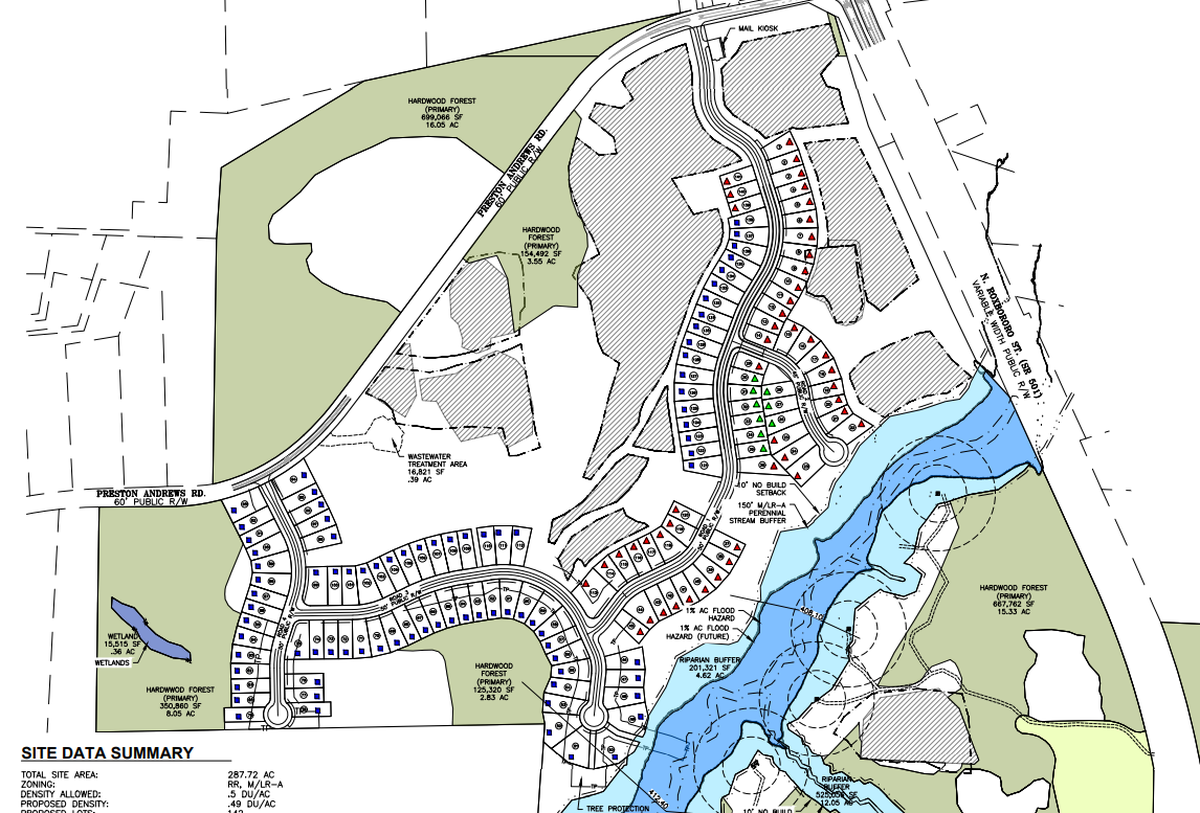
The court ruling comes three years after the Durham County commissioners approved Mason Farms, a 141-home subdivision in the unincorporated community of Bahama on 287 acres southwest of North Roxboro and Preston Andrews roads.
The project was challenged by six residents who lived within 650 feet of the proposed development site. They sued the county, saying the plan didn’t meet all 12 requirements in the county’s unified development ordinance, or UDO.
The UDO was amended in 2006 to create “conservation subdivisions,” which cluster housing at higher density to protect undeveloped spaces.
The county argued that the UDO’s list of 12 “purposes” for conservation subdivisions were not mandatory requirements for projects to be approved. Specifically, the county said the Mason Farms site plan met the “actual requirements” found in later sections of the ordinance.
The court ruling reverses a 2023 trial court summary judgment, or court order that ends a lawsuit, that sided with Durham County. The plaintiffs will also get their legal fees reimbursed.
“As the site plan only met six of the twelve requirements, Plaintiffs argue the Board’s approval was erroneous, and the trial court erred in granting summary judgment for the County,” wrote Judge Donna Stroud. “We agree.”
The court’s decision is being reviewed by the Durham County Attorney’s Office, according to a county spokesperson. The city and county amended the UDO in 2023 to clarify that the purposes outlined in the section are “the reasons for establishing the conservation subdivision standards and not specific criteria that each conservation subdivision must meet,” the spokesperson said.
The amended wording reads, “the conservation subdivision standards are established for the following purposes,” and lists 11 purposes.
“This clarification aligns with how all 14 conservation subdivisions prior to the amendment were reviewed and approved,” the county spokesperson said.
The News & Observer contacted the developer, III Capital Management, by phone and email for a comment on the ruling, but did not hear back.
The court’s ruling
In the 2-1 ruling, Stroud made key points explaining their Appeals Court decision, including the use of the word “shall” in the conservation subdivision section of the UDO.
The beginning of the section reads, “the conservation subdivision shall be established for the following purposes.”
The plaintiffs, represented by the Brough Law Firm in Chapel Hill, argued that “shall” implies that the 12 purposes for the development are mandatory and not just suggestions.
“While it is true that the use of ‘shall’ does not always evince an intention to make a provision mandatory,” Stroud wrote, “the UDO itself bars any other interpretation.”
Additionally, the court found that since the UDO uses the word “and” to connect the last two purposes — 11. to conserve scenic views from public roadways and reduce perceived density; and 12. to protect prime agricultural land and preserve farming as an economic activity — all 12 of the purposes were requirements for conservation subdivision approval.
The 12 purposes in the UDO
Section 6.2.4A states that a conservation subdivision “shall be established” to
- provide flexibility of design in order to promote environmentally sensitive and efficient uses of the land
- preserve in perpetuity unique or sensitive natural resources such as groundwater, floodplains, wetlands, streams, steep slopes, woodlands and wildlife habitat
- preserve important historic and archaeological sites
- permit clustering of houses and structures on less environmentally sensitive soils which will reduce the amount of infrastructure, including paved surfaces and utility easements, necessary for residential development
- reduce erosion and sedimentation by minimizing land disturbance and removal of vegetation in residential development
- promote interconnected greenways and corridors throughout the community
- promote contiguous green space with adjacent jurisdictions
- encourage interaction in the community by clustering houses and orienting them closer to the street, providing public gathering places and encouraging use of parks and community facilities as focal points in the neighborhood
- encourage street designs that reduce traffic speeds and reliance on main arteries
- promote construction of landscaped walking trails and bike paths conveniently located both within the subdivision and connected to neighboring communities, businesses and facilities to reduce reliance on automobiles
- conserve scenic views from public roadways and reduce perceived density, and
- protect prime agricultural land and preserve farming as an economic activity.
The court’s dissenting opinion
The appellate court’s reversal sends the case back to the trial court, instructing it to enter summary judgment in favor of the plaintiffs. The lower court will also determine how much money the plaintiffs will get in reimbursement for legal fees.
One judge, Allegra Collins, dissented from the majority court ruling. Collins is a democrat and in the court’s minority, the two supporting votes were by Republicans.
She argued that the majority’s interpretation was incorrect and that the “purpose” of the section of the UDO is a general statement of intent, and that the specific requirements for conservation subdivisions were detailed in other sections of the ordinance.
“The Purpose subsection is an overview of the potential goals that such a project could accomplish,” Collins wrote. “The enumerated purposes do not impose, and were not intended to impose, twelve specific requirements on each and every conservation subdivision.”
Collins lists other subsections in the UDO to show specific requirements for the conservation subdivisions, including open space requirements and density calculations outlined in other sections.
“Furthermore, the majority’s opinion leads to non-sensical results,” Collins wrote, adding that it was “impossible” for any conservation subdivision project to include all requirements like natural resources, a historical site, green space, walking trails, scenic view, farming and others, at the same time.
Collins wrote that she affirmed the trial court’s judgment in the case and said the request for the plaintiffs to get reimbursed for legal fees was “moot,” or debatable.
This story was originally published August 28, 2025 at 10:49 AM.