
‘Wanted’ posters of Black Durham leaders spark debate over race and politics
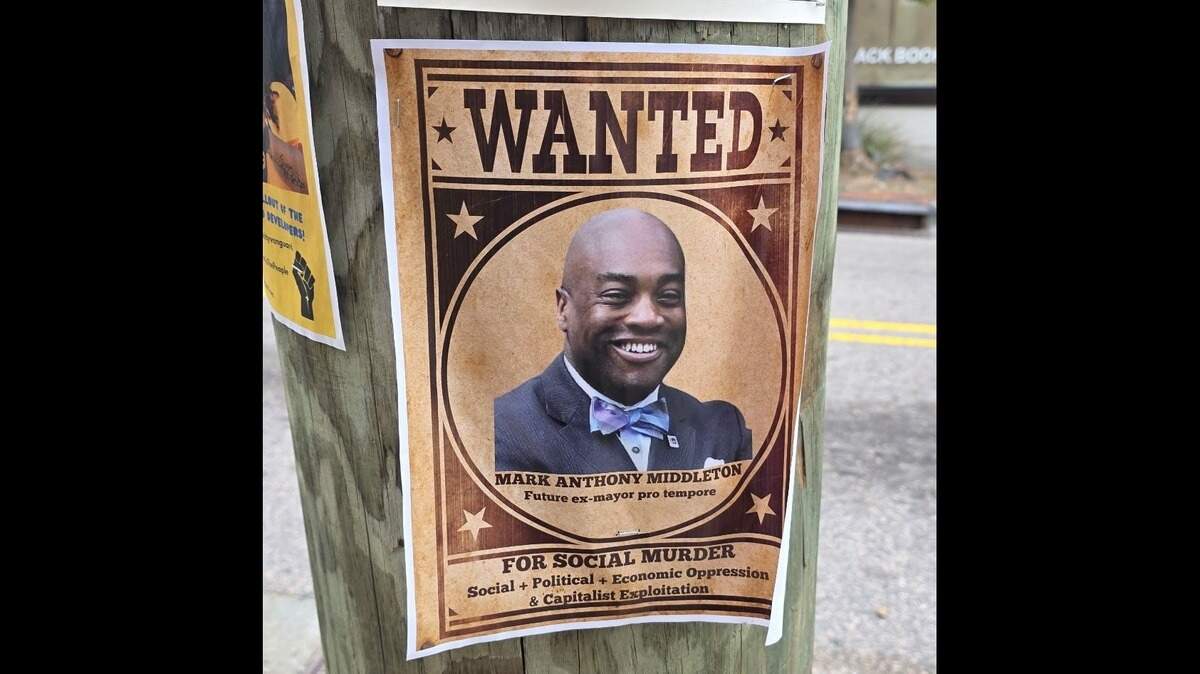
Durham’s municipal election took a tense turn after a recent candidate hung “Wanted” posters in the city featuring the faces of the mayor and mayor pro tem.
On Sunday afternoon, Mayor Pro Tem Mark-Anthony Middleton, running for re-election in Ward 2, took to his Facebook page to denounce the images, calling them “dangerous” and a “dazzling display of stupidity.”
The posters resemble old Western “Wanted” signs historically used to pursue fugitives and include headshots of Middleton and Mayor Leo Williams, both Black men.
“Are we OK with this?” Middleton wrote. “In addition to flirting with the dangers of the criminal black male trope, the flyers ... actually have the word ‘MURDER’ on them.”
Under the photos, in small letters, are the words “For Social Murder,” and “social and political and economic oppression and capitalist exploitation.”
The posters were created by Ashley Robbins, a former Durham City Council candidate for Ward 2 and one of Middleton’s opponents in last week’s primary, she confirmed to The News & Observer Monday afternoon. She ran on an anti-capitalist platform and a critique of the incumbents’ policies. Robbins shared the images on her Facebook page, The Bull City Vanguard.
The term “social murder” was created by 19th-century philosopher Friedrich Engels, who used it to describe economic conditions that harmed and killed working people in England, a concept Robbins said she was invoking in her critique.
The incumbents told The N&O they view the poster as an egregious personal attack with a racial connotation, citing the history of Black men and escaped enslaved people on “Wanted” signs. But Robbins, who also is Black, said she defends the posters as a legitimate political criticism of the Bull City leaders using a social-political term.
“I’m sorry they got their feelings hurt,” Robbins said. “If they want to get all upset about the poster, good. Hopefully it’ll facilitate some self-awareness and some self-reflection.”
‘There’s certain things you can’t do’
The posters can’t be found around Durham now, but Middleton said he learned of them weeks ago from supporters and wasn’t going to comment on them. He changed his mind for the sake of the city’s “public square” and believes the relationship between elected officials and residents has grown more toxic, like the national political landscape.
“When I reflect on the political climate that we’re in right now and some of the things we’re seeing locally and nationally, I just thought how dangerous and irresponsible it is,” he said. “I welcome legitimate critique, but there’s certain things you can’t do because it’s going to take the conversation hostage.”
Elected to the City Council in 2017, Middleton finished with 40% of the vote in the Oct. 7 primary to become one of two finalists in the general election Nov. 4 alongside challenger Shanetta Burris, a local organizer who finished with 49% of the vote.
Middleton is one of the council members often criticized for voting for development projects opposed by residents and for speaking assertively on controversial issues. He and Williams were also at the center of a rift on the council two years ago, when Councilwoman DeDreana Freeman was accused of hitting Middleton during a heated discussion outside public view, which she denied.
The mayor pro tem said he’s open to criticism of his decisions, but the use of wanted posters with Black men’s photos “hijacks” any discussion about policy.
“How do you expect that that’s going to further debate?” Middleton said. “[Wanted posters] call for extra-judicial action on the part of private citizens; it calls for vigilantism when somebody driving by real quick, who sees that poster that sees my picture and sees the word murder on it.”
Politics takes a turn
In a phone interview Monday, Williams, who has faced both praise and criticism for his frank communication style and support of redevelopment projects, said this year’s reelection bid has been “the most difficult” as he juggles the politics and personal attacks.
This summer, Williams took heat for using the term “YN,” or “young [racial epithet],” when sharing his opinion about youth and gun violence in Durham. Like Middleton, he has also been criticized for supporting hot-button development proposals, such as the Heritage Square rezoning, which many Black residents said exacerbated issues of displacement, gentrification, and economic inequality.
Williams said in the heat, there has still been support for him and the City Council on controversial issues but believes part of the issue, and low turnout in the primary, is because “people are just disgusted with the way we do politics in the public square.”
“What we’re seeing here is part of the disgust,” he said. “You can disagree with me on policy all day; I have no issue with that, but trying to attack someone’s personal character, trying to do anything you can to take them down … What does that do to help our local community?”
Williams said he questioned Robbins’ use of an image that evokes the criminalization of Black men when she and others have been outspoken about the harm they say has been done to two Black women: Freeman and former member Monique Holsey-Hyman.
Both women have accused fellow council members and critics of unfair attacks that depicted them as “angry Black women.”
“How is it that they are OK with pushing this and giving permission to privileged white folks to join in and beat us down?” Williams asked.
Robbins defends herself
Robbins said she had no regrets about using the wanted poster and rejects any racist connotation. She said her posters reflected how many feel about the two incumbents and the city’s issues.
“The goal was to be provocative,” she said, adding her posters don’t look like an official FBI wanted poster but resemble novelty photos taken at the N.C. State Fair.
She called Middleton and Williams “culprits” in “sponsoring and supporting policies that further disenfranchise folks that look like them.”
“If the mayor was white, I would probably have his face on the poster,” she said. “This has been reduced to a racial thing, which is interesting to me [that it is] the same people who referred to young Black youth in Durham as YNs, and the same two people who participated in trying to ruin the political career of two Black women on council.”
Robbins, a graduate student at N.C. Central University, won 11% of the vote in last week’s primary. She ran her campaign without any major endorsements, with less than $1,000, and aimed to inform people about how “the corruption and conflict of interest” worked in Durham. She draws her inspiration for her activism from her mother, Nancy Robbins, who, while incarcerated, advocated for better living conditions and safety, she said.
“For me, the pain is very much about class struggle,” she said, adding that Durham is the place to have the conversation.
“Durham is like places like Atlanta that have largely Black leadership, have a Black mayor, a Black district attorney, a Black police chief, and yet the material conditions of a lot of the Black folks that live in Durham have not changed,” Robbins said.
But others argue her approach overshadowed her message about inequality, turning attention away from policy to personal attacks.
Residents speak out
Robbins’ posters have sparked debate among Durham voters and local leaders.
Angel Dozier, the creator of Be Connected Durham, said she understood the use of the term “social murder” and thought it accurately described the incumbents’ behavior.
“To be honest, rage bait and respectability are the responses I expected to hear if anyone spoke up about it at all,” she wrote in a Facebook comment.
Rep. Zack Hawkins, who represents Durham in the legislature, called the posters “completely unacceptable.”
“Not the kind of campaign environment we need here. So what will be their excuse if someone tries to harm you or the mayor in some way? Foolishness,” he wrote.
Carl Kenney, a local journalist, condemned the posters, writing, “Given the toxicity on the national stage, Durham has a unique opportunity to model something different: a return to civility and honest engagement.”
“The people of Durham — and the nation — deserve more than spectacle and hostility,” he wrote.
Early voting for the general election begins Thursday, with eight candidates on the ballot. The controversy underscores how questions of tone, race, and accountability continue to shape Durham’s political landscape.
NC Reality Check is an N&O series holding those in power accountable and shining a light on public issues that affect the Triangle or North Carolina. Have a suggestion for a future story? Email realitycheck@newsobserver.com.
This story was originally published October 14, 2025 at 5:30 AM.