
Classified school staff tell Durham commissioners, ‘Pay us a living wage’
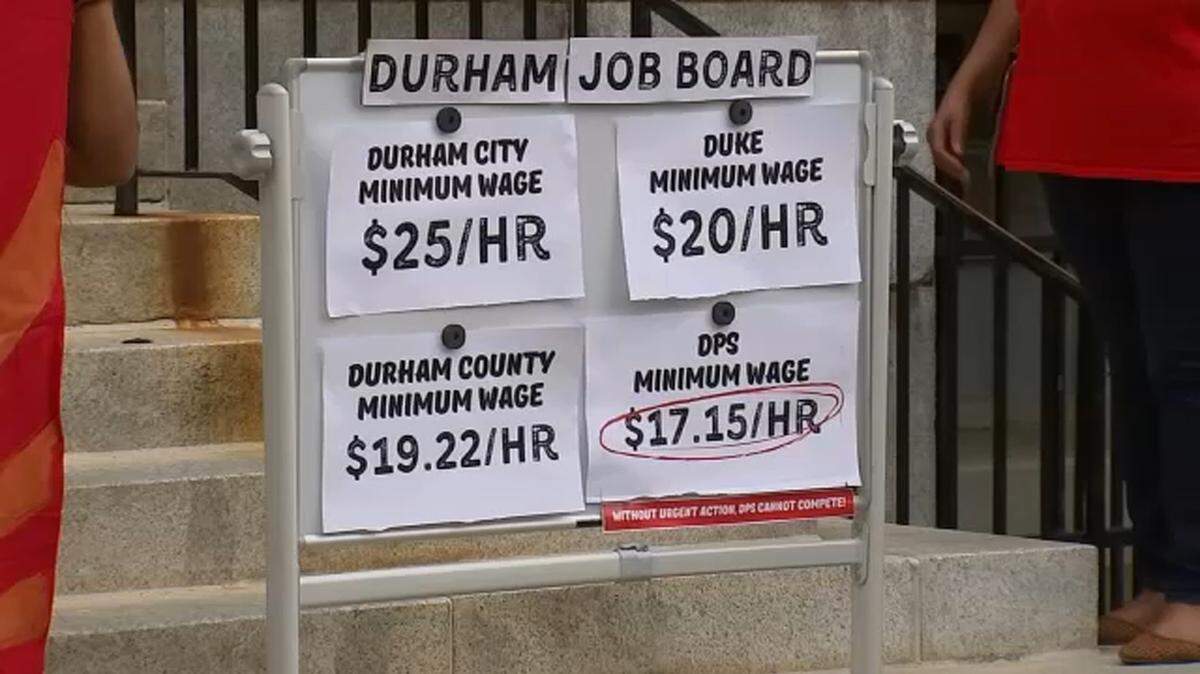
Ryan Burch, an instructional assistant at an elementary school in Durham, shared a reality familiar to many of his colleagues: not being able to afford groceries.
During a public hearing Tuesday night, Burch told county leaders that since he and other classified workers in Durham Public Schools have not received raises in the last two years, keeping up with rising costs and bills has become too much to juggle.
“It is very difficult to provide even basic essentials for my son and myself,” he said. “It’s important for the county to step up and show that you care as much as you say you do.”
Burch was one of several speakers during the public hearing on County Manager Claudia Hager’s $1 billion recommended budget for fiscal year 2026-27. While the budget makes education a priority with $235 million for DPS, the spending plan falls short of the $244.7 million that Superintendent Anthony Lewis requested in county funding.
A living wage in DPS
Bus drivers, cafeteria workers, instructional assistants and custodians — DPS’ classified workers — told the Durham County Board of Commissioners that a 12% raise and an increase in the district’s minimum wage to $19.22 per hour are not a request, but a demand.
Personal testimonies highlighted the urgency behind the demand.
“No one who works for our schools in K-12 public education is being treated with the respect that they earn and deserve,” said Vanessa Barnett Lauro, a member of the People’s Alliance Education Action Team. “Please do the best that you can for our classified folks ... they are the backbone of our schools.”
Hunter Morgan, a classified employee, said he had to delay medical care to make ends meet.
“I have not been able to show up for my students and co-workers the way I want, because I feel so much physical pain and exhaustion at all times,” Morgan told the board, adding that they were choosing to “trust that the district and the county will make a good faith effort to meet us halfway and pay us a living wage.”
Carolyn Eubanks, a staff member, said she is contemplating bankruptcy “because I can barely pay my bills.”
“The people who dedicate their lives to serving children deserve the ability to live and not just survive,” she said. “After years of service, I should be able to retire in two years. But honestly, I’m no longer sure retirement will even be possible for me right now.”
‘Tax us more’
Several homeowners and teachers told the commissioners to raise property taxes even higher than the proposed 2-cent per $100 of assessed value increase to cover funding gaps in the school district.
“I own a home in Durham, and it is absolutely worth it to me to pay less than $6 more per month so that the custodians, bus drivers, (instructional assistants), cafeteria workers, and front office staff who I work with can afford to go to the doctor or afford a babysitter,” said Northern High School science teacher Maggie Radek. “They have not seen any raise from y’all or from the state in two years, and it is unacceptable.”
Beyond tax hikes, residents also asked why wealthy institutions, like Duke University, and corporations are not carrying more of the burden.
“Those with the most should pay the most,” said James Webb, a resident. He cited the Blue Ridge Tax Loophole, which allows for-profit real estate developers to avoid local property taxes, costing Durham County millions of dollars in revenue. “Instead, it’s being mortgaged on the backs of residents. I don’t think that’s very progressive at all.”
The Board of Commissioners only has one public hearing for residents to speak out about the budget. More work sessions are planned before the commissioners take a vote June 8.
This story was originally published May 27, 2026 at 5:26 PM.