Council hears ‘big, bold’ plan for downtown Chapel Hill offices, parking, green space
Editor’s note: The story was updated Feb. 20, 2020, with additional details from the Town Council’s first public hearing on the project.
The town and a Charlotte developer are negotiating a plan that could bring more offices and more parking to downtown, dramatically changing the landscape on East Rosemary Street.
The Chapel Hill Town Council discussed the Grubb Properties proposal Wednesday night and authorized the town manager to draft an agreement for how to proceed.
A public information meeting will be held Feb. 27 in the Great Room at the Top of the Hill restaurant on East Franklin Street. The council could consider approving the agreement March 4, Mayor Pam Hemminger said. The initial agreement is not a commitment.
A draft economic development agreement could be considered this spring.
The plan would demolish two downtown parking decks, and add a larger parking deck, a new office building and two public green spaces. It would be a $50 million investment, Town Manager Maurice Jones said, and could generate an estimated $270,000 in new property tax revenues for the town.
The office building could bring up to 800 new employees downtown, and at least $4.2 million in sales for downtown businesses who are seeing fewer UNC student customers, said Dwight Bassett, the town’s economic development officer.
It could be a “catalyst — along with redevelopment of the 137 (East Rosemary Street) building — for the creation of an innovation hub in our downtown,” Jones said.
Grubb Properties owns the former CVS building at 136 E. Franklin St. and 137 E. Rosemary St. It also owns the CVS Plaza parking deck at 125 E. Rosemary St.
The new public parking deck could be approved by June, Hemminger said. The Grubb Properties redevelopment project could take more than a year to review and approve, she said.
It’s an exciting opportunity for Chapel Hill, she said. Fewer UNC students are eating at downtown restaurants, increasing the need for more people to live and work downtown year-round, and it also could bring back and retain UNC business spinoffs and startups that are moving to Durham and Raleigh to find adequate space.
Several small business incubators, including Launch and 1789 Venture Lab, already call the downtown district home.
“We haven’t had commercial development downtown other than Carolina Square if you look at the last 20 years,” Hemminger said. “This is another opportunity for us to have a commercial space downtown for vibrancy, for jobs, for putting up buildings on the tax rolls. It’s all good.”
Orange County opportunity zone
Grubb Properties brought the idea to the town, because owner Clay Grubb saw an opportunity for more investment, Hemminger said.
Grubb already is taking advantage of a federal Opportunity Zone program to redevelop the former CVS building, which his company bought for $23.5 million in 2019. UNC could lease that space when the renovations are done, Hemminger said.
The Opportunity Zone program gives developers a capital gains tax credit for 10-year investments in economically disadvantaged areas. Orange County only has one opportunity zone, which stretches from East Franklin Street to Estes Drive. Most of the zone is residential, and a portion is in the town’s historic district, leaving very little that could be redeveloped.
Grubb Properties has until 2022 to make investments that can be applied to the program.
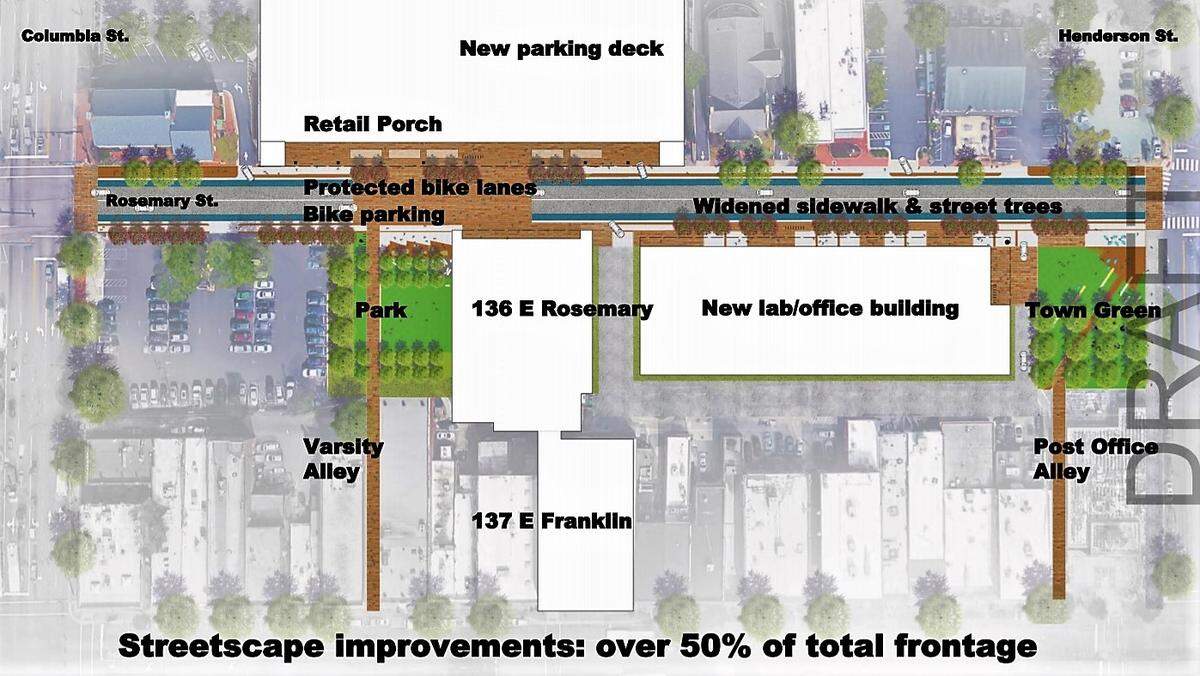
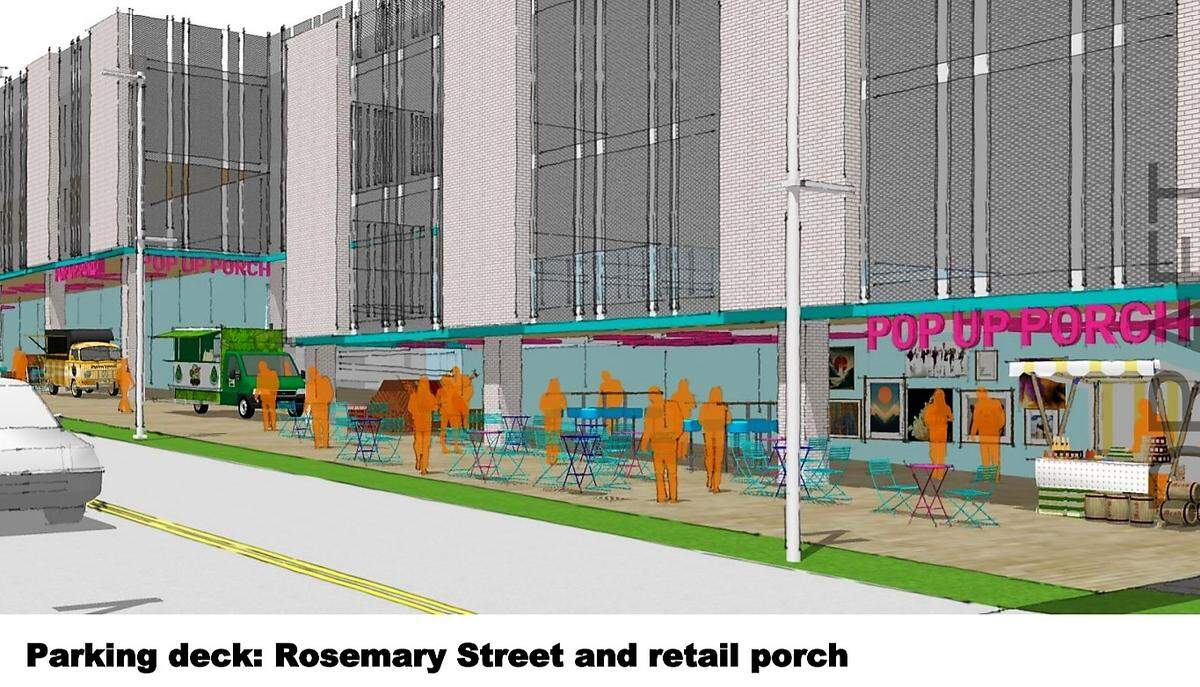
The new proposal would swap the 125 E. Rosemary St. deck for the town’s 1.6-acre Wallace Parking Deck at East Rosemary and Henderson streets. The town also is talking with Investors Title about acquiring a parking lot beside the 125 E. Rosemary St. deck, which would create a 1.6-acre lot for the town’s future parking deck.
Jones identified several challenges, including traffic, how to pay for the parking garage, and how to quickly get the projects underway to meet the Opportunity Zone requirements.
A traffic impact study to identify current conditions and how to minimize those in the future is the next step, he said.
Parking deck, offices, parks
The town could pay $28.1 million — over $39.5 million with the interest on long-term debt — for Grubb Properties to demolish the 125 E. Rosemary St. deck and build the new, 1,100-space deck. UNC might lease 100 of those spaces at roughly $40,000 a year to support its future downtown admissions office, town staff said. The university also could pay $2.4 million toward construction, they said.
The town is working on a plan to replace public parking during construction, Hemminger said.
After the new parking deck opens next year, Grubb Properties could demolish the Wallace deck and replace it with 200,000 square feet of office and wet lab space. Roughly 100 to 200 spaces on the lower level of the Wallace deck could remain, Hemminger said.
The new six-story building — and the former CVS building — could include rooftop solar panels and other green-building features, the developer has said.
Grubb Properties also would create two public green spaces: one behind the Chapel Hill Post Office, and the other on the lower level of a parking lot at Rosemary and Columbia streets. That green space would extend a midblock pedestrian link to Franklin Street via Varsity Alley. East Rosemary Street would get wider sidewalks and bike lanes.
“It could be just a really nice, welcome place, but the university is also excited about the possibility of wet lab (space) downtown that meets a lot of needs that their inventors have that we can’t fill here in Chapel Hill,” Hemminger said.
The project also might increase the possibility of development for a smaller site across from the Wallace deck at 157 E. Rosemary St. That site, which for decades housed popular dive bars, has been on the market for several years. However, proposed redevelopment plans have not fared well, in part because they would have relied on the Wallace deck for parking.
It’s an exciting project, with a lot of potential benefits, council members said, but a “big, bold project” doesn’t come without risks.
“I think making it self-sustaining is absolutely critical, and we have to pay attention to that,” council member Michael Parker said. “We absolutely can’t take our eye off the ball when it comes to these things, but we heard also the manager talk about his belief and his commitment to making the finances on this work, so I believe that we can do all these things.”
Downtown parking
Parking has long been a hurdle to bringing more people downtown, and town staff have said at 1,000 more spaces will be needed over the next 10 years, especially along East Franklin Street.
Part of the problem, staff has said, is the perception that there is no available parking, because visitors either can’t find off-street lots or are competing for a limited number of on-street parking spaces near their destination.
Roughly 70% of the parking downtown is privately owned and only available to leaseholders or customers of businesses with private lots. The other 30% — over 1,300 on-street, off-street and parking deck spaces — is owned or leased by the town as public parking.
Some changes have been made, including better signs for visitors, new parking spaces and pay stations, and an arrangement with UNC that opens some off-campus lots after hours. A West Franklin Street parking deck also is still on the table, Hemminger said.
The town also has tried to increase the number of people parking in the public parking garage at 140 West Franklin. The 154-space garage, which was expected to help pay for itself, continues to be underused, Hemminger said.
The town would rely on parking revenues to pay for the East Rosemary and West Franklin decks, Hemminger said. Part of that money would come from $2.4 million set aside for making critical repairs to the Wallace deck, which was built in 1991. The town could finance the rest through its dedicated Parking Fund, which could bring in roughly $2.9 million this year, largely through parking fees.
The town could increase the cost of parking in its public lots from $1 to $1.50 to generate more money for repaying the debt. Parking lease rates — the town has a waitlist for those spaces, Jones said — could increase from $115 a month to $125 a month.
“Parking decks are interesting because if you can prove that you can make them self-sustaining revenue-wise, they don’t affect your debt capacity,” Hemminger said. “So we’ve got strategies that we can put in place for doing that. They pay for themselves.”
What’s next
The Town Council will meet at 7 p.m. Wednesday in the Town Hall Council Chamber, 405 Martin Luther King Jr. Blvd.
This story was originally published February 18, 2020 at 11:36 AM.