Chapel Hill weighs risk vs. reward in downtown development deal
Chapel Hill leaders signaled this week they’re ready to take a financial risk to bring more jobs, business and parking downtown.
The Town Council’s pending deal with Grubb Properties would transform the 100 block of East Rosemary Street, now mostly a pass-through for those heading to Franklin Street and UNC’s campus or cutting across town.
A vote on the development agreement and a proposed land swap is scheduled for Sept. 30.
If approved, the CVS parking deck at 125 E. Rosemary St. would be replaced with a new, 1,100-space, six-story public parking garage with ground-floor space for pop-up retail and food trucks. Two small parks and bike and pedestrian improvements also are planned.
The town would give Grubb Properties roughly $1.7 million and the 309-space Wallace Parking Deck at 150 E. Rosemary St. for the new parking garage. The town would pay $30,000 a month to lease the Wallace deck until the new garage opens.
Once that happens, Grubb Properties could replace the Wallace deck with 200,000 square feet of office and wet lab space. That six-story project, with up to 200 parking spaces underneath, would complement an Innovation Hub the developer is creating in the former CVS building at 136 E. Franklin St. and 137 E. Rosemary St.
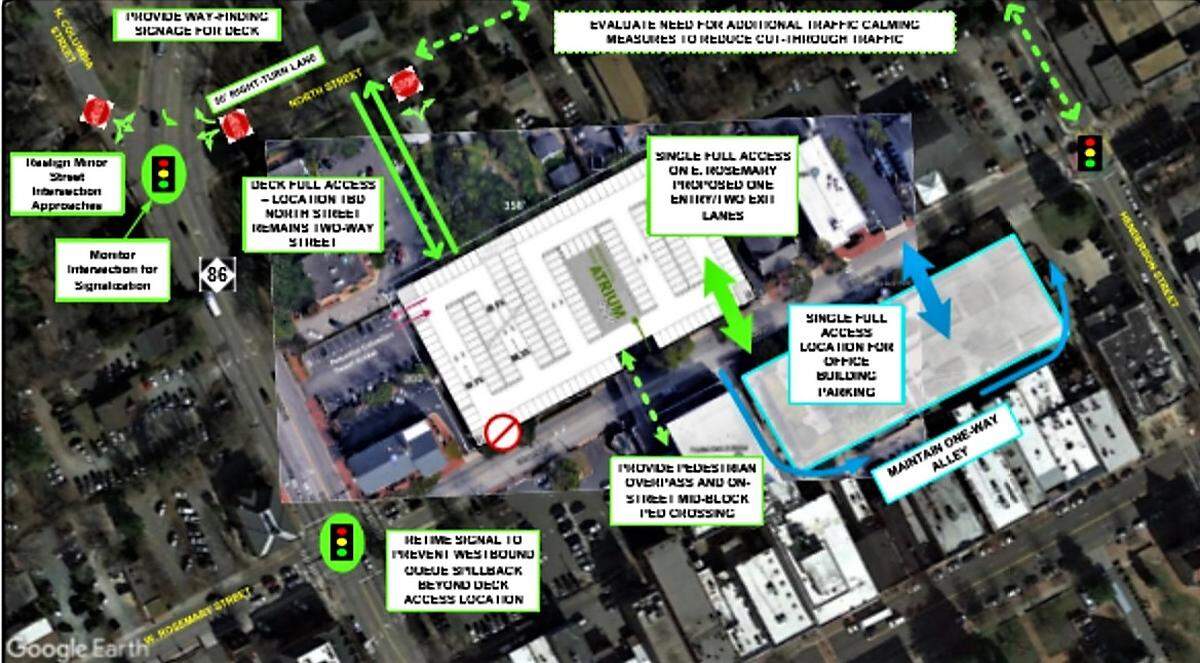
A traffic study has estimated 3,980 cars could use the new parking deck each day — roughly 800 more trips than the CVS and Wallace decks generate now. The office building could add over 1,700 more trips by 2023, it said.
The study recommended only one parking garage driveway on East Rosemary Street. Driveways also are planned on North Street behind the garage and through a parking lot on North Columbia Street.
Parking fees, financing
The town would finance the $32.9 million parking garage over 20 years at 2% interest, business management director Amy Oland told the council Wednesday. The town would pay it off from parking fees, she said.
It is not clear yet how much in parking fees the town has lost to the COVID-19 shutdown or because UNC students have left campus again. Mayor Pam Hemminger said a recent increase in parking rates and continued interest in long-term parking leases still make the deal work. The former CVS building also will be filled after sitting empty for five years, she said.
If the deal is approved, crews could begin demolishing the CVS parking deck by next summer. A concept plan for the new office building is expected later this year.
.jpg "East Rosemary areial view from northeast (2).jpg")
Economic growth, financial risk
The $80 million investment has the potential to create a business and technology hub serving UNC-generated entrepreneurial and biotech companies, and catalyze a stronger downtown economy, town officials said.
“The wet labs that are proposed will be critical to growth of small biotechnology companies that are formed here in Chapel Hill. They do often leave when they are in need of additional lab space,” Town Manager Maurice Jones said. The project “would really be a nice complement to the Innovation Hub that’s being planned for the building next door.”
Up to 800 jobs are anticipated and at least a $4.2 million bump in sales for local businesses, economic development officer Dwight Bassett has said. It also could mean $270,000 a year in new property tax revenues for the town, he said.
UNC is a major tenant being courted for the Innovation Hub, and the university also is negotiating with the town for 100 parking spaces in the new Rosemary Street garage, in part to serve a future Franklin Street admissions office. UNC could pay $2.9 million toward construction and $40,000 a year for garage maintenance.
Grubb Properties also could lease spaces in the new garage for its building’s tenants. If the new offices aren’t built, the town could buy back the Wallace lot, town attorney Bob Jessup said. Documents show the buyback price would be based on the appraised value of the CVS deck and an adjacent lot, plus a 6% annual increase and other costs related to planning for the office building.
Council member Hongbin Gu urged her colleagues to delay the deal to get more input from experts.
“We all want economic development in our downtown,” Gu said. “We see the impact of this pandemic to our downtown business, and we’ve heard about how the downtown businesses are struggling in our economic development meeting, but ... we have to do it based on the facts and data that we have ... instead of just wishful thinking and hope that it will work out.”
Other council members disagreed. Council member Michael Parker acknowledged the deal carries risk, but said the town has not invested enough in its downtown.
“If we’re serious about having the kind of downtown that harnesses innovation, entrepreneurship, that brings tourists, that is a vibrant place for our residents, that is a place that people want to go to just be there, then we have to invest in our downtown,” Parker said. “As we’ve heard on many, many occasions, the way that communities invest in their downtowns is by supporting the infrastructure that supports private capital. That’s what we’re doing here.”
This story was originally published September 11, 2020 at 5:55 AM.