Raleigh lost over a thousand acres of tree canopy. Apex, Cary & Holly Springs lost more.
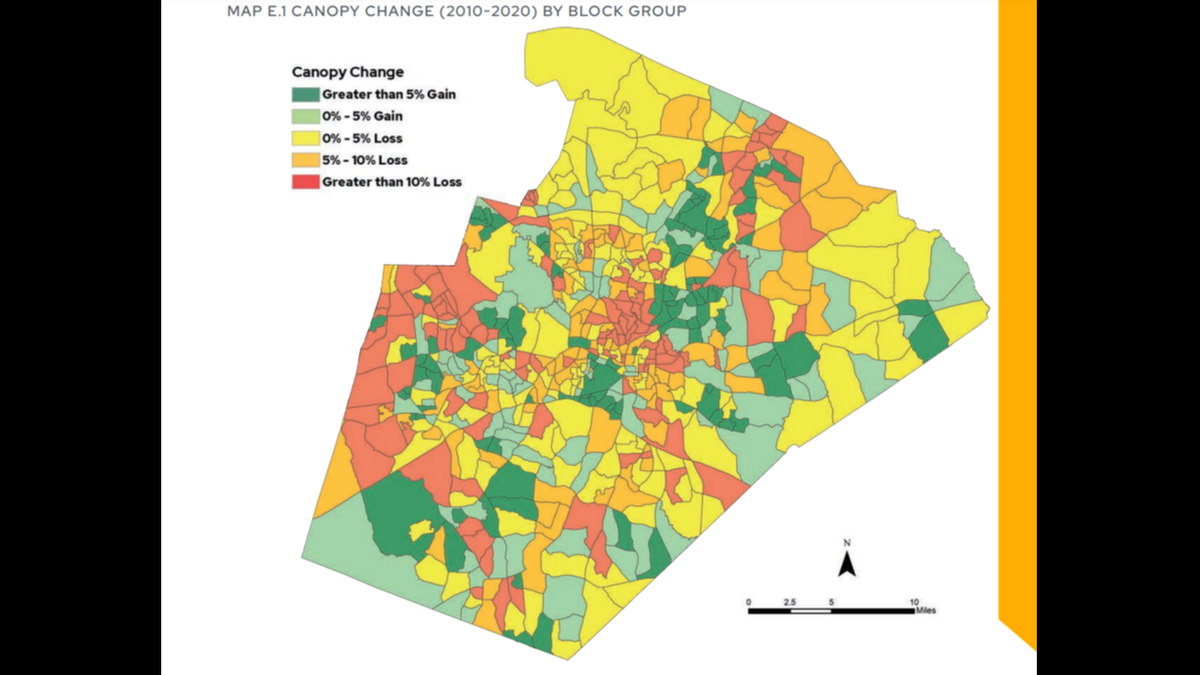
Wake County has lost thousands of acres of trees as the area has grown, especially in its fast-growing western towns.
The county lost 11,122 acres of tree canopy from 2010 to 2020, a new report shows. That’s about twice the size of Umstead State Park.
Tree canopy refers to the amount of land covered by trees including trunks, branches and leaves as seen from above.
“Trees provide critical community infrastructure by helping clean the air we breathe, filter the water we drink and mitigate the impacts of a changing climate,” said Shinica Thomas, the chair of the Wake County Board of Commissioners.
“As a board, we strive to achieve healthy, equitable and sustainable outcomes for all of our residents,” she said. “This study is another tool we can use to guide future decisions as we plan for the next wave of growth.”
This report breaks down the tree canopy in each of Wake County’s towns and cities from 2010 to 2020.
▪ Raleigh lost 1,305 acres, about 2.2%, of its tree canopy. Roughly half of the city is covered by tree canopy. About a quarter is covered by buildings, roads and other paved surfaces.
▪ Cary lost 1,709 acres, about 7.3%, of its tree canopy. Roughly half of the town is covered by tree canopy. About a quarter is covered by buildings, roads and other paved surfaces.
▪Apex lost 2,180 acres, about 15.2% of its tree canopy. About half of the town is covered by tree canopy, and 20% is covered by buildings, roads and other paved surfaces.
▪Fuquay-Varina lost 739 acres, about 5.3%, of its tree canopy About 45% of the town is covered by tree canopy, and about 15% is covered by buildings, roads and other paved surfaces.
▪Garner lost 806 acres, about 5.4%, of its tree canopy. About 56% of the town is covered by tree canopy, and about 16% by buildings, roads and other paved surfaces.
▪Holly Springs lost 1,392 acres, about 10.3%, of its tree canopy. About 55% of the town is covered by tree canopy, and 14.4% by buildings, roads and other paved surfaces.
▪Knightdale lost 256 acres, about 2.7%, of its tree canopy. About 52% of the town is covered by tree canopy, and about 14% by buildings, roads and other paved surfaces.
▪Morrisville lost 623 acres, about 22.7%, of its tree canopy. About 34% of the town is covered by tree canopy, and about 38% by buildings, roads and other paved surfaces.
▪Rolesville lost 399 acres, about 8.7%, of its tree canopy. About half the town is covered by tree canopy and about 11% by buildings, roads and other paved surfaces.
▪Wake Forest lost 1,190 acres, about 15.3% of its tree canopy. About 45.5% of the town is covered by tree canopy and about 24% by buildings, roads and other paved surfaces.
▪Wendell lost 136 acres, about 2.6%, of its tree canopy. About half of the town is covered by tree canopy and 10.5% by buildings, roads and other paved surfaces.
▪Zebulon lost 64 acres, about 1.4%, of its tree canopy. About half of the town is covered by tree canopy and 12% by buildings, roads and other paved surfaces.
The report calls 80,000 acres of the county “potential planting areas” with over 10,000 acres considered a “very high planting priority.”
Wake County snapshot
There are nearly 550,000 acres of land in Wake County. The report looked at data and images from 2020 to determine how much of the county is covered by trees, buildings and water.
- Tree canopy makes up 54.2%.
- Other vegetation, like shrubs and grass, makes up 23.3%.
- Open water, like lakes and ponds, make up 3.4%.
- Bare soil, including vacant lots, construction sites and agriculture fields, make up 4.1%.
- Impervious surface, buildings, roads, sidewalks and other built areas, make up 14.9%.
The 100-plus page report, including individual municipality reports, can be found online at wake.gov/treecanopy.
‘Nature of Oaks’ author talk
The Dix Park Conservancy, with the city of Raleigh and the Oak Folk Collaborative, is holding an author’s talk Sept. 14 with conservationist Doug W. Tallamy, the New York Times bestselling author of “The Nature of Oaks.”
The ticketed event begins at 6 p.m., with doors opening at 5:30 p.m. at the Dix Park All Faiths Chapel, 1030 Richardson Drive.
Tallamy will “share his work, research and advocacy around the importance of our living landscapes, the rich ecology of our most essential native trees and how we contribute to a more sustainable environment in our own backyards.”
Tickets are $20 for general admission.
This story was originally published September 5, 2023 at 2:18 PM.