
Wake County is losing tree canopy to development. Can these baby trees stem the loss?
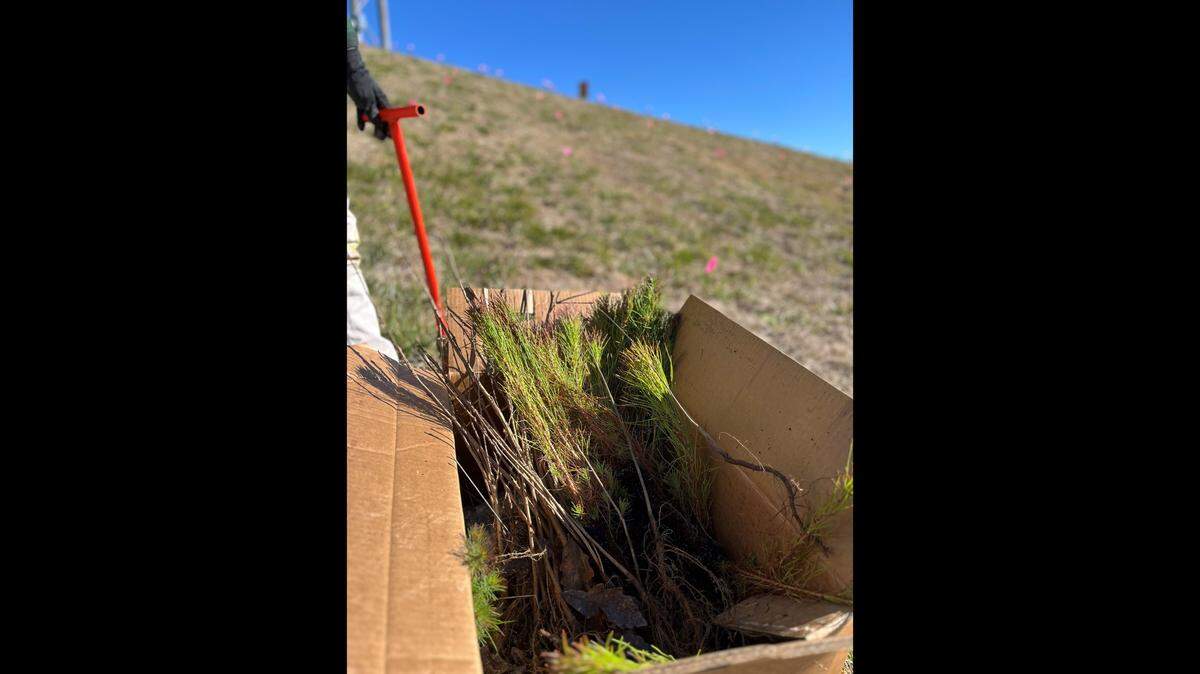
Seedlings need lots of TLC to grow into strong, healthy trees.
A planter will dig a hole two or three times as wide as the roots of the baby tree, cutting away damaged roots and providing water to keep the soil moist, before filling the hole and tamping down the dirt to remove any air pockets.
Then, all the seedling needs is water, sunlight, nutrients and time.
This week, Wake County crews planted over 1,600 seedlings across four grassy acres near the N.C. 54/N.C. 540 interchange in Morrisville.
The goal is to reverse the loss of tree canopy after a study found Wake County lost 11,122 acres from 2010 to 2022, an area twice the size of William B. Umstead State Park. Tree canopy is the amount of land covered by trees, trunks, branches and leaves.
During those years, the county’s population grew from 900,993 to 1.15 million people.
In Raleigh, 1,305 acres of tree canopy, almost 12% of the total, were lost. Cary, Holly Springs and Apex lost a combined 5,281 acres.
Over their 40-year lifetime, the trees — a mix of oaks, pines and cypress — will capture about 28 million gallons of rainfall and prevent 3.7 million gallons of runoff, according to the county. They will also store more than 5.4 million pounds of carbon dioxide, removing the heat-trapping gas from the atmosphere.
The reforestation pilot program is one of many Initiatives leaders say will help make the area more sustainable as Wake County grows.
Trees “help clean the air, filter the water and mitigate the impacts of climate change,” Wake County Commissioner Chairwoman Shinica Thomas said in a news release.
How do baby trees help the environment?
It can be hard to imagine the impact baby trees can have when they are first planted, said Joseph Joyner, with Davey Resource Group, the company partnering with Wake County on the reforestation project.
“Significant growth and visual changes such as increased height and foliage density are more likely to become evident after several months to a year as the seedlings establish their root systems,” Joyner said. “Even young trees begin contributing to ecosystem benefits including soil stabilization, erosion control and microclimate regulation.”
As the trees grow, their root systems play a crucial role In preventing runoff by stabilizing soil, while the trunk, branches, and leaves provide habitats and improve air quality. They also begin to look more appealing.
“The key driver of tree benefits Is canopy cover, so as healthy trees grow and get maintained, the magnitude of benefits Increases,” Joyner said.
“Natives are adapted to regional conditions,” he said. “Natives are hardy, low maintenance and may require less water than other ornamentals.”
Broadleaf trees, like the oak trees planted, tend to catch more rainfall while fast-growing trees, like the loblolly pines planted, can isolate carbon dioxide quicker, Joyner said.
Wake County’s reforestation efforts
The N.C. 54/N.C. 540 Interchange was ideal for the pilot program because of the amount of available land, its location and visibility from both roadways.
“Scheduled plantings, Including the recent reforestation pilot, are occurring on public lands as they will be protected from development,” said Liz Oliver, a project administrator for Wake County’s Planning, Development and Inspections division. “The county Is also looking for planting opportunities through private partnerships.”
Some Wake County municipalities encourage residents to help restore lost trees. Cary’s “My Tree, Our Tree” program offers free native saplings for people to plant in their own yards.
“By addressing environmental, social and economic factors,” Oliver said. “They promote everything from reforestation efforts and biodiversity, to positively influencing green infrastructure equity. The success of these initiatives depends on effective planning, community involvement and long-term follow-up.”
Wake County has a second planting scheduled to take place in March.
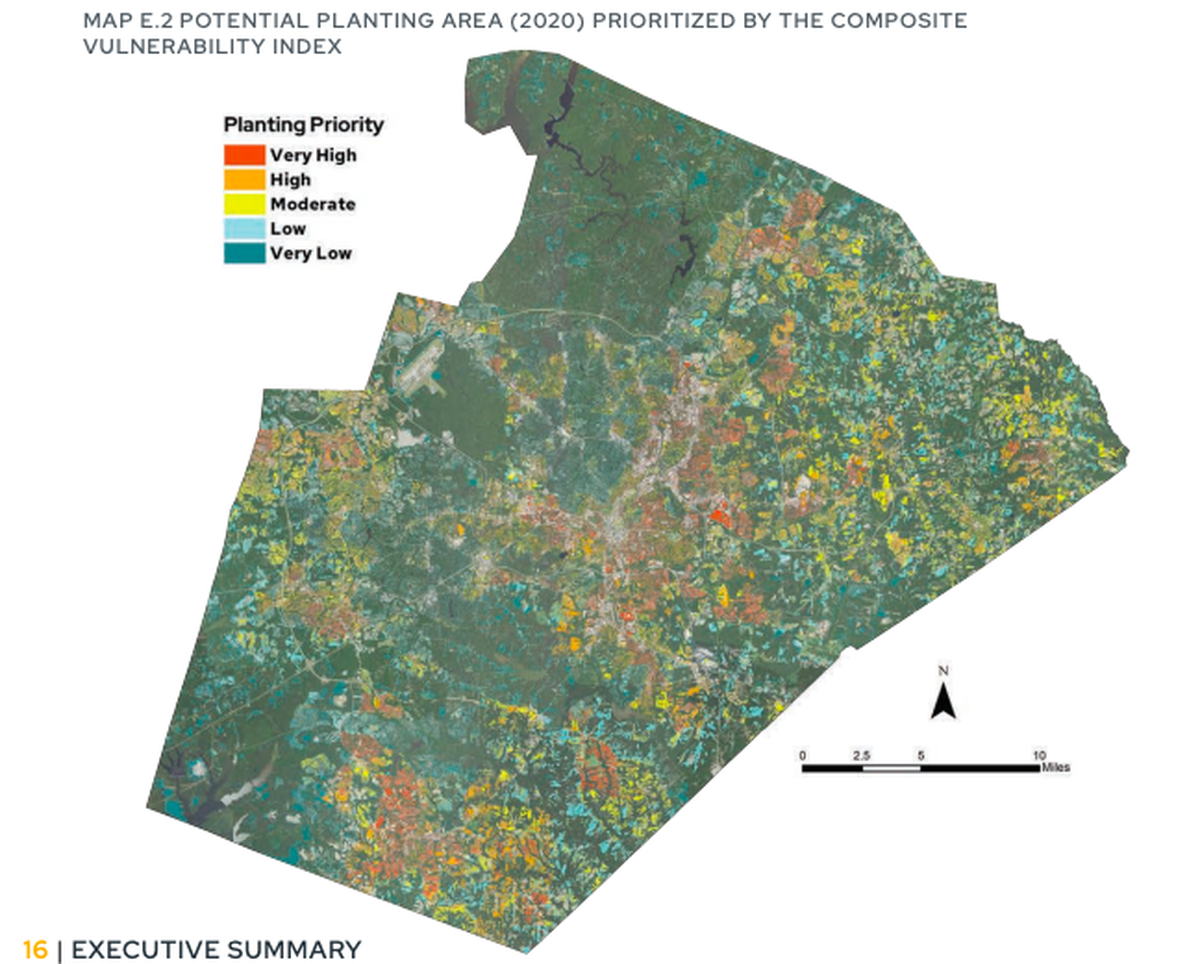
Wake County’s tree canopy study
Tree canopy covers about 54% of the county’s 550,000 acres, according to the Land Cover Analysis with Supporting Tree Canopy Assessment.
Other data showed vegetation like shrubs and grass made covered roughly 23% of the land; lakes and ponds, 3%; buildings, roads, sidewalks and other areas, 15%; and bare soil like vacant lots, construction sites and farmland, 4%.
The study broke tree canopy Into two distinct forest types: coniferous and deciduous.
Coniferous trees retain their leaves and needles year-round. These are pine, spruce, hemlocks, cypress and cedar trees. Wax-leaf trees, like magnolia and hollies, are also In this category. The coniferous trees make up 29%, of canopy In Wake County.
Deciduous trees lose their leaves In the winter. In North Carolina, the most common are oak, hickory, maple, beech and elm trees. They make up 71% of the canopy, in Wake County.
Each year, Wake County trees remove 11,022 tons of pollutants from the air, absorb over 414,000 tons of carbon dioxide and catch 8.1 billion gallons of stormwater.
This story was originally published February 23, 2024 at 10:01 AM.