Developer sued 87 homeowners in east Raleigh. Here’s how it ended
AI-generated summary reviewed by our newsroom.
- Developer Steve Sypher sued 87 neighbors to void old land-use covenant.
- Wake County judge ruled the covenant remains enforceable and applicable.
- Townhouse development plans halted due to potential for irreparable harm.
Local developer Steve Sypher sued his neighbors — 87 to be exact — in east Raleigh’s Woodcrest subdivision.
He wanted to remove a decades-old covenant, tied to his properties as well as his neighbors’, that restricts the land’s use.
In a recent decision handed down in Wake County Superior Court, he lost.
He must now shelve city-approved plans to build 12 four-story townhouses across two lots — about nine-tenths of an acre — at 524 and 528 Barksdale Drive in this historically single-family neighborhood.
The covenant is “applicable,” Judge Warren McSweeney said in the 3-page decision.
The covenant, he wrote, has “not been extinguished” by the North Carolina Marketable Title Act, which helps clear old claims and defects from property titles.
“If plaintiff were to proceed with the development in violation of the declaration, irreparable harm would result.”
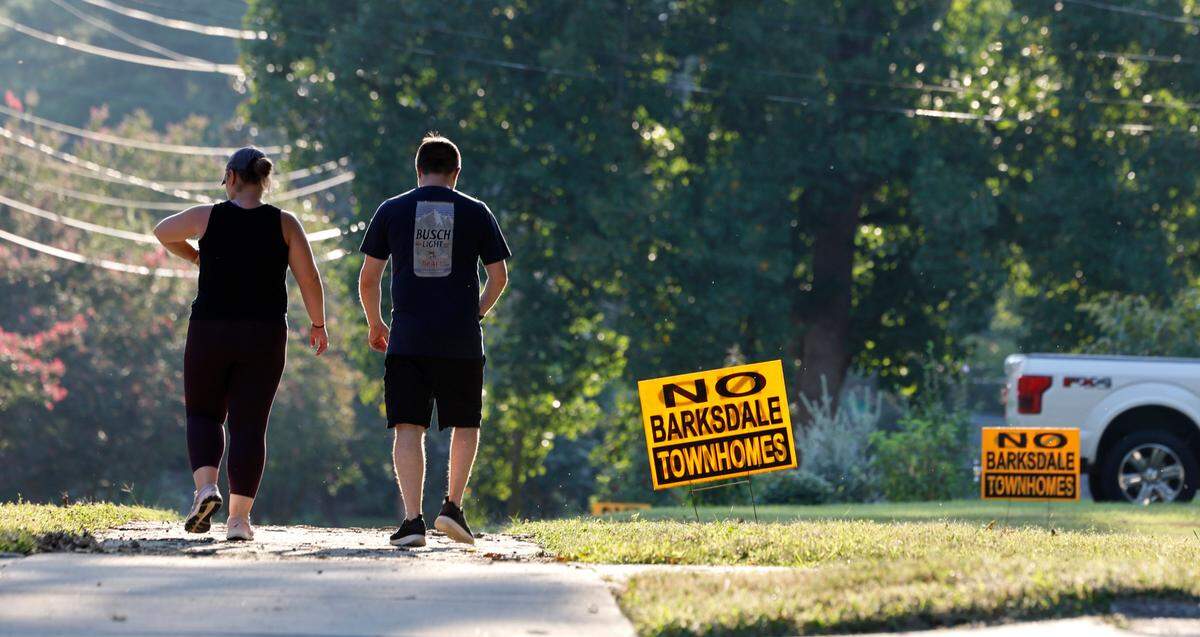
The judge’s decision could reshape Raleigh’s housing policy debate.
The case was one of several lawsuits sparked by Raleigh’s 2021 “missing middle” reforms. Facing a chronic housing shortage, officials loosened zoning rules, incentivizing developers to build denser housing — like duplexes, townhouses and accessory dwelling units — in single-family neighborhoods. But in recent years, these reforms have ended up in court, pitting homeowners against the city and developers, creating uncertainty, delays and increased legal costs.
On Friday, Sypher said he won’t appeal, but he’s disappointed. “This just furthers Raleigh’s housing shortfall,” he emailed in a statement.
“The ultimate effect,” he added, “is instead of 12 units being available for families at reasonable prices, the properties will now have two much larger houses at significantly higher prices.”
For many Woodcrest residents, they’re just relieved that it’s finally over. Others are pushing the city for text changes that allow for “more nuance.”
“Missing middle shouldn’t be a blanketed ‘yes’ or ‘no’ issue,” said Ann Sun, 48 , who appeared as a defendant in the case.
In 2012, the designer paid $240,000 for a three-bedroom ranch home on Barksdale Drive, just a few houses down from Sypher’s lots. Many homeowners purchased houses in the subdivision because of the covenants, she said. In this blue-collar suburb, it served as security on their investments.
At the moment, “it feels like a one-size-fits-all agenda,” Sun added, “but our neighborhoods are all different. [They] need to be evaluated to see what makes sense.”
Post-World War II subdivision meets ‘missing middle’
In 2023, Sypher, 52, a custom builder who has worked in the area for over 20 years and renovated close to 70 houses in the neighborhood, got the city’s green light for his project. But he faced another hurdle: the deed’s restrictions.
In 1958, the George Building Co., Woodcrest’s original developers, recorded in Book 1319 on page 253 of the Wake County Registry: Only detached, single-family, two-and-a-half-story homes allowed.
To proceed, Sypher needed to get the declaration removed. So, in July 2024, he sued anyone whose property is subject to Woodcrest’s 1958 covenant: roughly 59 households spread across four streets, totaling 87 defendants (some properties have multiple owners.)
During Raleigh’s post-World War II housing boom, such declarations were common in the push for suburban sprawl. But Sypher argued it should no longer apply “due to the passage of time.”
A 2023 North Carolina Supreme Court ruling made it easier to invalidate these covenants.
Andrew Atkins, an attorney with Raleigh law firm Smith Anderson, believes the latest decision won’t be the final word. He expects new litigation.
“This area of the law is developing,” he said. “It will be interesting to see how these nuances play out in the appellate courts.”
City remains silent
For its part, the city continues to remain on the sidelines.
“The issue regarding the restrictive covenants is a private matter that the city is not involved in,” said Julia Milstead, the city’s public information officer, in an emailed statement. “The city does not enforce restrictive covenants, and they are not considered during the plan review process.”
In addition to Sypher’s case, Hayes Barton residents are trying to overturn the city’s second administrative approval for 17 townhouses in one of the city’s most historic neighborhoods.
Raleigh’s board of adjustment unanimously denied the homeowners’ appeal to block the revised development plan, which addressed previous concerns about a landscaped buffer zone, Raleigh Forward reported. They’re expected to appeal the decision.
Separately, residents are also seeking to invalidate the city’s broader reforms. Last November, the city asked the N.C. Court of Appeals to have the case dismissed. The appeal is pending.