Raleigh is building ‘missing-middle’ housing. Is it reducing rents and homelessness?
AI-generated summary reviewed by our newsroom.
- Southeast Raleigh contains about 40% of Raleigh’s ~4,700 missing middle units.
- 2021–22 zoning changes let duplexes, townhomes and cottages be allowed without rezoning.
- Officials cite rent declines and lack local data to confirm homelessness impacts.
Raleigh is on track to add nearly 5,000 units of “missing-middle” housing since easing zoning rules five years ago, but at least one local leader wants proof it’s really helping with affordability and homelessness.
Missing middle refers to homes between single-family houses and large apartment complexes likes duplexes, backyard cottages, townhomes and small apartment complexes.
Before 2021, about two-thirds of the city of Raleigh was zoned exclusively for single-family homes.
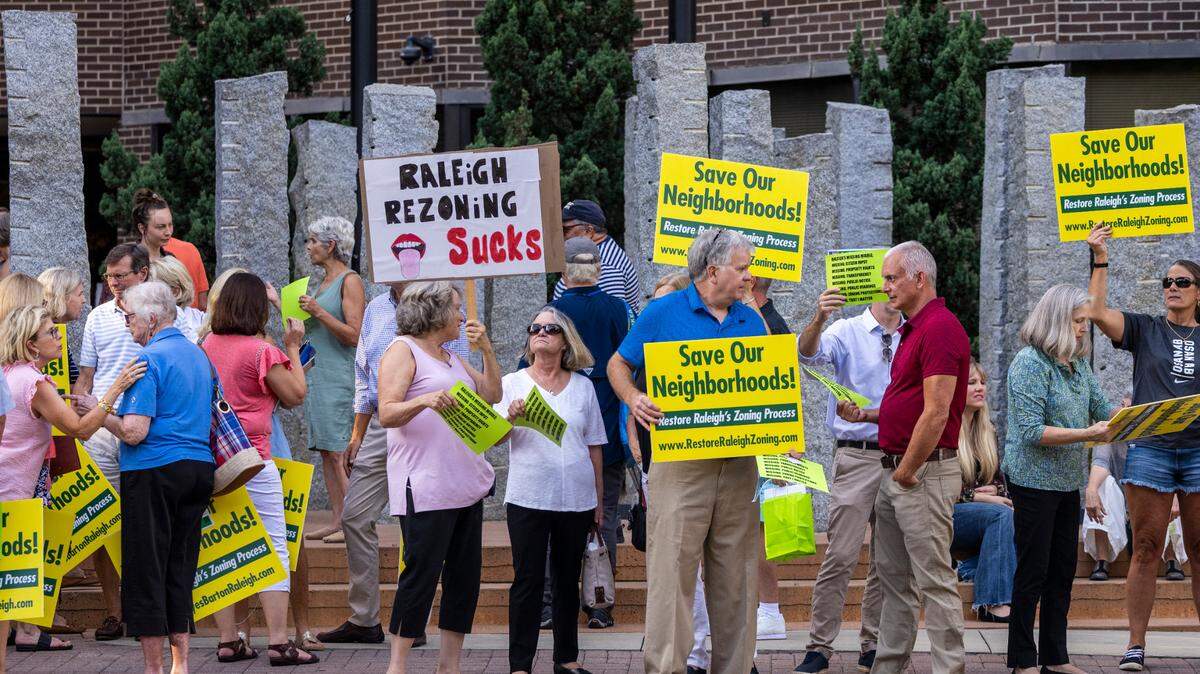
The Raleigh City Council voted in 2021 and 2022 to change its zoning rules to allow missing-middle housing without going through a rezoning, prompting legal fights with some neighborhoods unhappy and worried about the changes to their neighborhoods.
“These changes allow for smaller homes on smaller lots, which provides a wider array of housing, allows for more housing options in residential neighborhoods and increases housing supply for existing and future residents, especially near those high-frequency transit areas including the bus rapid transit corridors,” Emila Sutton, the city’s housing and neighborhood director, recently told the City Council.
Where missing-middle housing is going
Sutton showed city leaders a map, broken up by council districts, of where missing-middle housing is under review by staff, where the housing has been approved by staff but not built yet, and where missing middle housing has been built.
Of the more than 4,700 townhomes, duplexes and other missing-middle housing built or planned in Raleigh about 40% will be in southeast Raleigh.
Here’s the breakdown:
- District A, north Raleigh: 11 units in review, 73 units approved and 29 units complete, for a total of 113 or 2.4% of the city’s total.
- District B, northeast Raleigh: 310 units in review, 755 units approved and 22 units complete, for a total of 1,087 or 23.1% of the city’s total.
- District C, southeast Raleigh: 335 unis in review, 955 units approved and 567 units complete, for a total of 1,857 units or 39.4% of the city’s total.
- District D, southwest Raleigh: 133 units in review, 606 units approved and 127 units complete, for a total of 866 units or 18.4% of the city’s total.
- District E, northeast Raleigh: 171 units in review, 488 approved and 125 units complete, for a total of 78416.7% of the city’s total
Impacts on rent, homelessness
Missing-middle housing is increasing housing supply locally, and national data shows that rents fall or stabilizes in places where housing is built, Sutton said.
“We are actually seeing our rents fall, and this is directly because of this missing middle change and the more housing types that are allowed,” Sutton said.
That doesn’t mean those homes would be considered affordable housing, especially for people with lower incomes, she said. But, she added, research also shows that homelessness goes down where more housing is built with many types available. Reducing homelessness wasn’t an original goal of the missing middle changes.
Council member Christina Jones said “she loves the theory” but asked if the city is seeing similar trends in homelessness since missing middle was implemented.
That’s not something the city has tracked, Sutton said, and it would likely need to be benchmarked over time and compared to other cities.
“I think we have to be careful how we position it then,” Jones said. “I don’t know if the message to start then is ‘This is what’s seen nationally’ when locally we can’t prove that.”
She brought up a previous presentation to the City Council that showed there were about 750 evictions each week in Wake County. Without better data, Jones said, she can’t defend missing middle against critics.
“Because [if] we’re only saying, ‘Oh, this is good, it’s good, it’s gonna work, it’s gonna work, it’s gonna work’ and then we wait until it like crashes, then we haven’t done the due diligence,” she said.
Drawing the connection
It may be difficult, Sutton said, to draw a direct, local connection between missing middle housing and homeless rates.
“We know on a broader scale ... that you can look at regional differences within homelessness, and when you take communities where they offer more housing sizes and types, and they have better vacancy rates and lower rents, their homeless rates are lower,” she said. “I think it gets harder to show at a granular level in Raleigh how those are connected.”
Some of those challenges include how people experiencing homelessness are counted, usually one time a year in January that often underrepresents the full picture.
Part of the challenge is making sure people understand what work the city has done, its impact and what work still needs to be done, said council member Jonathan Lambert-Melton.
“Folks are still feeling priced out,” he said. “We still got folks that are living on the street. We still have folks that can’t find an affordable home purchase or rental, and it’s helpful if we can do a better job of telling our story because I think it’s important folks know that there is still a lot more work to do. But the solution cannot be to stop the progress we’re making. We know that we have to get supply up.”
This story was originally published February 12, 2026 at 5:11 PM.