How this Wake County group is helping South Asian survivors of domestic violence
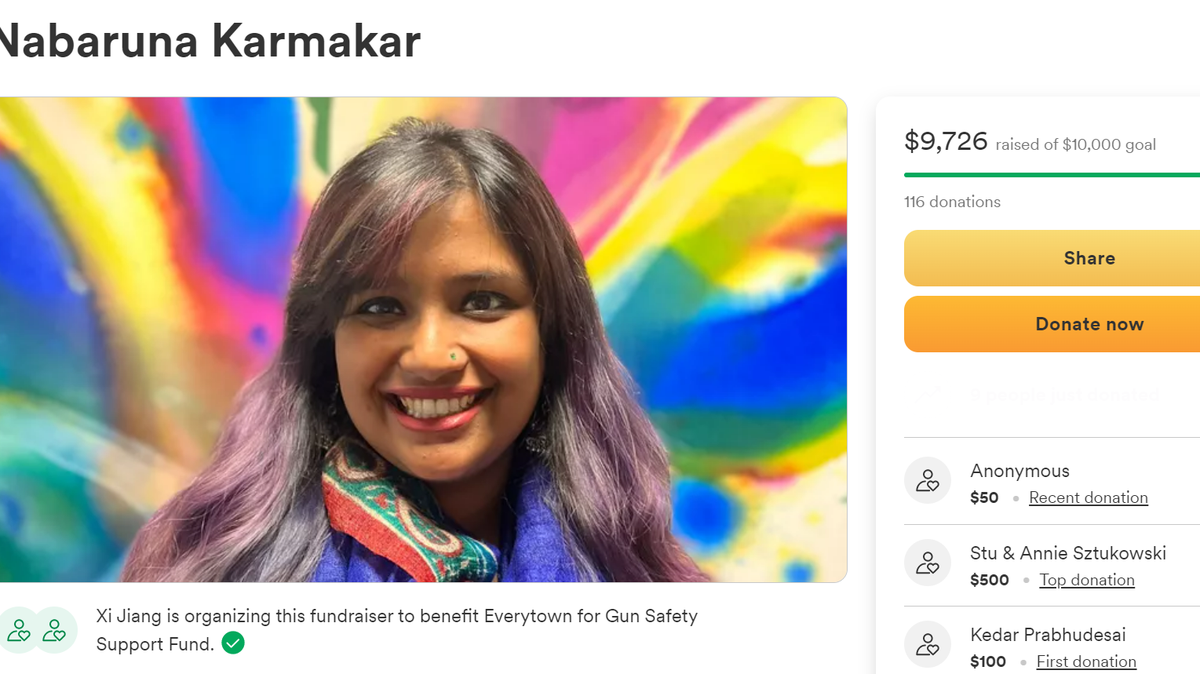
Nabaruna Karmakar was 33 years old when two shotgun blasts ended her life on a rainy April night in her quiet suburb.
Minutes after getting a brief 911 call reporting a “double suicide” on April 14, 2023, police rushed to the Morrisville home that Karmakar, an N.C. State alumna and senior operations research specialist at SAS, shared with her husband, Michael Aaron Matthews.
First responders found Karmakar lying on a dog bed, next to a 12-gauge shotgun and an urn containing the ashes of the recently deceased dog, Boomer, that she adored, according to a civil suit filed by her sister.
Matthews, 41, was arrested that night on a charge of murder and is awaiting trial, tentatively set for May. The civil suit alleges he tried to stage the suicide of his wife of four years, writing “a note as if it was from Nabaruna Karmakar purporting to state the reasons she had allegedly committed suicide,” the complaint states.
Karmakar was the first of three known victims of homicides tied to domestic violence in 2023 in Wake County, according to the N.C. Coalition Against Domestic Violence.
Statewide, North Carolina saw at least 73 domestic-violence homicides in 2023, with 2024 on track to surpass that number — as of Oct. 23, the coalition knew of at least 73 homicides, including two in Wake County.
In Wake County, one organization works to reduce that number by focusing on those like Karmakar: members of the Triangle’s South Asian community.
A ‘ray of light’
Seema Kak is the executive director of Kiran, a Raleigh-based nonprofit founded in 2007 by a group of friends concerned about domestic violence in the South Asian community in Wake County. (Kiran means “ray of light” in Hindi.)
“A mainstream agency would not be able to handle language [and] cultural barriers,” Kak said. “Immigration is huge because many agencies don’t even understand what’s going on. What kind of a visa are they on? Why are they so scared to come forward?”
Kiran has about eight staffers and at least 60 trained volunteers and serves people from nine countries — Afghanistan, Bangladesh, Bhutan, India, Maldives, Myanmar, Nepal, Pakistan and Sri Lanka — whose cultural practices and linguistic foundations overlap, Kak said.
“They all present the same underlying cultural difficulties,” she explained
Its services include:
A 24-hour crisis line, 1-877-625-4726.
Safety planning.
Legal advocacy.
Client empowerment through case management, crisis counseling, job placement, resume building, driving lessons, therapy sessions, yoga support groups and help buying a car.
Housing referrals.
Medical referrals.
Interpretation assistance.
Help with child care and transportation.
Culturally aware law enforcement training.
Kiran’s annual report for 2023 shows it served 174 clients and took 3,275 calls last year, spending $316,924 of its $418,060 budget.
Kiran has two offices in the Triangle — a headquarters in Raleigh and a satellite office in Cary — and just added a part-time staffer to its chapter of volunteers in Charlotte, including a task force of six volunteers.
“They’re our eyes and ears when we can’t be everywhere,” Kak said.
Asian population increasing
The community Kiran serves has exploded in recent years..
A 2022 analysis by the UNC-Chapel Hill Asian American Center found North Carolina’s Asian American and Pacific Islander population increased 64% from 2010 to 2020. As of 2019, about a third of that population were naturalized citizens, a third were born in the United States and a third were not citizens, the analysis found.
Cary Town Councilwoman Sarika Bansal has seen the growth in her town. She represents District D, which has a large Asian American population, she said.
“Cary is a very, very good town,” Bansal said. “It provides everything that a successful South Asian family would be looking for to raise their families, their children — good schools, good environment, good town and [a] safe community.”
When Bansal moved to Cary almost a decade ago, Kiran’s presence was immediately evident, she said.
“For example, there are so many groups for moms in the community, and so when someone posts like, ‘Hey, I’m having an issue with my spouse,’ [Kiran’s] name pops up at least 50 times,” she said.
Now, as a council member, Bansal is able to give Kiran additional visibility, she said, citing the recent ceremonial lighting of the Downtown Cary Park fountain for National Domestic Violence Awareness Month as an example.
That presence is important, said Kak, because South Asian survivors of domestic violence can face unique challenges.
These might include immigration status, like a visa tied to a spouse’s job, or cultural attitudes. South Asian cultures are still largely patriarchal, Kak said, and arranged marriages are still common, while divorces are often frowned upon.
“The father [and] mother spend everything on this wedding; now they’ve sent their daughter here,” she said. “When she calls them and says, ‘This is happening,’ many, many times they will say, ‘Figure it out. You can’t come back, because everything we had, we spent it on you.’”
That problem isn’t unique to South Asian women in Wake County or North Carolina; a 2003 study by Boston University and Harvard found that 40% of South Asian women studied experienced intimate partner violence, while a 2023 study by UCLA and Harvard reported 47% of South Asian women surveyed had survived intimate partner violence.
That means Kiran has become more important than ever, Basal said.
“For people who have moved from an Asian country, and they don’t know anyone here, [I think] they would not feel comfortable to reach out to an organization which is not Asian,” she said. “Kiran provides that opportunity and a safe space for uncomfortable conversations.”
Kiran’s 24-hour confidential crisis line can be reached at 1-877-NC-KIRAN. Those seeking help can also visit Kiran’s office at 1012 Oberlin Road in Raleigh or Kiran’s website at www.kiraninc.org.
This story was originally published November 4, 2024 at 8:00 AM.