Wake schools pass equity policy, say voters ‘returned a sound board for the students’
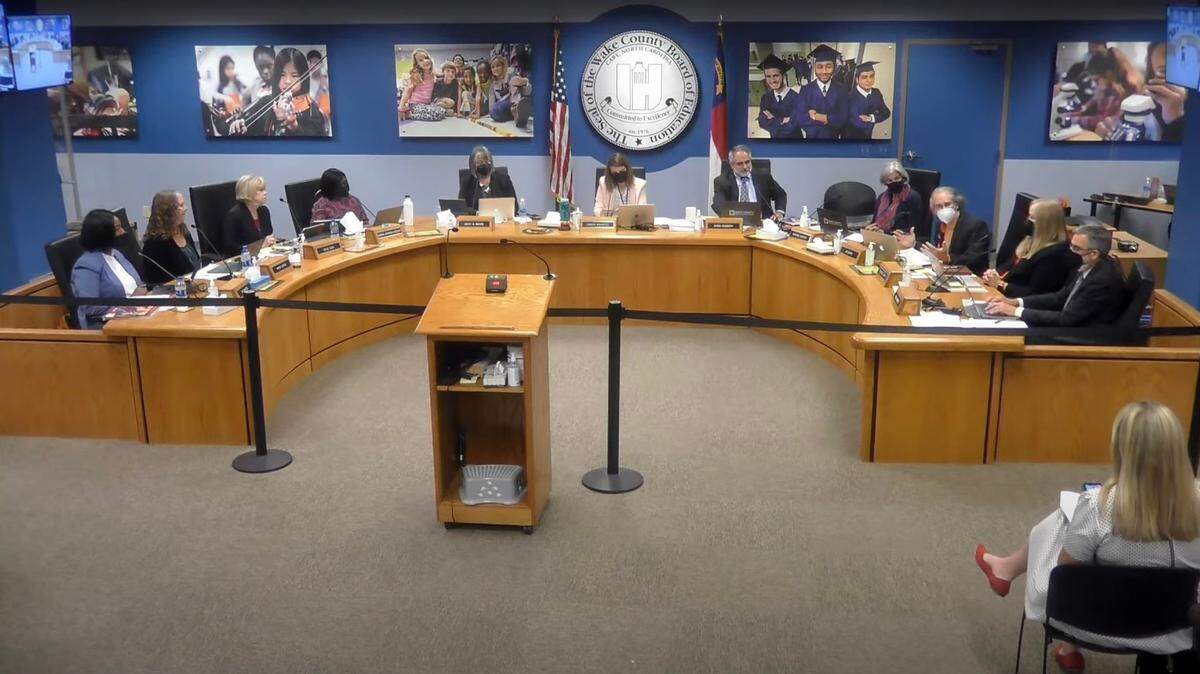
Departing members of the Wake County school board urged their successors to continue the board’s work as they gave final approval Wednesday to a long-debated equity policy.
In an emotional final regular meeting for five of the nine board members, several members said their colleagues need to keep up the job of fighting for public education. The board isn’t expected to undergo any major philosophical changes after conservative candidates won two of the nine seats in last week’s election.
“This was a tough race to watch from the sidelines because I think there was so much negativity and false narratives,” said departing board member Christine Kushner. “I’ve never seen that in a school board race before. I’m grateful that voters for the most part rejected it and returned a sound board for the students.”
‘Like a family’
The board is losing its most experienced members after Kushner, Karen Carter, Roxie Cash, Jim Martin and Heather Scott decided not to run for reelection. The other four board members won their seats last week, with Monika Johnson-Hostler. who was first elected in 2013, becoming the senior member.
Scott was elected in 2018.
Kushner and Martin both joined the board in 2011 when their election reversed a Republican majority that had led the district for two years. The board is officially non-partisan but has maintained a Democratic majority since 2011.
Cash had served on the board from 1991 to 1999 before being elected again in 2016. Both Cash and Carter, who was elected in 2020, were the only two Republican members on the board but had sided with their colleagues on many issues.
“Sometimes we disagreed on things and sometimes we agreed on things, but I always felt like we worked really hard to listen and to talk and to compromise when we could,” Cash said. “One of the things that I’m going to miss is we’re like a family here.”
‘Applying an equity lens’
In one of their final actions, the outgoing board members helped to unanimously pass an equity policy that calls for addressing disparities, reflecting on biases and recognizing the voices of marginalized groups. The board had given initial approval to the policy a week before the election.
The new policy defines equity as “the elimination of predictability and disproportionality of outcomes based on student characteristics.”
Examples of student characteristics are race, ethnicity, socioeconomic status, language of origin, disability, sex, gender identity and sexual orientation.
The policy calls for “applying an equity lens,” which means asking teachers and other school employees to reflect on whether any of their practices and biases negatively impact students.
School employees are asked in the policy to reflect on how they can “interrupt inequity” and in what ways do they “affirm” the “lived experiences, culture and identities” of students.
‘How will we live it’
The policy says Wake will take steps such as:
▪ Identifying and providing high-quality instructional materials and methods that “represent the rich diversity of our nation, respect the legitimacy of different cultures, and empower students to value diverse perspectives.”
▪ Recruiting and retaining racially and linguistically diverse and culturally competent administrative, instructional and support personnel.
▪ Eliminating practices that lead to the over- or under-representation of any student group compared to peers in areas such as special education, student discipline, academically or intellectually gifted programs, advanced coursework and Advanced Placement courses.
Martin said he’s excited about the new equity policy but Wake needs to make sure it comes alive “off the paper.” He said his deepest regret is that the district is more racially and economically segregated now than when he joined the board.
“How will we live it in terms of how we treat each other and how we look at our facilities?” Martin said. “How about the courses we teach or the teachers teaching them? Are we going to make the kids at a school that doesn’t have as many AP offerings just take AP offerings online?”