Are UNC trustees influencing admissions? Updates on applicants are just a text away

When a typical student applies to UNC-Chapel Hill, they might submit their application and go months without hearing an update from the university.
But for applicants who have ties to members of the university’s Board of Trustees, updates about admission are more readily available — just a text message away in some cases.
Records obtained and reviewed by The News & Observer through a public records request show that some of the university’s 15 trustees routinely messaged university officials over the 2023-24 admissions cycle, asking for updates on prospective students’ application and admission status — including whether applicants might be admitted off the waitlist.
The messages, which span more than 100 pages of screenshots, are heavily redacted, with the names and identities of applicants obscured. That makes it unclear how many separate students, exactly, the trustees inquired about or how many times they inquired about a single applicant. It also generally makes the prospective students’ relationships to the trustees unclear, though in some cases the trustees appeared to inquire on behalf of a friend or other acquaintance.
The messages reviewed by The N&O do not appear to include any language in which a trustee explicitly directed officials to admit a student. In some cases, though, the trustees appeared to weigh in with their perceptions of the students and their academic record or athletic accomplishments.
The trustees’ communication with administrators during the admissions process could raise questions about whether the trustees are unduly influencing officials’ decisions — even if they do not intend to do so — or otherwise getting involved in the process in an unauthorized way.
But the communications could also represent some board members’ growing frustration with the length of time it takes for students on the waitlist to receive a decision about their admission.
Trustee Ramsey White, whose communications with a top university development official about the waitlist were included in the messages, pointed to a growing number of applications received by the university and the impact it had on the admissions office as a concern in comments to The N&O.
UNC Board of Trustees Chair John Preyer, whom the messages show making inquiries about applicants this spring, declined to comment. Two other trustees contacted by The N&O — Jennifer Lloyd and Rob Bryan, whose messages with administrators are referenced in this story — did not respond to requests for comment.
In a statement, UNC spokesperson Kevin Best said the university “is committed to a rigorous and comprehensive admissions process that is based on integrity, fairness and opportunity for all student applicants.”
Possible ‘appearance of impropriety’
At universities across the country, including at UNC-Chapel Hill and others in the public UNC System, trustees are generally tasked with overseeing broad, high-level decisions at the university. In the UNC System, trustees are expected to serve as advisers to the university’s chancellor, but are not authorized to direct “matters of administration,” as system President Peter Hans reminded the UNC trustees in a memo earlier this year.
UNC is a member of the Association of Governing Boards of Universities and Colleges (AGB), a national organization that provides guidance on board governance, according to the organization’s membership database.
When it comes to admissions, AGB President Fram Virjee told The News & Observer, the roles of trustees should include “providing oversight for admissions and ensuring that the admissions process works properly,” among other tasks. Those roles should not include “getting involved in the day-to-day operations of admissions, and definitely not reviewing individual admissions decisions,” Virjee said.
“The board has to balance their fiduciary responsibilities with the need to maintain that independence of the admissions process,” Virjee said.
Trustees at any university getting involved with admissions beyond high-level decisions about the process, including by regularly inquiring about an applicant’s status, Virjee said, could create an “appearance of impropriety.”
There is “room for overreach” when trustees get involved in admissions, Virjee said.
“And that overreach occurs when a trustee or board member tries to influence an individual admission decision or interfere in established admission processes,” he said.
But there are some roles trustees can play in the admissions process that are acceptable, Virjee noted.
Letters of recommendation from trustees
Virjee, who previously served as president of California State University, Fullerton, and general counsel for the CSU System, said it’s not uncommon for trustees to submit letters of recommendation for prospective students — which many universities require as part of the application and admissions process. That’s not unlike an elected official or other dignitary writing a letter for a student, Virjee said.
“It’s going to be considered in the same way that a letter of reference for anybody else is,” Virjee said. “Does it matter that it comes from a trustee? I would think it probably does. It carries heavier weight, just like if it came from a U.S. senator or the president of the United States, it would carry heavier weight.”
Roger Perry, who served on the UNC Board of Trustees from 2002 to 2010 and was the board’s chair for two years during that time, told The N&O it was an acceptable practice to submit letters on behalf of applicants when he was on the board, particularly if a trustee knew the student well.
“You advocated and let the admissions committee know that — no different than any other person who often does that — that you were interested in this student and thought that they perhaps would be a good fit for Carolina,” Perry said.
Perry is a co-founder of the Coalition for Carolina, which he helped form in the wake of the controversy surrounding whether the trustees would grant journalist Nikole Hannah-Jones tenure in 2021. Since that time, he has been outspoken about the current trustees’ actions, including what the coalition calls “partisan interference” and overreach.
Perry said that during his time on the board, he generally did not inquire about applicants beyond submitting those letters, believing that doing so could be seen as “coercive” or put “undue pressure” on admissions officials. He acknowledged that trustees would sometimes receive advance notice that admissions decisions were going to be released on a certain date or at a certain time — though he said it generally was never more than 15 minutes or so beforehand.
“That was pretty much the only feedback you would get,” Perry said. “You might get a short heads-up on whether or not they had been admitted.”
In his statement, Best, the university spokesperson, said the admissions office “carefully reviews the full range of an applicant’s qualifications before determining whether to admit them to Carolina, including academic achievement, curiosity and creativity; leadership, kindness and courage; honesty and perseverance.”
Best added that anyone can submit a letter on behalf of a prospective student through the university’s supplemental recommendation form, which “become part of candidates’ files and are assessed as other recommendations are assessed,” according to the landing page where the letters are submitted.
“There is no single factor that determines an applicant’s admission, including an endorsement or reference from someone connected to the University,” the statement said.
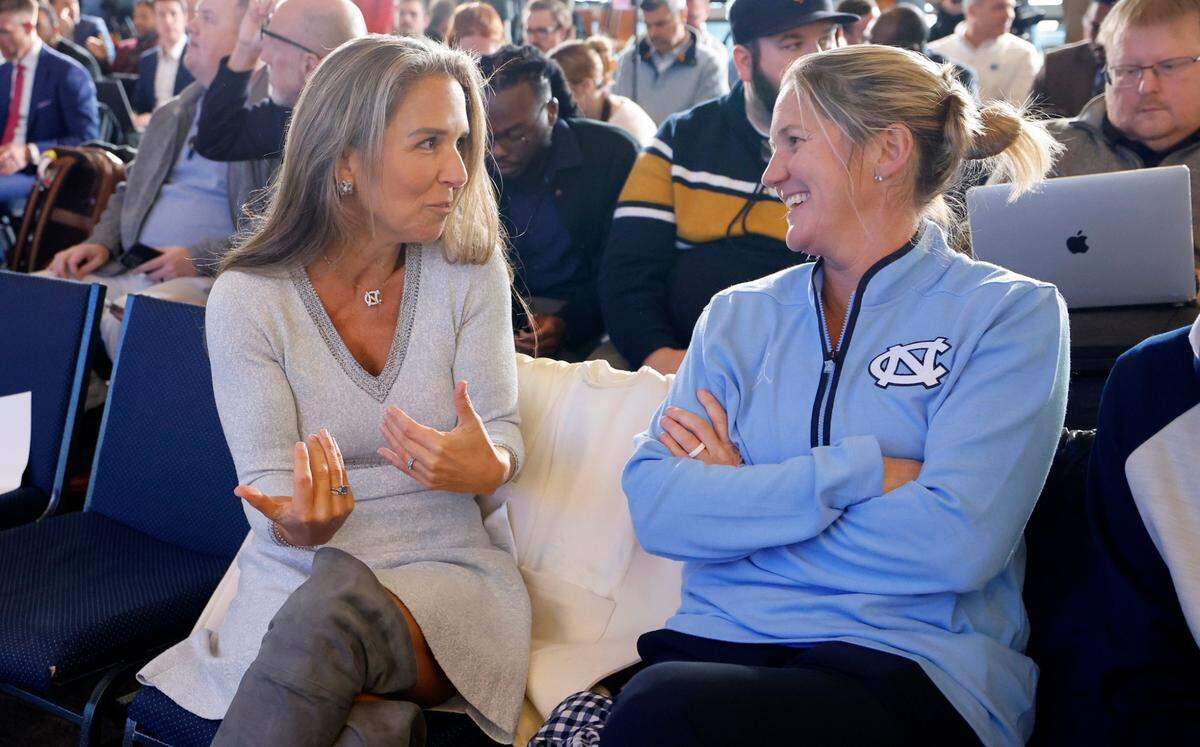
At least one trustee, Jennifer Lloyd, wrote a letter of recommendation for a student and submitted it through the official channel for doing so, according to the messages obtained by The N&O. In an undated message to Jen Bowman, associate vice chancellor in the Office of University Development, Lloyd mentioned the letter and appeared to say the student was a “total superstar.”
In an undated message to Preyer, the board chair, Lloyd appeared to recount receiving instructions from admissions staff about what to include — or not — in letters of recommendation.
“Don’t talk about how great their families are or their potential as donors. Talk about the kid and why he should be admitted,” Lloyd wrote to Preyer.
In her next text to Preyer, which appeared to be sent soon after her initial message to him, she added: “Advocate. Don’t expect favors.”
Trustees receive frequent updates from officials
Most of the trustees who made inquiries about applicants did so to Chris McClure, a senior adviser to Chancellor Lee Roberts who is also the Board of Trustees’ secretary. White told The N&O that “all trustees are told to refer any question on admissions” to McClure. It is unclear from the messages obtained by The N&O whether McClure then referred trustees to other officials with their questions.
At least one trustee communicated with Rachelle Feldman, the top university official overseeing admissions and enrollment, and at least two trustees, including Lloyd, communicated with either of the top officials overseeing university fundraising — Bowman and Vice Chancellor Michael Andreasen. (It is unclear what role development officials are authorized to play in the admissions process.)
Best said in his statement that “there is no written policy outlining how anyone may contact the administration regarding admissions.”
“Board members are given a presentation at orientation about admissions and information is shared verbally on how to connect with administration about admissions candidates,” Best said. “In practice, it is common for board members to seek guidance from designees of the chancellor about admissions and other questions.”
Several of the trustees who made inquiries about applicants did so multiple times over the admissions cycle.
Virjee said, from his experience, trustees checking on the status of a student’s application is “not uncommon at all.” But “checking in directly with an admissions officer would create important ethical considerations,” as would checking in frequently or on behalf of multiple students in a single admissions cycle, he said.
In the same undated message exchange to Bowman in which Lloyd mentioned writing a letter of recommendation, Lloyd asked if Bowman would add the student to Bowman’s “tracking.”
Lloyd then asked for and received updates throughout the admissions process, with the inquiries stretching from late February to mid-June. (Because many of the messages are heavily redacted, it is sometimes unclear whether Lloyd was inquiring about a student’s application or another issue at the university.) At one point, Lloyd appeared to provide information to Bowman about a student athlete who was seeking admission.
In some messages, Lloyd and Bowman spoke about the admissions waitlist, which gives some applicants an opportunity to be admitted to the university if spaces in the enrolling class become available.
The university typically offers spots on the waitlist to a few thousand applicants each year, but offers admission to only a small percentage of those students. Students are not ranked on the waitlist, according to the Office of Undergraduate Admissions.
The waitlist and applicants’ status on it appear to be the most common themes in trustees’ inquiries.
For instance, the head of the Office of University Development, Andreasen, frequently exchanged messages with White between late January and mid-May, with the pair appearing to communicate about the status of a student who was placed on the waitlist after applying for admission. In a March 19 message to White, Andreasen said he had “arranged” a “personalized approach,” though it is unclear if that message is about the same student White initially inquired about in January.
The approach “starts with a specific issue that needs to be resolved before discussing alternative first year options,” Andreasen wrote to White. “This is going to take a few steps. But the plan is in motion.”
Best did not answer a question from The N&O about the “personalized approach” Andreasen was referencing. White declined to comment on her communications with Andreasen to The N&O.
Preyer also made frequent inquiries about the waitlist.
On March 18, Preyer wrote to McClure, the board secretary, asking for a “status report” on two applicants, including one on the waitlist.
On April 4, Preyer and McClure exchanged messages about a student, whom McClure said was on the waitlist and was in the “middle of the pack from [redacted].” Preyer responded that it was “hard” to see the student as “middle of pack unless there is a bunch of Asians there.”
On May 8, Preyer again wrote to McClure about a student on the waitlist. In the same message, he later wrote “I would like to see [redacted] in.”
“This is a good [redacted] who’d be good for lots of programs at UNC,” Preyer wrote.
It is unclear, exactly, if Preyer was advocating for a student to be accepted off the waitlist, due to the redacted portions of the message.
While many messages about the waitlist are from the spring, some stretch into June.
Students who are not placed on the waitlist are generally required to decline or accept their offer and pay a deposit to enroll by May 1 each year, though last cycle the deadline was extended to May 15 due to technical glitches and delays with the Free Application for Federal Student Aid, or FAFSA. The university states that it will notify students on the waitlist of their final admissions decisions no later than June 30 each year.
On June 24, McClure informed Preyer that there had been “no movement” on the waitlist and that “no one was moved off transfer waitlist.” Preyer responded: “That’s it — no [expletive] off or go to hell?” McClure responded by saying “no” and reiterating the earlier point about the transfer waitlist.
“Those names of course were good candidates had the wait list opened up,” McClure wrote.
Communicating with head of enrollment
One board member, Rob Bryan, communicated directly with Feldman, the university’s vice provost for enrollment who oversees divisions that include the Office of Undergraduate Admissions, about the waitlist — doing so at least four times in the messages obtained by The N&O. Bryan also communicated with McClure about an “admissions check,” among other exchanges.
“Another waitlist kid to ask about,” Bryan wrote to Feldman in late April.
Replying to a separate undated and completely redacted message from Bryan, Feldman informed him: “It will be awhile before we go to waitlist but will flag [redacted]. That gpa is pretty low in our pool.”
Bryan responded: “That’s what I figured.”
Virjee said it is generally not a best practice for trustees to communicate about admissions directly with the officials who oversee the process.
Instead, he suggested that it is a better idea for trustees with concerns or inquiries to go directly to the university’s chancellor or president, which can help avoid the appearance that a trustee is trying to “exert pressure or create undue influence” on an employee lower in the university’s reporting structure. From his own experience as a university president, Virjee recounted that he would sometimes take the inquiries trustees had made to him to admissions officials himself.
“I would try to avoid letting them know who wants to know, so there’s not any undue influence, but still provide the information if I can,” Virjee said.
The records provided to The N&O did not include any messages to or from Roberts, the UNC chancellor, nor his predecessor, Kevin Guskiewicz, despite both men being included in The N&O’s request for communications. That could mean such texts do not exist or they were not subject to disclosure under state public records law.
Best told The N&O Feldman and McClure were not available for interviews.
Applications to UNC continue to increase
The trustees’ communications about admissions come at a time when it is increasingly competitive to be admitted to UNC, the state’s flagship university and one of the country’s leading public universities.
From students applying to become Tar Heels this fall, the university received more than 73,000 applications, an increase of more than 15% over the previous cycle.
White pointed to the volume of applications as a potential reason it took so long to clear the waitlist.
“The admissions office was overwhelmed with the increase in applications and number of applicants put on the waitlist,” she said.
The university enrolled 4,641 first year students and 983 transfer students this fall, the first class in decades to be admitted without students’ race being considered in the process, due to a landmark U.S. Supreme Court ruling involving UNC that prohibited the practice. The class saw a noticeable drop in the proportion of Black students compared to the previous year, though Feldman cautioned in September that it was “too soon to see trends with just one year of data.”
Roberts told the university’s Faculty Council in remarks last week that applications so far this year are up by about 16% compared to last year, and up by about 30% over the past two years.
The trustees in recent months have also spoken about their opinions on the current admissions process, including whether standardized test scores or essays should be considered. Preyer, for instance, said at a September board meeting that he did not think the university’s admissions staff should continue to read every applicant’s essay, as is currently the case, because of the “angst” it can cause some students.
“My suggestion would be, do away with the essay,” he said at the time. “And if there is somebody who’s waitlisted and you want to see whether or not they can write a coherent essay, then maybe ask them to do it.”
Feldman replied to Preyer at the time: “Suggestion noted.”
Since 2020, students were given the option to submit test scores, but were not required to do so, under a COVID-19 waiver from the UNC System Board of Governors. Under a policy change that board approved this spring, applicants with GPAs below a certain threshold will be required to submit scores, beginning next fall.
Meanwhile, UNC is also considering a proposal from a working group, formed by Roberts, that would see enrollment grow by 5,000 undergraduates over the next five years, equally divided among in-state and out-of-state students, and see the proportion of out-of-state students allowed in each incoming class increase from 18% to 25%.
This story was originally published December 19, 2024 at 10:25 AM.