UNC basketball player Zayden High suspended for sexual misconduct, kept team perks
UNC-Chapel Hill suspended men’s basketball player Zayden High from the university last semester after finding he violated the campus policy on sexual exploitation, according to documents and correspondence reviewed by The News & Observer and interviews of those involved in the case.
High filmed another student without the student’s consent during a sexual encounter between them last year, the student told The N&O. The N&O confirmed the student’s account of the incident through additional interviews with five people who had knowledge of the situation.
The student felt “validated” and “relieved” when UNC’s Equal Opportunity and Compliance Office found High responsible for violating the university’s policy on sexual misconduct in late August, she told The N&O.
“Not that it made my pain from what happened go away, but it did make me feel like he was being held accountable,” the student said.
But in the months since the university issued the findings, the student said she has become increasingly concerned that the university has not ensured that High adequately followed the sanctions imposed upon him.
After serving a one-semester suspension in the fall — in which he was not allowed to be enrolled as a student at the university or participate in athletics — High reenrolled at the university this spring while remaining on probation for at least the duration of the semester. Per the terms of the sanctions issued to High by the EOC office for his misconduct, he is barred from representing the university in any way, including by participating in athletics, while on probation.
But during the probationary period, High has retained several perks that accompany being an athlete at the university, according to university correspondence about the issue reviewed by The N&O. That includes access to athletic facilities, where High has been allowed to practice on his own and receive athlete meals and other services. High was also around several members of the basketball team on the court of the Dean E. Smith Center on at least one occasion while he was on probation, according to video evidence reviewed by The N&O.
“It’s extremely frustrating, to say the least,” the student said.
The N&O is not identifying the student, adhering to her wishes and the paper’s longstanding practice of not making public the names of victims of sexual misconduct. The N&O is also shielding the identities of most sources who corroborated the student’s story in order to avoid the student inadvertently being identified through her relationships with those people.
The student did not press criminal charges against High, choosing instead to report the incident to the EOC office in an effort to retain her privacy, given that her identity may have become public through a police report or other legal documents.
Lawyer for High did not respond
Spokespeople for the university and the athletic department did not answer questions from The N&O about the investigation into High, instead providing one-sentence statements. The university also provided answers to general questions about standard rules for disciplinary procedures and processes involving students.
Under a 2020 state Supreme Court ruling against UNC, public universities in North Carolina are required — if such information is requested — to release the names of students who are found to have violated university policies on sexual misconduct, as well as the violation the student committed and any sanctions imposed by the university on that student.
A lawyer who represented media outlets, including the Daily Tar Heel and McClatchy newspapers, in the case said High’s records would likely be subject to disclosure under that ruling.
But the university denied The N&O’s request for the documents related to the investigation into High’s misconduct, citing the state public records act and the Federal Educational Rights and Privacy Act, or FERPA. The university said in a statement it complies with the 2020 ruling, but did not explain why High’s records would not be subject to disclosure under the ruling.
“We fully comply with federal privacy law and the 2020 North Carolina Supreme Court case DTH vs. Folt when sharing information about whether any student is subject to an academic or disciplinary process,” a statement from the university to The N&O read.
The unnamed student’s lawyer provided The N&O with key portions of the final notice of the investigation’s findings. While that notice does not specifically name High, additional documentation and correspondence viewed by The N&O, as well as interviews about the situation, confirm that High was the unnamed “responding party” referenced in the document.
Sam Coleman, a Hillsborough attorney who represented High during the EOC proceedings, did not respond to multiple phone calls and text messages from The N&O over a weeklong period.
High filmed sexual encounter
Both the unnamed student and High were in their first year at UNC at the time High filmed the sexual encounter.
The student said she connected with High on Snapchat at some point during the fall 2023 semester, and the two would periodically message. At times, the student said, High asked the student to come to his dorm room.
The student declined to do so until the night of Jan. 25, 2024, when she agreed to meet him in his room, she said. One friend of the student’s confirmed the student went to High’s room that night, telling The N&O that he walked the student to the residence hall and knew the student was meeting up with High. Another friend, one of the student’s hallmates in her dorm, also confirmed she knew the student had planned to meet up with High that night, saying the student had texted her about her plans.
That night marked the first time High and the student met in person, though they had seen each other in passing on campus on one previous occasion, the student said. The student’s friend, her hallmate and her mother confirmed they knew she and High had been communicating prior to that night.
At some point during the encounter between the student and High, which continued into the early hours of Jan. 26, “I noticed his phone, and I stopped us from what we were doing,” the student said.
High initially denied filming the student, she said. But after asking High to open Snapchat on his phone, she saw the video he had filmed and deleted it from the app herself, she said.
“It became very clear that he had filmed me without my knowledge, without my consent, or just without any warning,” the student said.
The student then asked High to show her additional locations on his phone where the video might have been saved, like the camera roll. She confirmed — to the best of her knowledge — that no additional copies existed.
The student left High’s room in tears, she said.
The student’s friend and hallmate confirmed the student’s account, based on information the student provided them when she confided in them about the incident. The student spoke to the hallmate immediately after the student returned to her dorm following the incident. Later on the morning of Jan. 26, the student told the other friend what had occurred between her and High.
The student also provided The N&O with a photo of Snapchat messages High sent her on Jan. 26. She told The N&O she messaged High after leaving his room to again confirm he had deleted the video, and the messages appear to show High affirming that he had done so. (The photo does not include the student’s messages to High.)
“i apologize,” read one message from High to the student.
“i’m sorry. i deleted it i promise,” read another.
Later on Jan. 26, a Friday, the student’s mother picked her up from campus and the student told her about the incident, naming High, the mother told The N&O. The student’s friend witnessed the conversation between the student and her mother and confirmed their accounts of the exchange.
“My heart kind of sank,” the student’s mother recalled thinking after the student told her what happened. “She was still very traumatized.”
The student stayed at her parents’ home for the rest of the weekend before returning to campus on Monday, Jan. 29.
EOC finds High responsible for sexual exploitation
Within days of returning to campus, the student decided to report the filming incident to the EOC. In doing so, she hoped to hold High accountable for his actions, but protect her identity — particularly given that High’s membership on the university’s basketball team could have led to a police report or other legal proceedings against him garnering significant attention from the media and public.
“I wanted to control my privacy, especially after that incident, because my privacy was violated,” the student told The N&O.
The EOC opened an investigation, interviewing the student, her hallmate and friend, as well as High and witnesses who spoke to his account of the incident. The student said transcripts she reviewed of High’s interview showed he contradicted her version of the events at multiple points, but she provided additional evidence to investigators that further supported her account. In a statement to investigators, she expressed concerns about High’s testimony.
Based on the investigation, officialseventually found High responsible for sexual exploitation — a violation of the university’s broader policy on prohibited discrimination, harassment and related misconduct.
Per the policy, sexual exploitation can include the “non-consensual creation, distribution, or streaming of images, photography, video, or audio recording of Sexual Contact or nudity.”
The student and Skye David, the student’s attorney, told The N&O that High appealed the sanctions twice. Both appeals were unsuccessful, and the EOC’s recommended sanctions stood.
On Aug. 26, 2024, the EOC issued its final noticeof the investigation, which included several sanctions, beginning with an “indefinite” suspension of at least one “full” semester, during which High could not be enrolled as a student at the university. (Classes for the fall semester had been in session for a week at the time of the EOC’s final notice, making it unclear whether the EOC enforced the stipulation that High serve a “full” semester suspension.)
The sanctions indicated that High could choose to enroll again after his suspension, assuming he fulfilled his sanctions and his application for readmission was approved.
“Disciplinary suspension terminates the Responding Party’s relationship with the University under conditions that both permit and anticipate his return to the University,” the notice read.
If High reenrolled at the university, according to the notice, he would be required to remain under probation for at least one additional semester.
While on probation, High would be banned from “participating in any activity in which [he] represents the University, including athletics or other competitive teams, and from participating in any University-recognized student organizations either within or outside the University community,” per the EOC’s notice.
High was also required to satisfy an “educational requirement,” in which he was to complete “an approved course of instruction or counseling that addresses consent, sexual exploitation, and healthy relationships,” and meet with an EOC official to discuss the university’s policy on discrimination and harassment, among other mandates. His sanctions also required him to “permanently delete” any recordings or photos of the student on his phone or other devices.
High described as ‘not enrolled,’ not ‘suspended’
One day after the notice was finalized, the basketball team announced in a news release on Aug. 27 that High was “not enrolled at the University of North Carolina,” providing no reason for the change.
The team’s description of High’s status raised questions from the student and her attorney, David.
“I just thought that was a weird way to phrase it, because it makes it sound like he was deciding to take some time off and it was his decision, when in reality, he was suspended and he had to serve that suspension,” the student told The N&O.
David, a staff attorney with the North Carolina Coalition Against Sexual Assault who has represented survivors of sexual misconduct across the UNC System and private universities, said the description was a “red flag.” David said university officials told her that it was against university policy for the university to announce that an athlete or other student was “suspended.”
The university told The N&O that “federal privacy law generally prohibits the University from commenting on student discipline matters, which would include indicating whether a student has been suspended or subject to other sanctions.”
But there is precedent for the university and its athletic department describing students as being suspended, as opposed to them simply being unenrolled.
In 2018, for instance, the university suspended basketball player Jalek Felton for initially undisclosed reasons, which were later discovered through public records to be violations of the university’s policies on sexual assault and sexual violence. A press release from the athletic department read that Felton had “been suspended from the University and therefore is not currently eligible to participate in any University activities.”
Also in 2018, the university identified 13 football players as “suspended” for selling school-issued sneakers, though the sanctions applied only to games and not the students’ academic studies. Last year, a UNC wrestler was “suspended” from the team after he punched another student, another case of a student facing athletic sanctions but remaining enrolled at the university.
Beyond the public description of High’s status at the university, though, the student would soon come to have deeper concerns about how the sanctions against High were interpreted and enforced at the university.
High retained access to athletic facilities, perks
The student said EOC officials informed her last fall, around Thanksgiving, that High was seeking to reenroll at the university. Shortly before the first day of the spring semester on Jan. 8, EOC officials informed the student High would be resuming classes, she said.
Two sports media outlets published stories on Jan. 10, two days after classes began for the spring semester, reporting that High had reenrolled at the university — and that he apparently had access to the court of the Smith Center during the fall semester, while he had still been suspended.
Tar Heel Illustrated, a UNC-specific site of Rivals.com, cited an unnamed “spokesperson for the program” in its report and wrote that “High has been in Chapel Hill and regularly working out at the Smith Center on his own.” The report noted that the outlet had previously reported on High’s access to the Smith Center in December.
“He has access to the facilities but not when the Tar Heels are present,” the January article read. “His work must be done alone.”
Similarly, Inside Carolina reported that High had “worked out on his own” on the court of the Smith Center following the basketball team’s home game against Georgia Tech. That game, held Dec. 7, was three days after the final day of classes for the fall semester at the university, but before final exams had concluded.
Spokespeople for the university did not answer a question from The N&O about what the university considers to be the end of the semester — the last day of classes, the end of exams or another date.
Further, per the Inside Carolina report, High had “maintained access to the Smith Center, and had a presence around the building,” though the story did not offer an exact timeframe of High doing so.
The student’s father saw the Inside Carolina story shortly after it was published, he told The N&O. The report unsettled him, given that he knew High had been suspended in December and remained on probation at the time the story was published.
The father informed the student and her mother of the story. The next day, on Jan. 11, David emailed an EOC official to express concerns about the reports and the narratives they included about High being allowed access to the Smith Center.
“I would assume that being suspended meant that he would not have access to team facilities — am I wrong about that?” David wrote to Rebecca Gibson, director of report and response in the EOC office.
On Jan. 22, Gibson responded to David and the student, writing she had confirmed with Elizabeth Hall, the associate vice chancellor overseeing the EOC office, that “while on probation Zayden is not permitted to play, practice, or travel with the team, but he is permitted to use Athletics facilities to work out on his own, to receive services, and for meals.”
That was the first time the student or David were made aware of the university’s apparent interpretation of the terms of High’s probationary sanction, they said. The interpretation raised questions for them about how it could align with the sanction, which said High could not participate in athletics.
The university told The N&O that students who are disciplined by the university are “provided information about the terms of the sanction applicable to them.”
In her Jan. 22 email, Gibson did not specifically address the reports that High was in the Smith Center while he was suspended, or whether the EOC office believed that might be a violation of his sanctions, only saying that the office would “look into those concerns and address with Zayden if necessary.” Gibson said in her email that she would “not be able to share specific details” about those communications with High, if they occurred, with the student or David.
Spokespeople for the university and athletics did not answer questions from The N&O about whether non-students or students who are not part of athletic teams are generally allowed access to the Smith Center or other athletic facilities.
A spokesperson for the athletic department wrote in a statement to The N&O: “Zayden High did not play with, travel with or participate in any official practice with the team during the 2024-25 season.”
Gibson concluded her email by noting that the student or David “may continue to see articles like those you sent to us, which I understand is upsetting and frustrating.”
“As I’ve mentioned to you, neither UNC nor EOC are able to control what the media says,” Gibson wrote. “We are not able to require Zayden or anyone else to provide information to the media about the EOC process.”
High seen around players on Smith Center video
Weeks after receiving that interpretation of High’s sanctions from the EOC, the student encountered another instance that she believes represents a violation of High’s probation.
While she was attending the Tar Heels’ home game against NC State on Feb. 19, the student saw High in a video played on the screens of the Smith Center. Attending the team’s home game against Miami on March 1, she saw the video again — and recorded it.
The student provided the recording to The N&O.
In the video, filmed on the court of the Smith Center, UNC basketball players spoke to the camera, one by one, to answer the question: “What’s your happy place?”
A few seconds into the video, High can be seen, for approximately five seconds, on the left side of the video shooting a basketball, while another player is answering the question directly to the camera. High appears to be wearing a shirt referencing UNC basketball while on the court.Additional players can be seen in the background of the video for the duration of the roughly 30-second clip, shooting hoops.
The student’s friend, who was with her when she initially told her mother about the filming incident, was with the student at both games and witnessed her reaction.
The student texted her parents about the video. Her mother noted to The N&O that the student had chosen to attend basketball games this semester under the assumption that she would not see High.
“She’s going to the games this year because she knows he’s not playing, knows he’s not going to be sitting there on the bench,” the student’s mother said.
The student, David and the student’s parents met with the EOC about the video and other concerns about High’s sanctions on March 31. According to David’s notes from the meeting, Gibson, the EOC official, confirmed the video was filmed after a team practice during the spring semester.
Per NCAA rules,players are allowed to spend 20 hours per week during their sport’s season on “countable athletically related activities,” including official practices.
Gibson said during the March 31 meeting that athletic officials reviewed the footage and determined High was not coached by the basketball team staff during the practice, according to David’s notes. Further, Gibson said High was not representing the team in the video, David’s notes show.
The student’s father asked Gibson whether it was the EOC’s position that High had not violated his sanctions. According to David’s notes, Gibson replied: “That’s correct.”
The student’s mother read a statement during the meeting, expressing her frustration with the EOC’s apparent interpretation of High’s sanctions.
“Ever since he has been found responsible, there have been loopholes, privileges and an irresponsible lack of oversight allowing him to exploit and take advantage — the exact opposite of what he should have been learning,” the mother said, according to a copy of the statement she provided to The N&O.
She continued: “No reasonable person would have read the sanctions and thought he would still be given athletic privileges.”
The student said incidents like discovering the reports of High working out in the Smith Center and seeing him on the video boards made her feel “like I’m almost doing the EOC’s job for them.”
It is unclear whether the EOC or the athletic department assigns someone to monitor athletes while they serve their suspensions and complete their additional sanctions.
“Consistent with federal privacy law, school officials may be provided information about specific students if they have a legitimate educational interest in the information, that is, information necessary to fulfill their assigned duties to the University,” the university told The N&O.
The university also said any “possible violations of sanctions can be brought forward to the office that issued the sanctions.” The university did not answer a question about what course of action officials take if they believe a student has violated their sanctions.
High seeking to return to team
During the March 31 meeting, Gibson also informed the student that High had submitted his petition to return to “good standing” at the university and return to the basketball team, according to David’s notes. The student has not been informed of the final outcome of that process, she said.
“The University assures that students have completed any sanctions imposed through the University’s disciplinary processes prior to the student’s reinstatement to good standing,” the university told The N&O.
Citing multiple unnamed sources, Tar Heel Illustrated reported on April 23 that High “will be back in the program after the spring semester ends in early May.” Referring to High as “suspended,” the publication again asserted that High maintained access to the university’s athletic facilities throughout the fall and spring semesters, though he “was not part of the team in any capacity.”
Also citing unnamed sources, Inside Carolina on Wednesday reported that “the expectation is for High to return to the team.”
High, a 6-foot-9 power forward from Spring Branch, Texas, was a four-star recruit in the Class of 2023. He joined UNC as a scholarship player, quickly making an impression as a promising player and enthusiastic bench presence.
In his freshman season (2023-24), he added depth to the post and played in 23 games. High didn’t make a major impact on the court — recording a season-high four points in the ACC quarterfinals against Florida State and regular-season-high three points against Clemson — but was often praised by coaches and teammates for the intangibles he brought.
The high-ranking recruit often spoke up in huddles and was a go-to hype man. He was frequently entrusted with carrying the Tar Heels’ Bumpboxx speaker as the team made its way from the locker room to the court before games.
While High typically contributed in short spurts, he showed flashes of potential.
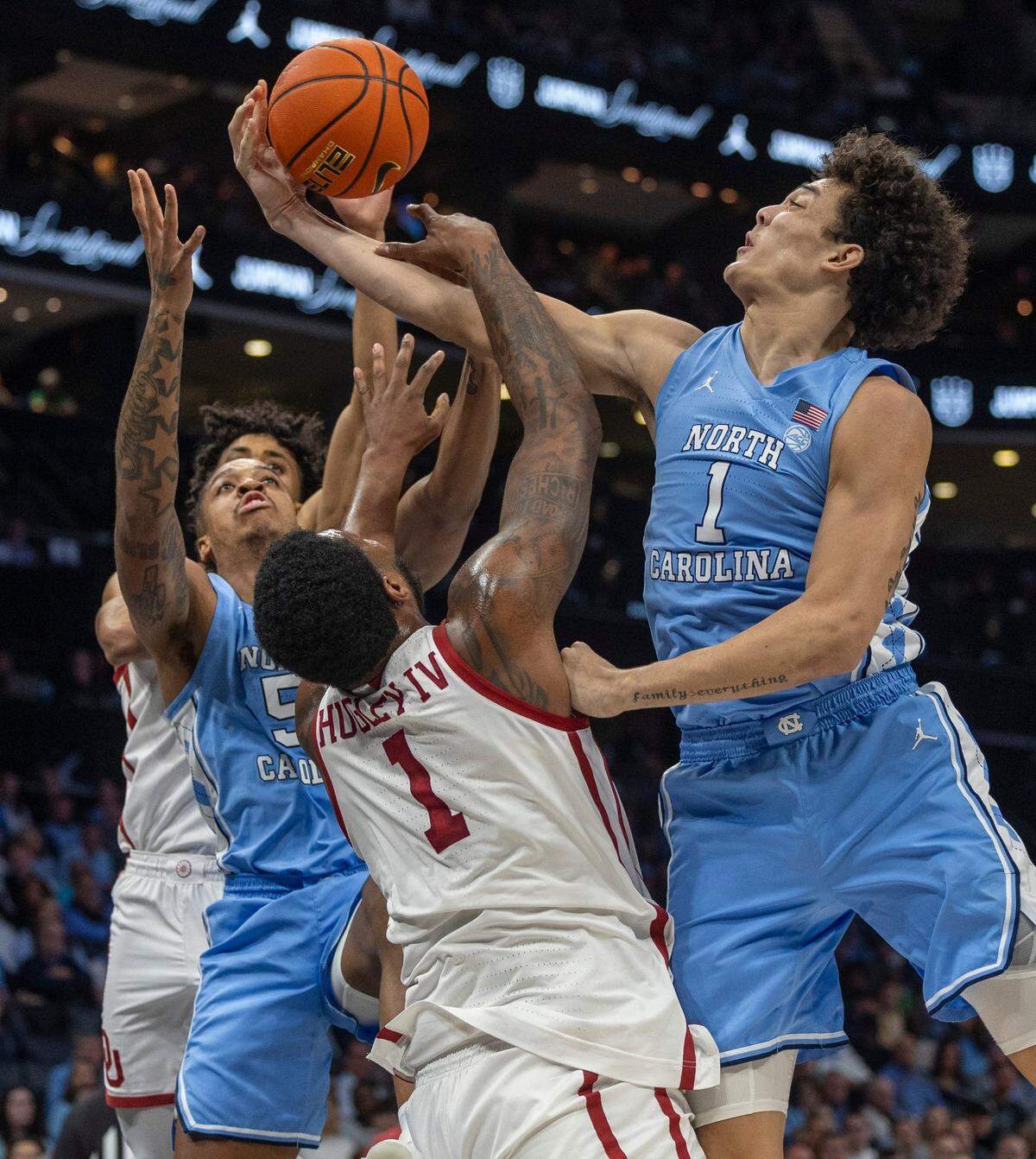
At the Jumpman Invitational in December 2023, High pulled down three rebounds and logged a season-high 12 minutes in a win over then-No. 7 Oklahoma.
“His number was called tonight, and he stepped up,” North Carolina coach Hubert Davis told the media after the contest in Charlotte. “It won’t show up huge on the box score, but a huge determining factor of us winning this game was him. … I wish there was a stat of how many balls he kept alive or almost got. He always attacked the offensive glass. He just does exactly what I ask him to do, and I was really proud of him.”
The student’s parents emphasized to The N&O that they recognize High’s sanctions allowed him a path back to the team, had he followed his sanctions — which they do not believe to be the case.
David told The N&O that she often sees clients feel let down by universities’ investigations into sexual misconduct. But in this case, the student “felt like the process worked for her” — until it didn’t.
“I think that’s what has been really, incredibly frustrating, because it felt like, for so many months, she went through this process to get to an end point, and when she got there, she thought, ‘Wow, the university responded in the correct way,’” David said. “They reviewed everything and made a determination. But then the university didn’t follow through on that determination.”
The student said she is “angry” with the university’s response to her concerns, and what she sees as a lack of accountability for High.
“It’s extremely disappointing to me that UNC and the EOC and athletics would excuse this behavior from anyone,” the student said. “They’re cutting corners for him.”
This story was originally published May 1, 2025 at 1:58 PM.