Trump administration targets Duke in latest clash with universities
Welcome to Dean’s List, a higher education newsletter from The News & Observer and me, Korie Dean.
The Trump administration’s historic clash against higher education has come to the Triangle: to Duke University and Duke Health, to be specific.
Last week, the administration hit Duke with multiple actions:
- First, U.S. Health Secretary Robert F. Kennedy Jr. and Education Secretary Linda McMahon sent a letter to top-ranking Duke officials, threatening to pull federal funding for Duke and its health system over alleged “illegal use of race preferences” in their policies.
- Then, the administration reportedly froze $108 million in federal funds designated for the university and Duke Health.
- And separately, the Department of Education opened a civil rights probe into the Duke Law Journal, citing a conservative news report that said the publication considered students’ race and ethnicity when selecting editors.
All of this came days after Duke announced it would begin making layoffs this month and after nearly 600 employees took voluntary buyouts — moves the university made amid already-increased threats and cuts to its federal funding for operations like research.
In this week’s newsletter, I’ll share more of our team’s reporting on the Trump vs. Duke clash. Also included:
- A dispatch from last week’s UNC-Chapel Hill Board of Trustees meetings;
- A look at upcoming budget cuts at UNC;
- A leadership change in the North Carolina Community College System;
- and more.
Here we go.
Trump administration targets Duke
The letter from McMahon and Kennedy to Duke officials — President Vincent Price, Board of Trustees Chair Adam Silver and School of Medicine dean Mary Klotman — did not include specific examples of alleged discrimination at the university or in the Duke Health system.
Instead, the secretaries said only that they were aware of “allegations” that the Duke School of Medicine “and other components of Duke Health are engaged in practices that, if true, would violate Titles VI of the Civil Rights Act and Section 1557 of the Affordable Care Act, and render Duke Health unfit for any further financial relationship with the federal government. These practices allegedly include illegal and wrongful racial preferences and discriminatory activity in recruitment, student admissions, scholarships and financial aid, mentoring and enrichment programs, hiring, promotion, and more.”
The letter continued by noting that both the health and education departments have “historically recognized Duke’s commitment to medical excellence and would prefer to partner with Duke to uncover and repair these problems, rather than terminate this relationship.”
As my colleague Brian Gordon reported, Duke receives a substantial amount of federal funding each year, its health system included. So far in 2025, the university has been awarded nearly $300 million from the National Institutes of Health, the most of any North Carolina institution. The school last year received more than $580 million from NIH.
To preserve the funding and Duke’s relationship with the federal government, McMahon and Kennedy requested the university “review all policies and practices at Duke Health for the illegal use of race preferences, take immediate action to reform all of those that unlawfully take account of race or ethnicity to bestow benefits or advantages, and provide clear and verifiable assurances to the government that Duke’s new policies will be implemented faithfully going forward — including by making all necessary organizational, leadership, and personnel changes to ensure the necessary reforms will be durable.”
To perform the review, the secretaries demanded the university form a “Merit and Civil Rights Committee,” which would act over the next six months and be made up of “members of Duke’s leadership and medical faculty most distinguished in and devoted to genuine excellence in the field of medicine.”
The letter gave Duke 10 business days to decide whether it will form the committee and 20 days to provide documents and information to the Office for Civil Rights within the federal Department of Health and Human Services.
Duke has not publicly responded to the letter or commented on the matter. A day after McMahon and Kennedy sent the letter, the federal government froze $108 million in funding for the university and health system, as reported by Fox News and CNN. The Duke Chronicle reported that the frozen funds are from the NIH.
What’s next? It’s not clear when, or if, the administration will release the funds to Duke — or what action the university might take in the process. Recent developments at Columbia University, which agreed to pay a $200 million fine to the federal government and settle multiple federal investigations, and Harvard University, which has sued the administration for freezing federal funds, could offer two possibilities.
Looking for more? You can read all of our coverage about this action against Duke, as well as the separate probe into the Duke Law Journal, in these stories:
- Trump administration threatens all Duke Health funding over alleged race policies
- Read the letter from DHHS accusing Duke University of racial discrimination
- Trump administration freezes $108M intended for Duke and Duke Health, reports say
- US Department of Education opens DEI probe into Duke Law Journal
- Anti-DEI group’s complaint against Duke in sync with Trump administration threats
- Not just Duke: Do No Harm targets campuses, others across the US
- Will the Trump administration use the Harvard and Columbia playbook on Duke?

UNC trustees talk tenure
While I enjoyed some time off last week in Western North Carolina, N&O intern Sophia Bailly attended two days of UNC-Chapel Hill Board of Trustees meetings in my place.
Among other agenda items, the trustees spent 90 minutes debating tenure — a discussion that came months after the board made headlines for delaying votes to confer tenure to dozens of faculty outside the health sciences.
Here’s more from the meeting in a dispatch from Sophia:
Interim Provost Jim Dean, who was appointed to the temporary role in May, outlined the tenure-track process to the board.

Tenure status for a member of the faculty is the culmination of a rigorous, seven-year process, with progress reviews scheduled in the third and sixth years. By year seven, the faculty member is either terminated or granted tenure, Dean said. If tenured, that faculty member becomes an associate professor.
Of UNC’s current faculty, Dean said, 57% are on a fixed-term plan, meaning they are not eligible for tenure and typically have one- to three-year appointments at the institution. About 32% of UNC faculty are tenured, and 11% are tenure-track, which means they are still undergoing review.
Among the goals of the review process and eventual tenure decision are to secure “world-class talent” for the university and maintain a competitive advantage over other top research institutions across the globe — which, Dean added, are also looking to attract and retain top scholars. Tenure also helps reduce faculty turnover and strengthen academic departments, Dean said.

Following Dean’s presentation, trustee Jim Blaine, a longtime tenure skeptic, raised concerns about the status perpetuating ideological conformity in academia. He cited a “lack of viewpoint diversity and the homogeneity of faculty viewpoints — especially in liberal arts.”
“Does tenure perpetuate that problem? Is it an obstacle to address it?” Blaine asked.
“To my knowledge, [there is] no ideological influence in these processes,” Dean said.
Worth reading: The Assembly reported late Friday that former UNC Provost Chris Clemens claimed in an email that Chancellor Lee Roberts agreed to delay the tenure votes this spring, citing a “net present cost evaluation” of the positions.
State community college system leader to retire
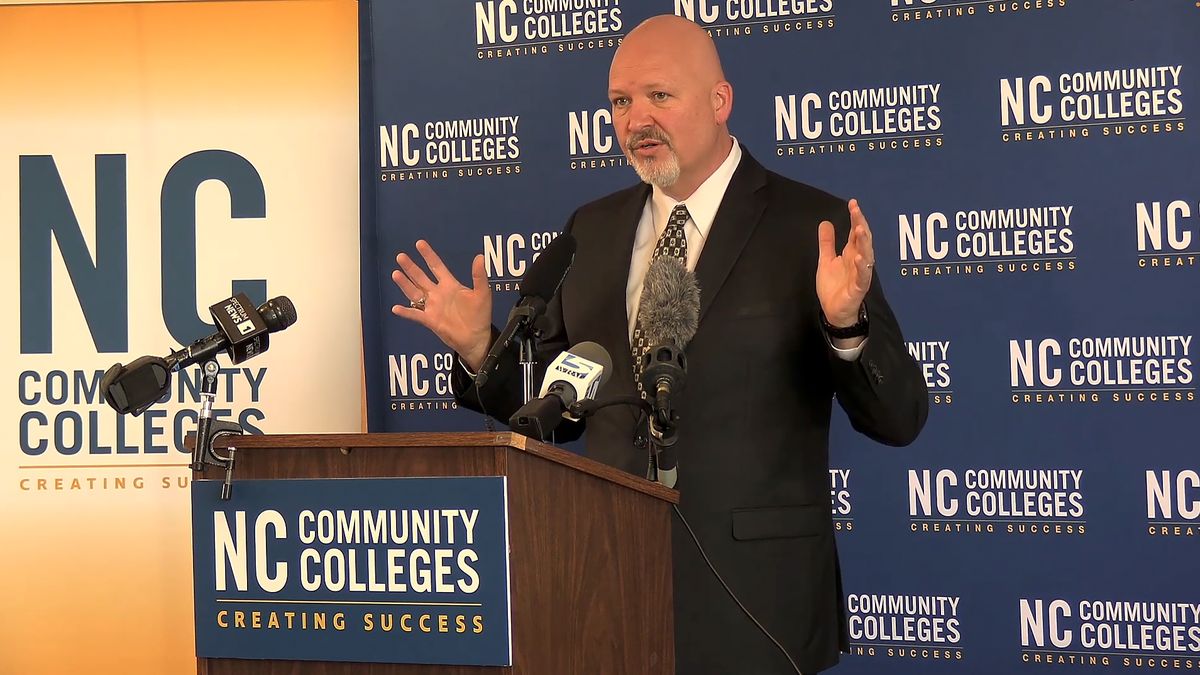
Jeff Cox, who has served as president of the North Carolina Community College System since 2023, announced Friday he will retire next summer.
In his role as president, Cox oversees the state’s 58 community colleges and has led the system in focusing on economic mobility for students in tandem with meeting workforce demands in the state. He previously served as president of Wilkes Community College — which saw its completion rates for students more than double under his leadership — and as superintendent of Alleghany County Schools.
Cox’s tenure at the system, which will reach three years by the time he enters retirement, will be the longest of any president in a decade, per Education NC. He said he gave his notice early, so that the state Board of Community Colleges could pursue a comprehensive search for his replacement, who will need to be confirmed by the General Assembly, per a law passed in 2023.
“As a first-generation college student from rural Alleghany County, I could never have imagined that one day I would lead the state’s community college system. Our colleges play a pivotal role in changing the lives of 600,000+ students every year,” Cox said in a news release. “I’m so proud of the impact our colleges make every day, and I am honored to be a part of this system. I look forward to continuing this important work over the next year.”
Durham Tech president’s contract extended
Meanwhile, the Durham Tech Board of Trustees has extended the contract of President JB Buxton until 2029.
Buxton, who was first hired for the job in 2020, is credited with strengthening local relationships and partnerships with public schools, universities and the business community, per a news release. Looking forward, he will lead the development of a new strategic plan for the college and oversee major construction projects at its Durham and Orange County campuses.
“I am grateful for the opportunity to continue serving with my Durham Tech colleagues and supporting the College’s students and the people of Durham and Orange counties,” President Buxton said. “I am proud of the role we play in supporting individual opportunity, regional economic growth, and the vitality of our local communities.”

Higher ed news I’m reading
- A group founded by the conservative Heritage Foundation is asking UNC-Chapel Hill for syllabi and other class materials from roughly 70 courses, citing a need — in the group’s words — to show whether the university is complying with “current Executive Orders issued by the President of the United States,” Inside Higher Ed reports.
- Harvard University’s accreditor is considering removing language in its standards that refers to DEI, The Chronicle of Higher Education reports, a move that comes as accrediting agencies and their members face intense pressure from the Trump administration.
See you next time
Thanks for reading Dean’s List. I’ll see you right back here next week.
Not a subscriber? Sign up on our website to receive Dean’s List in your inbox each week.