Students plead with UNC trustees to keep international studies centers
AI-generated summary reviewed by our newsroom.
- Trustees approve resolution saying closing six area study centers would save $6 million.
- Students lobby trustees, arguing centers coordinate research, outreach, language.
- Administration cites federal funding losses of about 60% and seeks $70M savings.
In 10 years, will UNC-Chapel Hill student Noa Roxborough’s degree be seen as a valuable asset for a career in international human rights law?
For her, it’s an open question.
She posed it to the university’s Board of Trustees Thursday in a heartfelt presentation arguing for the preservation of the school’s six international area study centers.
As early as this year, UNC plans to shutter the African Studies Center, the Carolina Asia Center, the Center for European Studies, the Center for East European Studies, the Center for Islamic Studies and the Institute for the Study of the Americas. The move could save the university around $6 million, according to a resolution approved at Thursday’s board meeting. The controversial cut is part of a wider effort to save a total of $70 million in the face of state and federal funding pressure.
Thursday’s presentation was orchestrated by student body president and trustee Adolfo Alvarez, who asked Roxborough to speak during his allotted time at the meeting.
“I just ask you to consider whether we can really put a price on the value of the programming and infrastructure that the centers provide,” Roxborough, a senior global studies major, told the trustees. She shared testimony from other students, including those who transferred to or chose UNC specifically to study at one of the area study centers.
“These centers distinguish UNC among our peer institutions at the national and global level,” Alvarez said. ”They are something most campuses do not have. Most institutions are continuing to support their academic centers throughout this moment of uncertainty coming from the federal government. The centers strengthen the academic experience and retention of students and faculty because they offer an incomparable experience.”
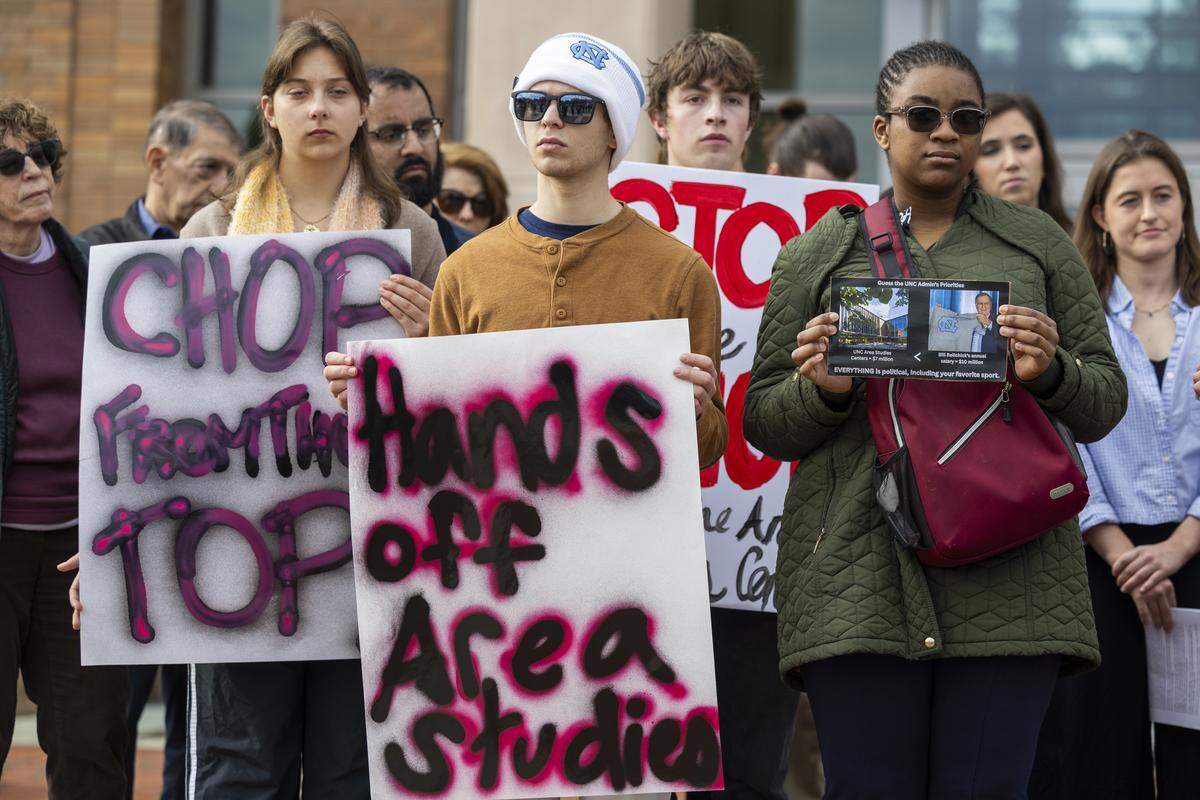
The trustees had no questions for Roxborough or Alvarez following the pair’s time at the podium. Outside the meeting, members of the advocacy group TransparUNCy gathered to protest the cuts.
If not for Alvarez, “we would have been given no voice, which is why we’re outside here today,” Bebe Castañeda, a junior global studies major, told The N&O.
“The faculty at the area study centers weren’t given a chance to speak with administration about it,” Castañeda said. “Their emails were ignored. They weren’t able to go to the Board of Trustees and speak to them directly. So our only option as a student organization was to provide the platform ourselves.”
After Roxborough’s presentation, Chancellor Lee Roberts, who has taken a lot of heat in recent weeks concerning the plan to close the centers, defended it as a way to respond to federal cuts.
“I haven’t heard anybody say that the area centers don’t do great work,” Roberts told The N&O while answering reporters’ questions on Thursday. “That’s true for hopefully just about everything we do around here. There are relatively few things, when you look at cost savings, where you say: ‘That’s a dumb thing to be doing, and we shouldn’t, it was never a good idea.’ That’s what makes these kinds of exercises so difficult.”
“I think what the working group looking at how to achieve savings for the centers and institutes was looking at was the fact that the area study centers lost their federal funding. It’s about 60% of their total funding on average across the centers. … That’s where the working group was coming from. But we’ve obviously heard a lot about the importance of the centers and the impact that they have, not just here, but globally. And so the provost and the dean of the college are going to try to continue to work through this effort to preserve the mission while achieving the cost savings.”
One strategy to preserve that mission is to absorb some of the work of the area study centers into different departments throughout the university. Advocates for the centers say that won’t work.
Roxborough enumerated for the trustees what she sees as the unique capabilities of the centers: coordinating research, language instruction and public engagement, stewarding private funding and outreach networks, supporting hundreds of affiliated faculty and students, as well as K-12 education programs like teacher training and study abroad, hosting conferences, functioning as outreach centers for the medical, public health and business schools, and connecting the university to the military and international business deals.
Those capabilities won’t transfer if the centers are absorbed by individual departments, Roxborough argued. Her allies at TransparUNCy agreed.
“It is unfortunately just a misunderstanding of the way that higher education works, specifically the way that humanities education works, to think that these kinds of area study centers can just be absorbed into departments,” Castañeda said.
Also at Thursday’s meeting, the board approved $17 million more in cuts to administrative costs, at least $1 million of which is slated to come from other academic institutes and centers. The university has identified 28 degree programs, in addition to 19 departments, that qualify for further review and could possibly be cut.
This story was originally published January 22, 2026 at 1:28 PM.
CORRECTION: A previous version of this story misattributed a quote by Adolfo Alvarez.