Board wants NC to halt private school voucher expansion. Will lawmakers listen?
AI-generated summary reviewed by our newsroom.
- Board seeks moratorium on Opportunity Scholarship expansion to fund public schools
- Republican legislative majority unlikely to back halting voucher expansion
- Board requests big funding boosts for pay, free meals, special ed and devices
State public education leaders want to halt expansion of North Carolina’s private school voucher program — an idea likely to be rejected by state lawmakers.
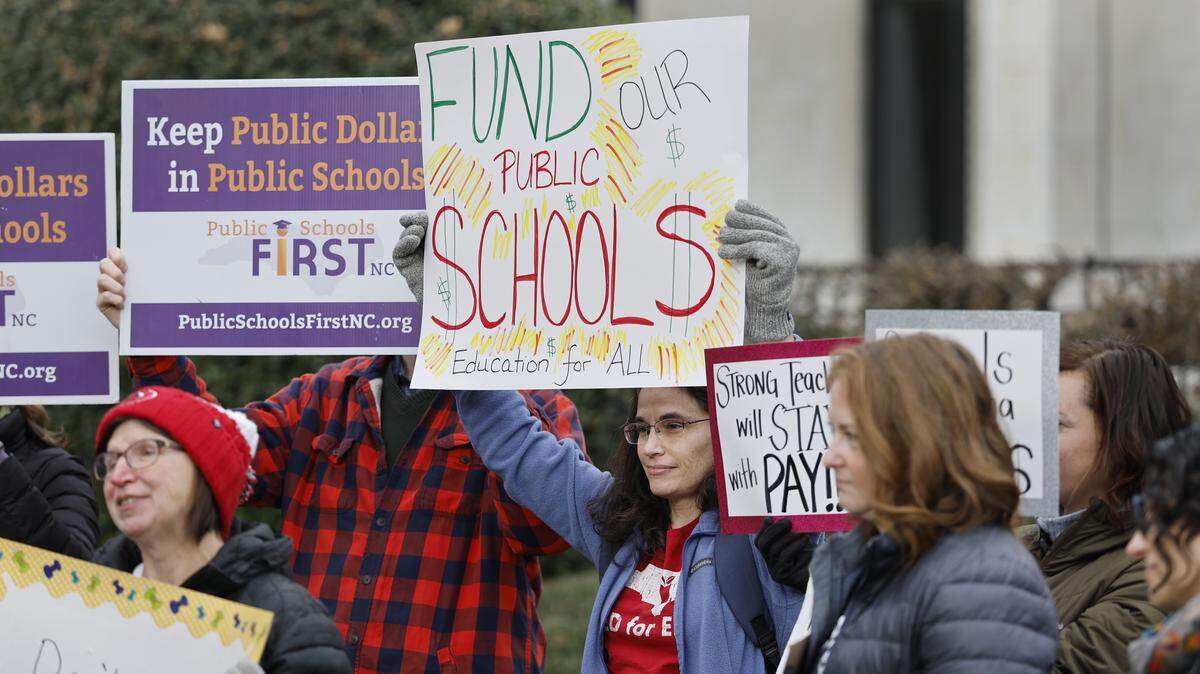
The State Board of Education on Thursday requested a moratorium on the expansion of the Opportunity Scholarship program with any new voucher money going instead to fund public schools. It’s part of a long list of priorities for this year’s legislative session that includes asking for more state money for items such as teacher pay, school construction and replacements for aging computers.
“We’re listing in short-term priorities a series of things that we’ve heard passionate appeals from our educators and others that they’re not ‘wants,’” said state board vice chair Alan Duncan. “They’re ‘needs’ here.”
The legislative priorities were approved in an 8-2 vote with the board’s two Republican members (State Treasurer Brad Briner and Olivia Oxendine) dissenting. The priorities are a joint request of Democratic State Superintendent Mo Green and the Democratic majority on the state board.
Request to halt voucher expansion ‘dead on arrival’
Items such as halting expansion of the voucher program aren’t expected to get backing from the Republican majority in the General Assembly. State lawmakers have significantly expanded the scope of the Opportunity Scholarship program in recent years to the point where the majority of North Carolina’s private school students now get vouchers.
“Rather than pursuing unrealistic, dead-on-arrival objectives such as stripping Opportunity Scholarship funding from nearly 105,000 North Carolina students, the State Board of Education should focus on shared legislative priorities like raising teacher pay,” Demi Dowdy, a spokesperson for House Speaker Destin Hall, said in a statement Thursday.
The state board says it’s asking for a halt on new vouchers, not on existing ones.
State accepting new voucher applications
The state is accepting new Opportunity Scholarship applications for the 2026-27 school year. The priority application deadline is March 2.
The state board doesn’t want those new applications to be funded. Instead, the board says the money for new scholarships should go toward “addressing needs in our public schools.”
State lawmakers had previously agreed to increase voucher funding by an additional $50 million to $675 million next fiscal year. It’s scheduled to increase to $825 million a year by the 2032-33 fiscal year. The state board says future funding increases to the Opportunity Scholarship program should be tied to the annual percentage increase in public school funding.
Participation in the Opportunity Scholarship has tripled over the past two years since state lawmakers expanded state funding and opened the voucher program to all families. The changes allowed many existing private school families to get a voucher as well as attracting some new students to private schools.
As of Jan. 5, 104,599 students were getting an Opportunity Scholarship voucher.
NC falling in teacher pay rankings
The “additional needs” in public schools cited by the state board include raising pay for teachers and non-certified school staff.
The state board wants to raise teacher pay so that North Carolina has the highest teacher salaries in the Southeast. North Carolina has fallen to eighth in the Southeast in average teacher salary and to 10th when adjusted for cost-of-living, according to the National Education Association and the state Department of Public Instruction.
“We’ve clearly fallen, and fallen behind some of our closest neighbors,” said Geoff Coltrane, DPI’s senior director of government affairs and strategy. “South Carolina, Tennessee and Alabama all have average teacher pay that’s higher than us.”
When adjusted for inflation, North Carolina teachers are being paid less than they were in 2013-14, Coltrane told the board.
“The reality is teachers in January this year, principals in January this year, custodians and bus drivers, we make less this year than we did previously because of not just inflation but specifically our health insurance costs,” said Beckie Spears, a Wilkes County principal and adviser to the state board.
North Carolina is the only state that didn’t adopt a comprehensive state budget last year. That meant no new raises for teachers and other school employees.
State House Republicans approved a plan to sharply raise teacher pay. But it’s held up amid an ongoing dispute with Senate Republicans on how much to cut taxes.
Is the state board asking for too much money?
Other items in the state board’s legislative priorities include:
- Provide $377 million so all students can eat free school breakfasts and lunches.
- Increase funding for special education by $197.6 million by providing money based on the needs of students.
- Provide $150 million over the next four years to help schools replace aging computers given to students.
- Increase funding in needs-based school capital fund by $117 million to help poor school districts pay for construction projects.
- Increase funding for school health personnel positions by $64.3 million.
Briner said they’re asking for $800 million in new funding at a time when the state is projected to have only $100 million in new state revenue next fiscal year.
“There’s a lot more prioritization that I would want to see before we put this in front of the General Assembly,” Briner said.
Do schools need computers?
The request for money for school devices comes at a time when 88 of North Carolina’s 115 school districts say they don’t have the money to replace all the computers they’ve given to students. Schools began providing a device to every student during the pandemic, using one-time federal COVID aid.
The state board opted not to ask for less costly options such as $117 million to replace computers in grades 3-12 or $82 million to replace devices in middle and high schools.
The advisers to the state board, which include teachers, principals, students and local school board members, said students having new devices is critical for education nowadays.
“We’re talking about preparing our kids to be career ready, future ready, life ready,” said Carol Worley, a Clinton City school board member and state board adviser. “This is a part of where it is right now. You have to have a device to be able to function.”
This story was originally published February 5, 2026 at 11:56 AM.