Class materials help show how UNC School of Civic Life pursues its lofty mission
AI-generated summary reviewed by our newsroom.
- The News & Observer reviewed 21 publicly released syllabi from UNC’s SCiLL.
- Classes frequently require students to reckon with Christian thought.
- Contemporary readings often lean right, though some left-leaning texts appear.
UNC-Chapel Hill’s School of Civic Life and Leadership has a specific vision of civics education: Western, Christian, canonical and free-speech forward.
The school’s mission is lofty. It aims to “renew higher education’s public purpose — educating citizens who not only understand the freedoms our Constitution guarantees, but who also have the courage and capacity to use those freedoms well.”
It sees itself as “building a model for universities across the nation, grounded in open inquiry, civil discourse, and the pursuit of meaning and truth,” according to its mission statement on the school’s website.
The News & Observer reviewed 21 syllabi from the school — newly available as public record under UNC System policy — as part of a wider project looking at students’ experiences in the School of Civic Life and Leadership.
“There’s a desire to look at Western civilization and revive liberal arts, revive liberal education,” SCiLL professor Rita Koganzon told The N&O. “That could be considered conservative in academia but does not map on to partisanship at all.”
But when contemporary thinkers appear in SCiLL syllabi, they tend to lean right.
Students read JD Vance’s 2025 speech “American Statesmanship for the Golden Age” and the 2019 right-leaning document “National Conservatism: A Statement of Principles.” They read Roger Scruton’s “How to be a Conservative.” They read “The Tragedy of Liberalism.”
That’s not to say no left-leaning thinkers appear. Students read Saul Alinsky, Karl Marx, Martin Luther King Jr. and documents of the Black Panther Party.
But some of the only contemporary left-leaning texts in the syllabi are in Koganzon’s course called “Left, Right, and Center.” In that course, students read Ta-Nehisi Coates, Osita Nwanevu and anthropologist and activist David Graeber. That week on the syllabus is titled “The Current Left: Socialism and Identity Politics.”
Other days focus on libertarianism, traditionalism and neoconservatism.
‘Centuries-old conversation’
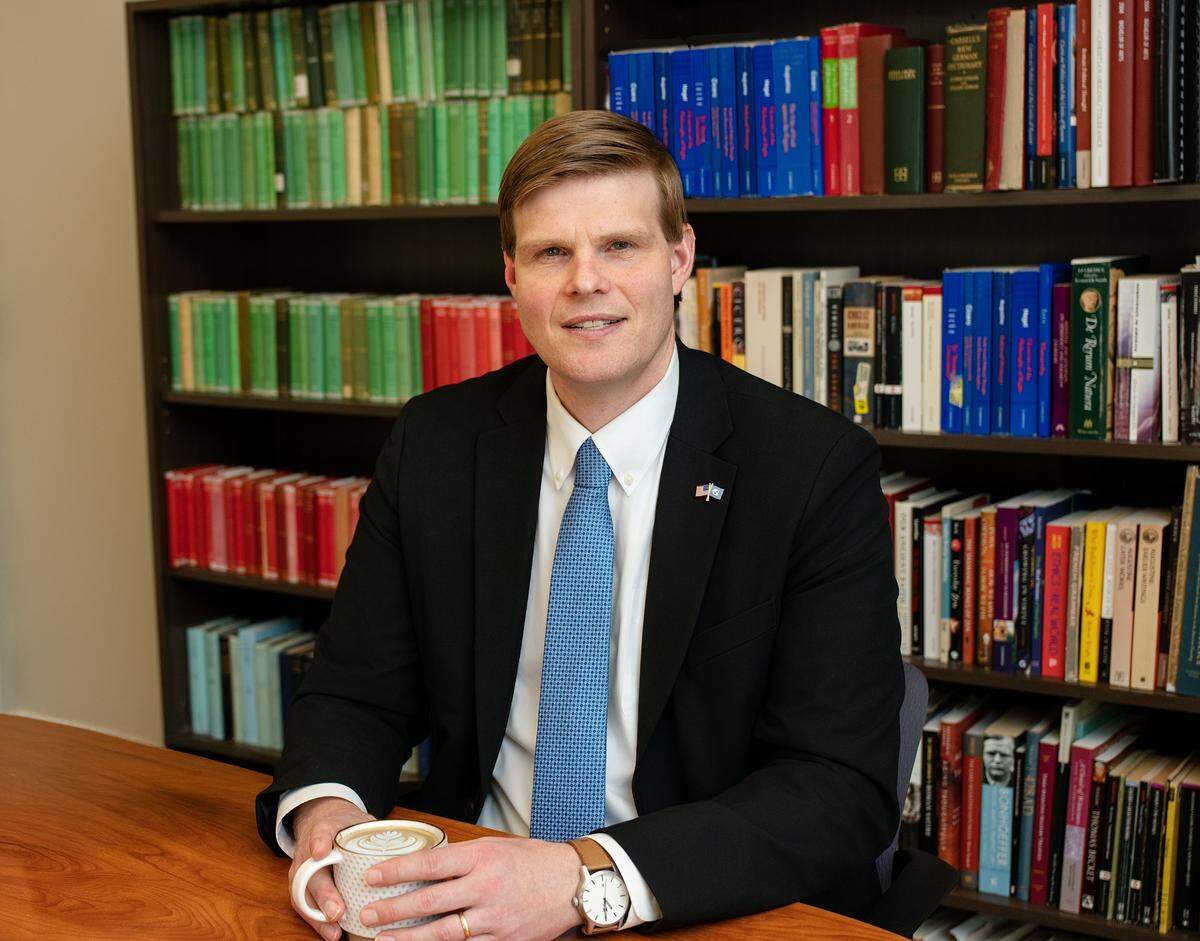
“I think we’re all pretty fanatically committed to depoliticizing the classroom and making it a place where ideas can really intersect,” SCiLL professor Flynn Cratty told The N&O. “There’s this enormous, centuries-old conversation going on, and we want our students to be a part of it and to feel confident and knowledgeable as they speak to one another and also interact with this tradition.”
I think we’re all pretty fanatically committed to depoliticizing the classroom and making it a place where ideas can really intersect.
Flynn Cratty
Professor, UNC School of Civic Life and LeadershipThe school has a focus on Great Books: classic texts that are traditionally seen as containing the basic building blocks of Western culture. Across courses, students read Plato, Aristotle, Cicero, Aquinas, Augustine, Hobbes, Locke, Rousseau, Tocqueville, the Federalist Papers and the list goes on. Deep analysis of these primary texts is central: multiple syllabi ban the use of secondary sources in papers.
The school also focuses on personal, lived engagement with these thinkers of old. In “Pursuing the Good Life,” students are asked to explore their values. In “The Christian Story,” students are visited by a Christian convert to hear her experience. In “Bud Light to Colin Kaepernick: Dialogue in the Market Place,” students are taught “the tools of a more perfect mind and soul for each of us.”
UNC student and SCiLL minor Nadège Sirot says the experience of reading Plato in a classics course is much different than in a SCiLL course.
“A classics course will focus on who Plato was, what informed his writing, what sorts of manuscripts and translations exist,” said Sirot, who was a sophomore when she was interviewed for this story. “A SCiLL course would focus on really big picture questions like: ‘What does Plato’s analysis of a just society entail about human nature, and is this an understanding of human nature that is conducive to how we ought to live our lives?’”
Classes frequently ask students to reckon with Christian thought, assigning either Biblical scripture or the work of Christian thinkers. The religion is intellectually central — in “The Christian Story,” but also in classes like “Pursuing the Good Life,“ “What is the American Character?” and “Natural Law and Human Rights.”
What critics think
Some professors outside of SCiLL wonder what’s lost when students are presented with this narrow focus on the Western canon. Erik Gellman, a history professor at UNC, sees a kind of false nostalgia in the desire to go back and focus solely on the works of authors who are “Western, white and male.”
“I appreciate many of these historical texts but teaching them on their own does not reflect the breadth and depth of scholarly work of the past half century in the social sciences and humanities fields,” Gellman said.
There are courses in SCiLL, too, that break out of the traditional mold of college classrooms.
“Israel and Palestine on Campus: Courageous Conversations” has six professors, and each class session is a discussion among faculty, guests and students. “Labcoats and Legislators: Science, Technology, Policy, and Politics” is co-taught by Republican Senate Majority Leader Michael Lee and Kirk deViere, former Democratic state senator and a current commissioner in Cumberland County.
Most courses include a stated commitment to free expression and a ban on artificial intelligence.
This story was originally published May 21, 2026 at 5:00 AM.
CORRECTION: An earlier version of this story misidentified the ideological perspective of an essay on the syllabus of Koganzon’s class.