UNC’s School of Civic Life has come under attack. Students reveal what it’s really like
AI-generated summary reviewed by our newsroom.
- Students can minor in the School of Civic Life and Leadership at UNC-Chapel Hill.
- The school aims to teach Western great works and inspire inquiry and civil discourse.
- Students reflect on their experiences taking courses like “Pursuing The Good Life.”
When UNC-Chapel Hill student Mo Zheng saw the course description for a class called “Pursuing The Good Life,” it seemed like kismet.
The questions asked in the course description were ones he’d been asking himself as of late: “How should I live? Whom and how should I love? What claims do family, friends and country have on me? What is the source of meaning, purpose, happiness and transcendence? How should I deal with suffering, injustice and my own mortality?”
Zheng said that sometimes, it feels like he doesn’t know why he’s doing what he’s doing — and he’s doing a lot. He’s pursuing a major in neuroscience, a minor in the School of Civic Life and Leadership, playing violin in the UNC Orchestra, volunteering at local hospitals and trying to figure out how to answer when people ask where he’s from. He’s lived in Shenzhen, Szechuan, Toronto, Clemson, Greenville, Raleigh and now, Chapel Hill.
At the age of just 18, his gifts and talents are matched by his dedication and thoughtfulness.
Of his many pursuits, there’s one that helps him pay for college: minoring in the School of Civic Life and Leadership.
The stated mission of UNC’s School of Civic Life and Leadership is to “educate citizens and leaders for constitutional self-government through free inquiry and civil discourse.”
But the school has drawn controversy from the start for the conservative values that informed its creation in 2023. An investigation into allegations surrounding hiring practices and leadership misconduct prompted further scrutiny — especially after UNC said the results of that investigation would not be made public.
The News & Observer delved into the debate to get a sense of what it’s like inside the school. The N&O spoke to four students who minor or take classes in the School of Civic Life and Leadership; attended a class session; interviewed professors; and analyzed more than 20 syllabi and 400 pages of email records.
Zheng was one of those students who spoke to The N&O this spring when he was a freshman.
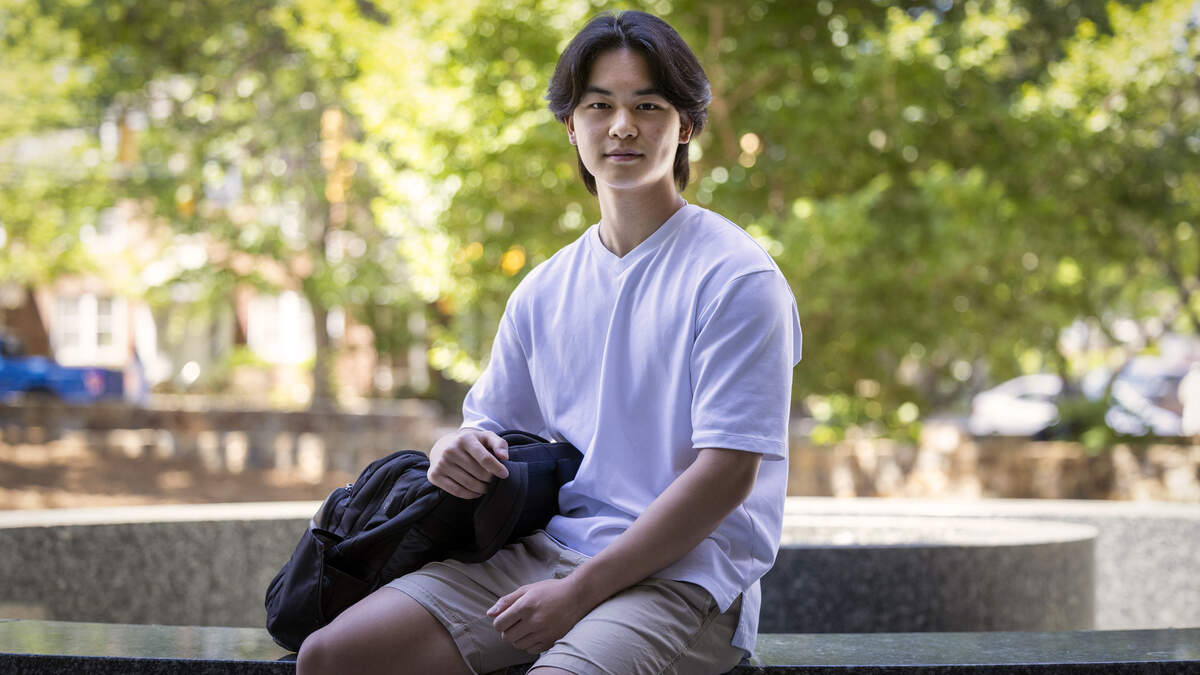
He is a recipient of the school’s Libertas Scholarship, which awards him $3,000 per year for pursuing the minor. Because he’s on financial aid, the $3,000 covers the remaining balance of his tuition and fees, giving him an effective full ride.
The money played into his decision to pursue the minor, Zheng said. So did fulfilling a credit distribution requirement. But he’s been fascinated by the course material ever since.
The first assignment was a one-page, double-spaced essay asking a simple question: “What is the meaning of life?”
UNC School of Civic Life controversy
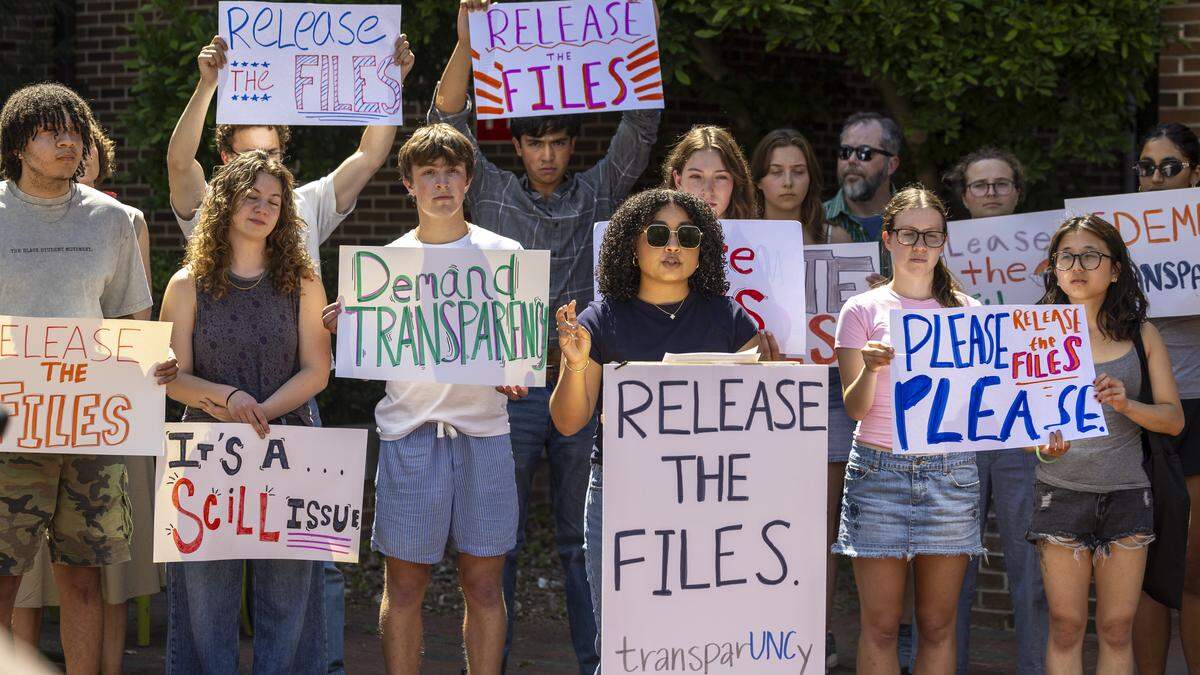
The School of Civic Life was envisioned as a haven for intellectual diversity on a liberal campus, a place where people could feel comfortable exploring viewpoints outside the mainstream. It’s also been referred to by its critics as a “thinly veiled Trojan horse for an explicitly conservative takeover of higher education,” as described by UNC student Nia Quigley at a campus protest.
Infighting at the school, and the allegations of mismanagement, have swirled since its creation — causing massive turnover in its faculty ranks. Almost none of the academics initially involved with the school are still a part of it.
The accusations triggered UNC to hire an outside law firm to investigate the school. All told, the investigation cost more than $1.2 million. The decision to not release the report has caused both outrage outside the school and discomfort within.
The end of the spring 2026 semester was marked by campus protests and calls for a boycott of the school — and a simultaneous elevation of its status on campus.
SCiLL is now an independent academic unit, separate from its original home in the College of Arts and Sciences. That means the school will stand alone — on par with units like the Kenan-Flagler School of Business or the Hussman School of Journalism. It will give the dean of the school, Jed Atkins, more autonomy over the school’s operations: things like hiring practices, budget considerations and curriculum.
Christianity at the forefront
When Zheng reviewed the syllabus for his Good Life class, he was surprised by what he saw.
“It was a bit jarring to see that the Bible was one of the four course materials,” Zheng said. “I’m from a family who’s quite atheist. I have a nonreligious background.
“But I wasn’t deterred by that. Religion is definitely something worth exploring, and there’s no reason why we should remove the Bible from the course requirements. But it’s definitely a choice whether you want to take the course.”

Throughout the 21 syllabi reviewed by The N&O, Christianity is a central intellectual framework. Scripture appears in courses like The Christian Story or Political Theology, but also courses that aren’t expressly about religion.
Students in SCiLL read the work of Augustine and Thomas Aquinas, among many other Christian thinkers. Texts from Judaism are more rare, apart from scripture that is common to both religions. Islam and other nonwestern religions appear on few occasions, though new courses are reportedly in the works.
For student Nadège Sirot, that is natural and not surprising. She’s a classics major and a SCiLL minor.
“The inclusion of religious texts and religious motifs — rather than to say [Christianity] is more important than others — is to understand the absolutely gargantuan impact that Christian morality and values have had on our society,” said Sirot, who was a sophomore whe she was interviewed for this story. “We as Americans today still grapple with those effects when becoming citizens in a world that is still very much colored by Christian values.”
SCiLL’s director of undergraduate studies, Rita Koganzon, sees the Christian focus as a result of it being early on in the school’s history. The school was founded in 2023 and does not yet have all the faculty hires with diverse interests she hopes it will one day have, Koganzon said.
“The goal is not to specifically focus on Christianity,” Koganzon said. “You would have to be especially suspicious of Christianity to say that this is a program dominated by Christianity.”
Zheng set up a time to meet with his Good Life professor Flynn Cratty, whom he deeply respects, to discuss that one-page essay assignment on the meaning of life. Zheng said the personal meanings Cratty shared with him were based in Christianity.
Now, Zheng is taking another course with Cratty. It’s a seminar on C.S. Lewis, where they read Lewis’s “Mere Christianity.”
“One of the really pressing themes in that book is: ‘The best time to convert is now,’” Zheng said. “I did feel that, in a way. I feel like [conversion] is more of an option, in a sense, and I’m getting to know that option. The thought is definitely there. It feels like a really big decision. It’s a leap of faith, right?”
Conversations around race and power
Arianna Smith-Barnes sat through her Foundations of American Civic Life course on April 7, when she was a freshman, flashing the occasional expression of exasperation.
The topic of the class was the 1858 Abraham Lincoln and Stephen Douglas debates. The debates centered around whether slavery should be permitted in new states joining the union from western territories. Professor Dan DiSalvo walked the students through each man’s argument, giving equal credence and sober analysis to each. The perpetuation of slavery in new territories was given equal weight as an idea.
That’s part of the point of SCiLL: to present controversial or debatable content in hopes that it will generate civil discourse. There’s a class in the school calIed “Israel and Palestine on Campus” and another titled “Bud Light to Colin Kaepernick: Dialogue in the Marketplace.”
In class that day, DiSalvo spent extensive time reconstructing the logic and political appeal of men like Douglas, in a neutral tone, without putting the moral horror of slavery front and center. That gave Smith-Barnes pause. She fears that a student could leave with the wrong idea.
“I don’t like the way that we’re talking about these topics and debating views on slavery in the United States,” said Smith-Barnes, a Black student. “In my experience going to a predominantly white institution, I already feel like I’m sometimes at a disadvantage. Talking about these things in a way that is framed to be debatable can be uncomfortable.”
She would rather this material be taught “by someone who is more in touch with the struggles and effects of slavery, someone who is more aware and empathetic toward how hard that period of time was and how complex it is. It can’t just simply be debated.”
DiSalvo said in an email to The N&O that the debates “cannot be understood without analyzing both Douglas’s and Lincoln’s positions,” which “force students to confront whether a majority can legitimize what Lincoln regarded as a profound moral wrong.”
Enrollment in SCiLL on the rise
Smith-Barnes is among a fast-growing number of students who are enrolled in SCiLL courses, according to Chancellor Lee Roberts’ internal preparation materials for a January interview with the Wall Street Journal. The document was obtained through a public records request.
“In Fall 2024, the School offered three courses, enrolling 85 students. By Spring 2025, offerings had grown to 12 courses enrolling 277 students, and by Fall 2025, to 18 courses enrolling 475 students,” the internal document reads. “For the 2025-26 academic year we anticipate that SCiLL will enroll more than 1,000 students. This is more than a 1,000% increase in just four semesters.”
UNC history professor Erik Gellman wonders if this is artificially inflated by distribution requirements that advantage SCiLL classes, including the requirement titled “Foundations of American Democracy,” and the temptation of the Libertas Scholarship.
Smith-Barnes says she now wishes she had signed up for a different class to fulfill her distribution requirement.
“I like to participate in class,” Smith-Barnes said. “But I wouldn’t share all of my beliefs in that class comfortably.”
A bit of SCiLL romance
Elsewhere in SCiLL, students are asked to complete a truly unorthodox assignment: go on a date with one another. That’s homework in John Rose’s course “Men and Women.”
Cara Noelle Allen, who is earning a SCiLL minor, said she got a lot out of the assignment.
“We’re talking about specifically the interactions between men and women, and a lot of those conversations were centered around dating, parenting and marriage,” said Allen, a senior when she spoke with The N&O. “So practically, let’s take these conversations outside of the classroom because that’s where they actually happen. So one of the assignments was to go on a date and write a reflection about it.”
Students weren’t limited to choosing another student in the class, and Allen said that, to her, the whole thing was pretty low-stakes. She went with a friend. But for some, it was the start of something special.
“One of my friends ended up in a relationship with the person that they went on a date with,” Allen said. “I think that eventually ended. There were a few couples in the class who, to my knowledge, are still together.”
For Sirot, it was an exercise in getting out of her comfort zone and reflecting on how college dating norms have changed drastically over history.
“Maybe someone will get married,” Sirot said. “But what I got out of that assignment personally was a really pertinent opportunity to reflect on my own past and my own hopes for my future — what marriage means to me as an individual, as a young woman who is ambitious, but also who marriage means a lot to.”
“I can’t speak for other students, but I think we’ve all been saying that SCiLL brings up these questions of meaning that are really, really pertinent for us,” she said.
Sirot loves the way SCiLL approaches the humanities from an angle of meaning-making and personal engagement, rather than traditional analysis.
Some professors, like Gellman, criticize the school’s overreliance on canonical works by dead white men. But Sirot rejects the idea that SCiLL leans too traditional.
“If we’re using traditional to mean ‘study the great texts of the Western canon, get married young, have many children and raise them in the Christian church,’” Sirot said, “then no, I don’t think SCiLL is pushing that at all.”
This story was originally published May 21, 2026 at 5:00 AM.
CORRECTION: A previous version of this article misidentified the frequency of the scholarship associated with the School of Civic Life. It also should have noted that some texts are common between Christianity and Judaism. The article has also been updated to give a clearer description of the nature of discussion in DiSalvo’s class.