Wake student vindicated after she says she was falsely accused of using AI
AI-generated summary reviewed by our newsroom.
- A Wake freshman saw a 0 and a note saying 'evidence of AI, Please redo.'
- The teacher reported three AI assessment tools returned likelihoods of 62%, 75% and 87%.
- Wake County and DPI guidance advise caution & recommend multiple measures over detectors.
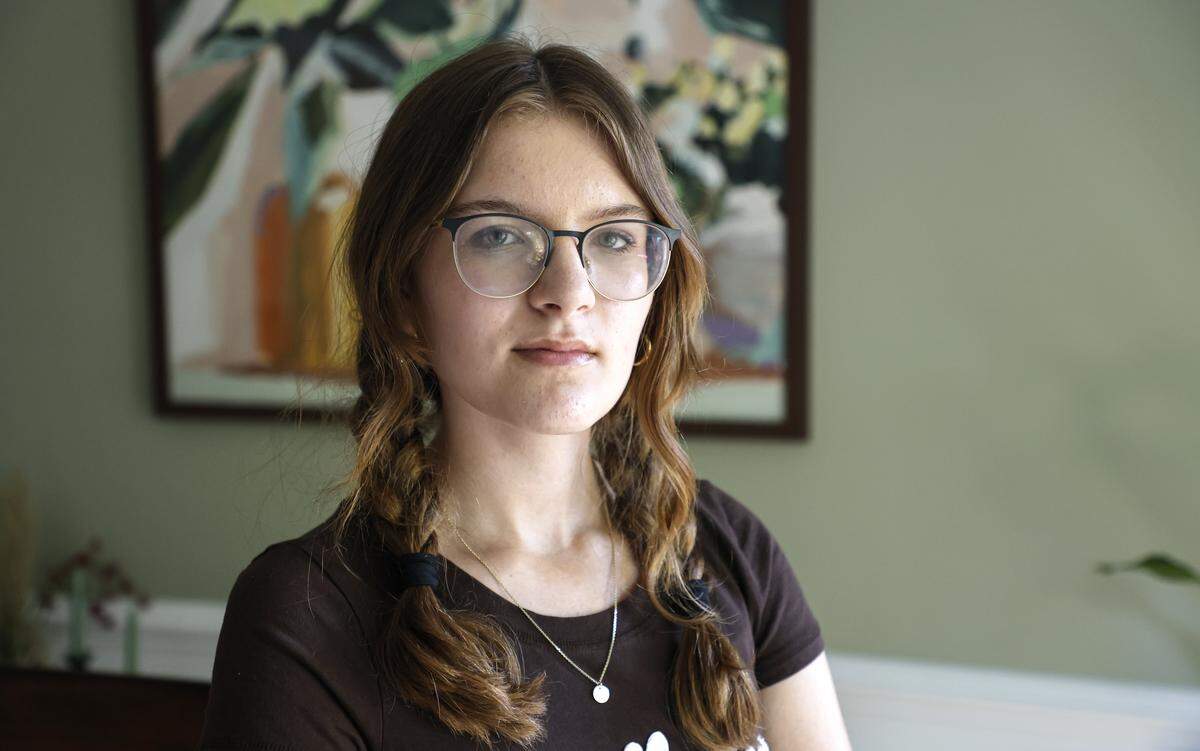
Eleanor Canina is as harsh a critic of AI as a 15-year-old can be, so she was surprised when an English teacher failed her for allegedly using AI to complete a writing assignment.
Canina and her mother, Stacy De Coster, waged a battle to clear her name and to try to protect other students from being falsely accused of using AI. The duo say Wake County teachers shouldn’t be relying on AI detectors that have been known to inaccurately say that work was AI-generated.
“We can’t just let people get away with using AI for their assignments,” Canina, 15, a freshman at Green Hope High School in Cary, said in an interview with The News & Observer. “But honestly, I think that the top priority has to be stopping people from being falsely accused.”
Due to student privacy rules, the Wake County school system didn’t directly respond to the family’s accusations. But in a statement Thursday, the district said it recognizes that the use of artificial intelligence in education is a new and rapidly evolving area.
“Our core responsibility is teaching and learning,” Wake said in its statement. “Teachers must be able to accurately assess student work in order to understand progress and adjust instruction when needed. At the same time, we have an obligation to ensure that student work is evaluated fairly and consistently.”
Concerns about student AI use rising
Students using AI to take credit for their work has become a growing concern for K-12 schools and institutions of higher learning. In 2024, the state Department of Public Instruction issued guidelines on AI use for North Carolina’s public schools, The N&O previously reported.
Canina recognizes the dangers of AI, both from the environmental impact of data centers and the ethical problems of using it instead of doing the work yourself.
“It’s stopping people from thinking freely, and using it as a quick excuse to get out of doing work isn’t going to help anyone in the long run,” Canina said.
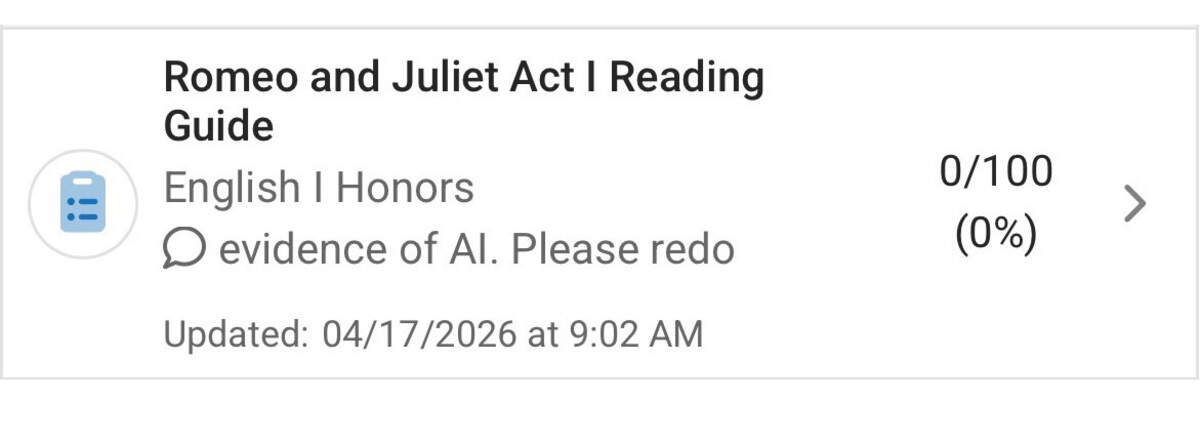
Canina didn’t see it coming when she checked online last week to see she had gotten a “0” on an English I assignment about the first act of “Romeo and Juliet.” The grade came with a note from the teacher saying “evidence of AI, Please redo.”
It was the only bad mark on a screen filled with grades of 100 from her different classes.
De Coster said she had been worried there might be problems all semester because her daughter’s English I teacher had resigned. A long-term substitute teacher is watching the class, but the assignments are being graded by other teachers who don’t know the writing styles of the students.
Teacher relied on AI detectors
De Coster and Canina immediately raised concerns with the English teacher, who isn’t being named by the N&O.
De Coster suggested that the teacher compare the writing on the assignment with her daughter’s past work. She also suggested that the teacher look at her daughter’s Google Doc history to see that she had been writing it and not cutting and pasting material.
Instead, the teacher responded he had run the assignment through three different AI assessment tools.
“The results indicated likelihoods of 62%, 75%, and 87% for AI generation or significant AI assistance,” the teacher said in an email to De Coster that she provided to the N&O.
But De Coster, a sociology professor at N.C. State, said there’s widespread evidence that AI detectors have shown false positives. That’s why DPI’s guidelines say schools should “use great caution with AI detectors.”
“AI detectors have proven not to be dependable, therefore they should never be used as the only factor when determining if a student ‘cheated,’” according to DPI’s AI guidelines. “Common issues with AI detectors are a high frequency of false positives for non-native English speakers and creative writers as well as a high frequency of false negatives for students who are skilled at working with AI and are capable of fooling the detectors.”
Multiple media outlets reported in February that a New York judge ruled in favor of an Adelphi University student who was accused of plagiarism based on a professor’s use of an AI detector.
Wake said it follows DPI’s AI guidance and provides ongoing support to schools on the appropriate use of AI in instruction and assessment.
“The district does not provide or require the use of AI detection tools and instead encourages educators to rely on multiple measures, such as reviewing a student’s writing process and work history, to inform their professional judgment,” Wake said.
New teacher confirms she didn’t use AI
“I understand and acknowledge your concern regarding the limitations and variability of AI detection tools,” the teacher said in his email to De Coster.
But the teacher said he’s “relying on the evidence available to me” given the unique situation where he’s not directly teaching Canina’s class. The teacher offered to give Canina an alternative assignment, which the family refused.
After the family complained, Green Hope had another English teacher grade Canina’s original assignment. She got a 100 after the regrading.
Canina said this new teacher told her that he had confirmed she didn’t use AI after looking at her Google Doc history.
Are AI detection tools stifling creativity?
Despite having her name cleared, Canina isn’t giving up her fight for change.
Canina has created an online petition calling for the “responsible use of AI Detection Tools at Green Hope High School.” Her points include putting protections in place so students aren’t harmed by false results.
One of the commenters in Canina’s online petition said a teacher accused them of using AI because the detection tool said the assignment “had intense vocabulary and few grammatical errors.”
De Coster said one of her friends is in fear that her child will be accused of using AI because she’s a good writer.
In Canina’s case, De Coster suspects her daughter was flagged by the teacher’s AI detection tools because she used terms such as “the titular character.” Canina is an avid reader and writer with a highly developed vocabulary.
”Now she’s writing under the specter of the possibility of false accusations,” De Coster said in an interview. “So I don’t know if I should tell her, ‘dim your light, write at a lower level, just so that you don’t get flagged.’”
Canina, who is currently reading “The Handmaid’s Tale,” said she’s not going to let AI accusations deter her.
“I’m not ready to change the way I’m writing for something as unfair as this,” Canina said. “I mean, I want the system to change, not me to have to change.”
This story was originally published April 23, 2026 at 6:17 PM.