Is tenure antiquated? Why some trustees at UNC-Chapel Hill think so

AI-generated summary reviewed by our newsroom.
- Asher’s tenured hire was approved at multiple levels but blocked by trustees.
- Blaine called tenure “an anachronistic relic” and warned of financial risks.
- Enrollment fell from 112 majors in 2016 to 50 in the most recent semester.
A tenure fight at UNC-Chapel Hill this spring — the latest of several in recent years — revealed that tensions between the university’s leadership and its faculty have only deepened.
Kiran Asher, who teaches at UMass Amherst, was set to be hired with tenure in UNC’s Women’s and Gender Studies department, a job offered to her back in the spring of 2025.
The appointment had been approved at multiple levels — the department faculty, the College of Arts & Sciences, the tenure committee, and the provost — before heading to the Board of Trustees for its approval.
No final approval was given. The closed-door deliberation appears to have focused on the anticipated return-on-investment for tenured hires like Asher.
The News & Observer reviewed emails sent by members of the university’s Board of Trustees in the wake of the controversy. The emails reveal some of the considerations that played into the controversial decision to not hire her — including a hostility toward the institution of tenure and the consideration of it as a primarily financial proposition.
A key tension is whether the Board’s role is to “rubber stamp” tenure decisions that have already been made at lower levels of authority, or whether they have an active role to play in who gets tenure and who does not.

First of all: what is tenure?
Tenure is a primary goal for most faculty at colleges and universities that have it: a permanent employment status awarded to experienced educators. The goal of tenure is to give professors job security so they can freely explore and discuss controversial topics without fear of retribution. It’s seen as a safeguard for academic freedom.
In recent years, questions around the economic value and perceived political slant of higher education have brought conversations about tenure to the fore. In states like Texas and Florida, lawmakers have pushed to increase state oversight to tenure at public universities.
At UNC, there have been multiple high-profile tenure controversies. In 2021, the Board initially chose not to vote on awarding tenure to Nikole Hannah-Jones, an investigative journalist who won a Pulitzer Prize for her work on The New York Times’ 1619 Project. Then, in 2025, the Board delayed tenure approvals for most of that year’s candidates.
Trustees make decisions about tenure cases in closed session, meaning their discussions are not subject to public meeting law. That’s a rule intended to protect private personnel information.
At its May meeting the Board approved 33 tenure conferrals, and denied one: Asher’s. Asher signed the offer letter for the tenured position more than a year ago. It was all but set in stone.
The decision to block Asher’s hire has led to outrage from faculty at UNC. There’s been both an op-ed and subsequent letter about the situation published in the Chronicle of Higher Education.
In an interview with The N&O, Asher said that despite losing the job she was practically guaranteed, she’s doing okay. She’s coming to terms with the fact that she’s not moving back to North Carolina after all — she studied at Duke — and trying to deal with the level of public interest in this case.
One of Asher’s primary concerns, she said, is the lack of transparency provided by UNC’s Board of Trustees. The decision-making process is “totally opaque and undemocratic.”
Through records requests and interviews with board members, The N&O has been able to dissolve some of that opacity.
Internal deliberations
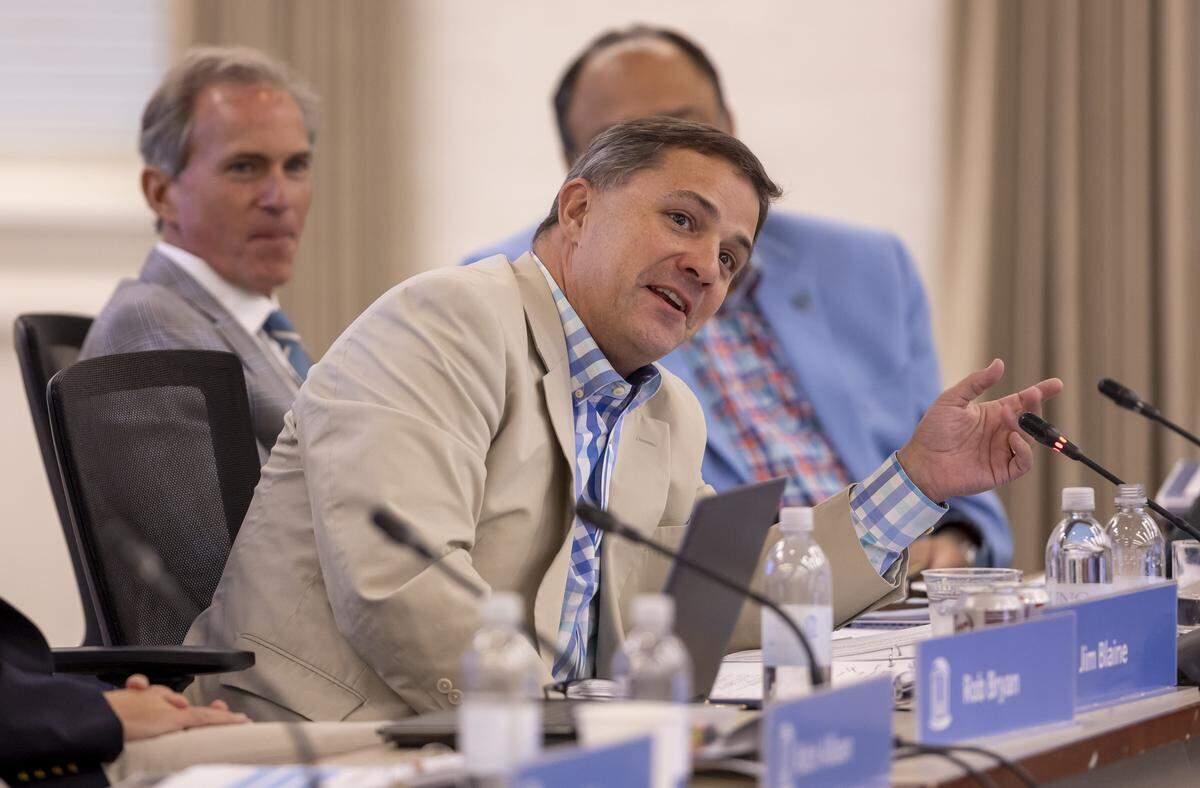
In an email sent by trustee Jim Blaine on May 15, just days after the meeting where they decided against tenure for Asher, he made his feelings about tenure clear.
Blaine is a former chief of staff for state Senate leader Phil Berger, and was highly influential in helping to shape and implement Berger’s political agenda — which turned out to be the dominant political agenda in the state. Now, he runs a political consulting firm called The Differentiators, which helped the UNC System select its current president, Peter Hans.
“I have opposed all tenure conferrals on the principle that they are an anachronistic relic of a different time that have tremendous potential to create long term financial challenges for the university,” Blaine wrote in the email. He hopes that the other trustees siding with him “is not a one off but the beginning of a trend toward trustees exercising the responsibility conveyed to them by the Board of Governors in the tenure process.”
Blaine said that in recent years, the trustees have begun to look at tenure as a financial proposition, and “dramatically improved the information available ... about the economics of specific tenure conferrals.”
In a separate email sent on May 15, Blaine warned fellow university leaders that “Everyone outside campus thinks admin is scared to death of the faculty.”
In another email obtained by The N&O, trustee Marty Kotis addresses members of UNC professors’ trade group: the American Association of University Professors, or AAUP.
Members at UNC wrote a letter condemning the board’s decision, calling it a vote “based on political ideology” and an “utter lack of professionalism.”
Kotis, a commercial real estate investor and developer, called the AAUP’s letter “a political attack masquerading as scholarship.” He says the authors “repeatedly attribute motives they cannot know and present assumptions as established fact. Because they disagree with the outcome, they simply assume Trustees acted out of ideology rather than legitimate governance concerns.”
The idea that the Board’s decision was the result of a political belief that Women’s and Gender Studies is a less-than-legitimate area of study is popular among faculty. The trustees’ politics have a conservative bent. Some of the trustees are appointed by the North Carolina General Assembly, and others are elected by the UNC Board of Governors, who are in turn appointed by the General Assembly.
Other faculty, though, see Women’s and Gender Studies as a political actor. School of Civic Life and Leadership professor Flynn Cratty told The N&O in April that “the main webpage of the UNC Women’s and Gender Studies program is like a political manifesto.”
Kotis, in his email to faculty, disavowed the characterization of the decision as political, and supplied the topics he thinks the conversation should revolve around instead.
“What is most revealing is what the authors ignore,” Kotis wrote. “There is no discussion of enrollment trends, credit-hour production, student outcomes, resource allocation, or return on investment. Instead, they assume faculty recommendations should prevail and that any disagreement must be political.”
He concluded, “discussions regarding program review, resource allocation, enrollment trends, and long-term commitments should occur earlier. Faculty, administrators, and Trustees would all be better served if these considerations were addressed before recommendations reach the final approval stage rather than after substantial time and resources have already been invested.”
Trustees are barred from discussing general personnel policy issues in closed session, and are limited to discussing specific personnel issues, according to UNC’s School of Government. Whether discussing the merits of tenure as an institution amounted to a violation of public meeting law was the subject of a 2025 lawsuit against UNC’s Board of Trustees from former provost Chris Clemens.
UNC’s student body president, Devin Duncan, has a seat on the Board of Trustees. Duncan told The N&O that he was one of few trustees to vote to award tenure to all the candidates presented at the May meeting. Records reveal that trustee Ralph Meekins voted in favor of Asher’s tenure as well.
For Duncan, if a candidate has ascended through all the checks and balances associated with a tenured hire, it’s not the board’s job to intervene, “unless information becomes available that suggests that this person isn’t worthy of employment for UNC-Chapel Hill, or if there was a process that was not followed correctly,” he said.
“I don’t want to say the board’s responsibility is to rubber stamp,” Duncan continued. “But I think that we should defer to the well-established policies in place.”
Enrollment trends & rubber stamps
In light of Kotis’s emphasis on enrollment trends, The N&O obtained enrollment numbers for UNC’s Women’s and Gender Studies department through a records request.
The data show that enrollment peaked in 2016. That year, there were 112 gender studies majors. Enrollment grew between 2000 and 2016, but has declined from 2017 to present. This past semester, there were 50 gender studies majors, and enrolled credit hours hit a record low of 891.
Ariana Vigil, chair of the Women’s and Gender Studies department, argues that blocking hires like Asher because of low enrollment is a paradoxical course of action.
“One of the ways that we were trying to address low enrollments is to hire more faculty who could teach more courses,” Vigil told The N&O. “And yet we’re being cut off at the knees and not allowed to do that.”
She sees the Board’s decision as less of an attack on tenure, and more of an attack on faculty in a particular disfavored field: gender studies.
The use of enrollment trends as a key reason for the decision raises alarm bells for Asher as well. She calls it “disingenuous.”
“If the Board’s goal is to dismantle tenure, it ensures that reputed but critical scholars like me don’t come to UNC,” Asher said. “If dismantling tenure is their goal and a political move, then the politics behind the no has nothing to do with my qualifications and what I can offer to UNC.”
TransparUNCy, a student group that advocates for transparency in university governance, has invited Asher back to UNC to speak at an event this fall.
Asher told The N&O she plans to take the group up on it.