
Heart-shaped ring from 1700s dug up at French fort in Michigan. It’s still wearable
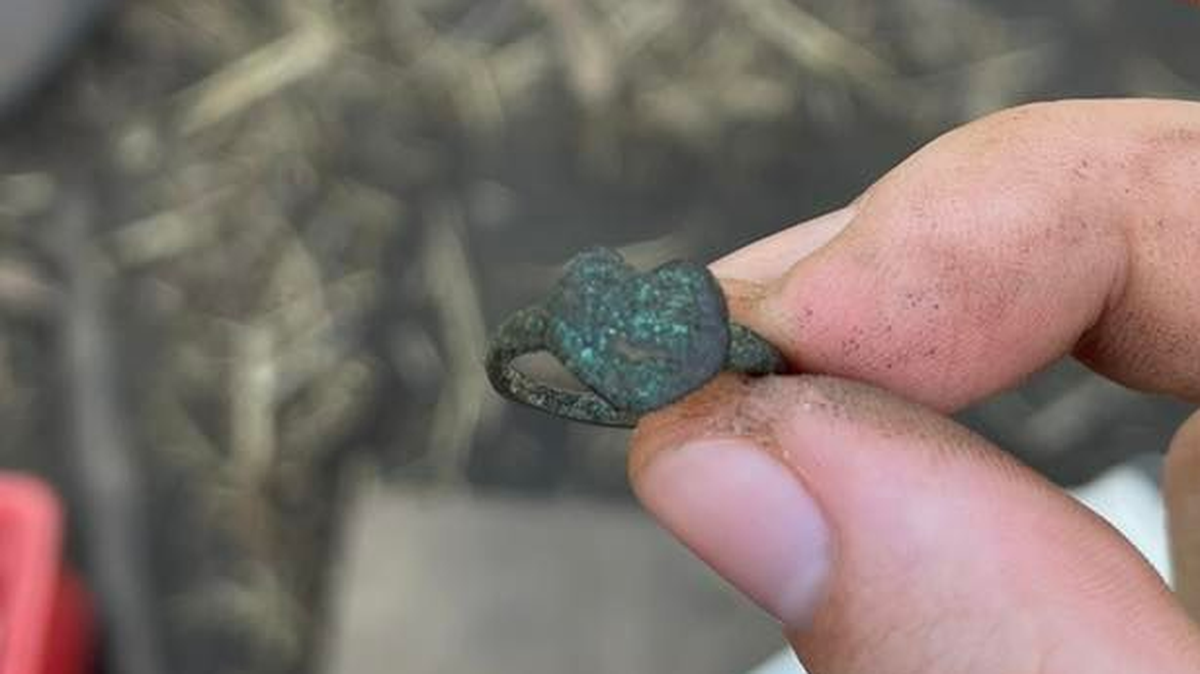
A surprisingly intact ring dating to the 1700s was found by a Michigan archaeology student on the grounds of an 18th century French stronghold known as Fort St. Joseph.
The ring is believed to have been a trade trinket used when southwest Michigan was known as New France, experts say. The fort, about 95 miles east of Chicago, was key part of France’s presence in the Great Lakes region, serving as a “mission, garrison, and trading post” before being abandoned in 1781.
Such historic baubles have come to be known as ”Jesuit rings.”
“Fort St. Joseph was occupied from the 1680s to the 1780s so the ring could have been lost at any point during that time frame,” according to Erika Hartley, field director and curatorial fellow at the Fort St. Joseph Archaeological Project.
“It was most likely manufactured prior to its arrival at the fort, but at this point it is hard to narrow down a specific date.”
The ring will be added to a collection fort artifacts at the Niles History Center, which houses the Fort St. Joseph Museum, Hartley said.
Western Michigan University student Kylie Krueger is credited with finding the ring “during our last week of excavation.” It appeared in a screen as she was using water to separate artifacts from soil, according to a project blog.
“These types of rings are typically made of copper alloy and the bezels can be found in numerous shapes such as round, oval, octagonal, etc.,” Krueger wrote.
“Other popular rings, included glass insets made to look like precious stones instead of the bezel. The ring I recovered is made out of copper alloy and has a heart-shaped bezel on the band.”
Similar rings from 17th and 18th centuries have been found at archaeological sites across the eastern U.S., “where French fur traders, missionaries, and explorers had contact with Native Americans,” according to the Museum of Anthropology at the University of Missouri.
“The exact origin of these rings is unknown; they are referred to as ‘Jesuit’ because of the religious motifs that are found on many of the rings, but secular designs are also common,” the museum says.
Use of the rings for trade began to wane in the early 18th Century, “disappearing almost completely in the 1780s,” Krueger wrote.
Other examples of “Jesuit rings” are already part of the Fort St. Joseph Museum collection, including some that were donated, she said.
“Jesuit rings” have an avid following of collectors across the world, who buy and sell them on the internet for hundreds of dollars.
This story was originally published September 12, 2022 at 2:05 PM with the headline "Heart-shaped ring from 1700s dug up at French fort in Michigan. It’s still wearable."