Federal judge to block NC voter ID law temporarily as the lawsuit continues
North Carolina voters might not have to show a photo ID in the 2020 elections, due to a ruling in federal court that’s expected in the coming days.
A federal judge in North Carolina said Thursday she would block the law, at least temporarily, as the voter ID lawsuit against the state continues. She said she will make her official ruling next week, but wanted to give advance notice of her decision. The judge, Loretta Biggs, wrote that state elections officials had been planning “a very large statewide mailing” next week to tell voters about the ID law, and she wanted to let them know they wouldn’t need to do that after all.
Details of what exactly the judge is planning to order are still not entirely clear. A spokeswoman for Attorney General Josh Stein, who must now decide how the state will react to the judge’s decision, said his office will wait to see the actual ruling next week before making any decisions on how to proceed.
Leaders from the N.C. NAACP — which sued over the law and asked for the injunction — said Friday that they expect voter ID to definitely be blocked for the 2020 primary elections in March. As for what the rules will be for the general election in November, they said it’s possible that the trial will have ended by then.
A spokesman for the N.C. GOP said Friday that Stein, a Democrat, should fight Biggs’ decision. And N.C. Speaker of the House Tim Moore, a top Republican and supporter of voter ID, also called on state leaders to appeal.
“To issue an injunction against one of the nation’s most lenient voter ID laws – which 34 states already have – without providing an opinion is an outrageous affront to due process, the rights of North Carolina voters, and the rule of law,” Moore said in a press release Friday.
Opponents of voter ID have said that voter fraud is incredibly rare. North Carolina officials caught one case of in-person voter impersonation in the 2016 elections, out of 4.8 million votes cast. They say the real intent of voter ID is to disenfranchise minorities and college students, who are less likely to have driver’s licenses and who tend to support Democrats.
North Carolina Republican lawmakers did have a previous voter ID law, from 2013, ruled unconstitutional after a panel of judges found that it was written with “discriminatory intent” to “target African-Americans with almost surgical precision.”
However, when lawmakers wrote the new version of the law in 2018, they made the rules less restrictive than they had in the unconstitutional 2013 version of the law. They also didn’t include some of the provisions of that previous law that had been singled out as particularly discriminatory.
That won over some Democratic support, although the bill still passed mostly along party lines. One Democrat — former Charlotte Sen. Joel Ford, who had been defeated in the Democratic primary earlier that year — co-sponsored the bill and was one of a handful of Democrats in the House and Senate who voted for it.
Voter ID amendment
The North Carolina NAACP and others sued the state in December 2018 over the voter ID requirement. In the 2018 elections, North Carolina voters approved a constitutional amendment requiring voter ID for future elections. Republican lawmakers wanted to put it into the state constitution after their previous attempt to pass it as a regular law was struck down as unconstitutional.
Voters approved the amendment by a 55.5-44.5 margin. However, the new amendment didn’t contain any actual details of what a voter ID law would entail, so the legislature came back to Raleigh after the election to write those details.
Lawmakers finished their work on the law in December 2018 — just after the “Blue Wave” midterm election in which Democrats ended the GOP’s veto-proof supermajority, but before any new Democrats were sworn in. Democratic Gov. Roy Cooper vetoed the bill, but in one of their final acts with a supermajority, Republicans overrode Cooper’s veto.
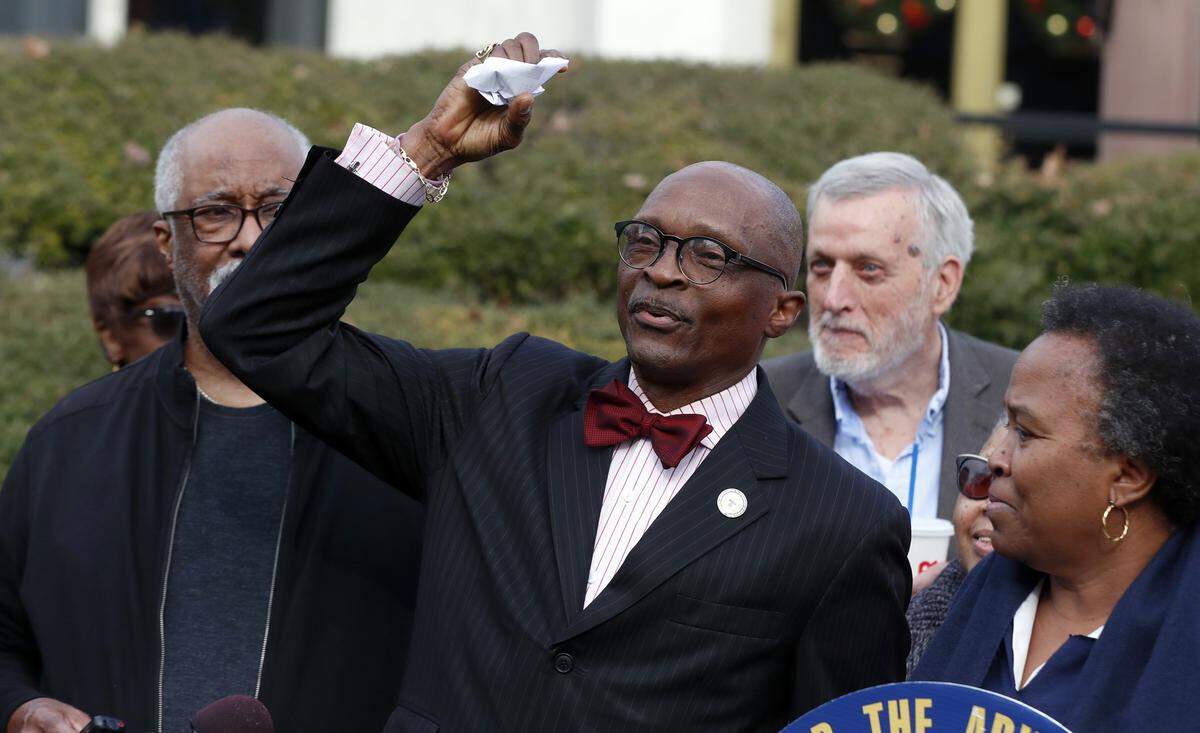
Almost immediately, the N.C. NAACP and others sued. And on Friday the group’s president, Rev. T. Anthony Spearman, called the judge’s announcement a “major victory” against “voter suppression using voter identification to deter minority voting.”
“We will continue to ensure that communities of color have a full opportunity to elect representatives who will protect their interests in the state legislature,” Spearman said in a press release.
North Carolina Republicans denounced the judge’s ruling Friday, pointing to the support the voter ID amendment received from voters statewide in 2018.
“This action, if it is allowed to stand, will invalidate the votes of millions of North Carolinians who voted overwhelmingly to implement voter ID and strengthen the integrity of N.C. elections,” NCGOP spokesman Jeff Hauser wrote.
There is another lawsuit, in state courts, challenging both the voter ID amendment and another 2018 addition to the state constitution that would lower the cap on the maximum level that income taxes could be raised to in the future. The NAACP is also a plaintiff in that case.
They won at trial, when in February Wake County Superior Court Judge Bryan Collins ruled the amendments unconstitutional.
Collins issued a sweeping order, writing that the General Assembly’s GOP supermajority was largely illegitimate due to unconstitutional gerrymandering. Regardless of how people voted on the amendments themselves, he wrote, the amendments should never have been on the ballot in the first place.
“An illegally constituted General Assembly does not represent the people of North Carolina and is therefore not empowered to pass legislation that would amend the state’s constitution,” he wrote.
State leaders appealed that ruling, and a decision from the N.C. Court of Appeals is expected next year.
This story was originally published December 27, 2019 at 9:16 AM.