NC prosecutors kept a Black Lives Matter protester off a jury. Did that bias a trial?
When a college student from rural North Carolina got called for jury duty in a murder trial back home, she showed up — only to be removed by prosecutors who didn’t want a Black Lives Matter protester sitting on the jury.
The North Carolina Court of Appeals has now twice upheld the defendant’s murder conviction.
Each time, the judges ruled that there isn’t enough evidence to prove that the Black man on trial had his rights violated when prosecutors blocked that college student and other Black people from serving on his jury.
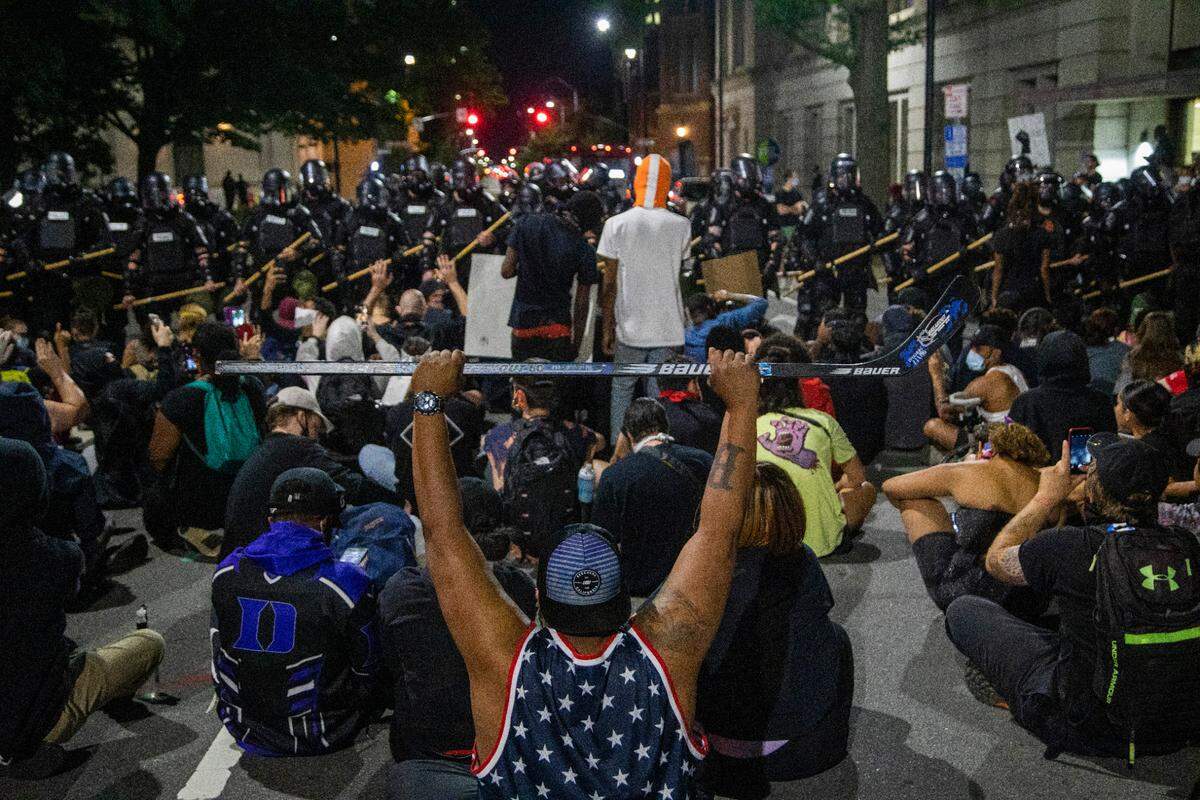
“This is just another instance of the racial biases in the system ... and it speaks volumes to the marginalization of individuals in the system,” said Kerwin Pittman, a prominent Black Lives Matter organizer in Raleigh, after the newest ruling came out this week.
In that 2017 murder trial, Antiwuan Tyrez Campbell was convicted of first-degree murder. Police said he killed another man at his ex-girlfriend’s home in Chadbourn, a small town in Columbus County in southeastern North Carolina.
But now Campbell is asking for a new trial. Although he has lost twice at the Court of Appeals, he could still go to the N.C. Supreme Court.
If he does win a new trial, it would be the first time this type of bias argument has ever worked in North Carolina — even though the legal basis for it has been around for decades.
Never in North Carolina
Courts all around the country have reversed numerous convictions due to claims of racial bias in jury selection. It’s known in the legal world as a Batson challenge, after a landmark 1986 U.S. Supreme Court ruling.
Even judges in heavily conservative Alabama have overturned about 80 convictions due to Batson challenges, said David Weiss, an attorney for the Durham-based Center for Death Penalty Litigation. But zero in North Carolina.
Both in North Carolina and nationwide, “prosecutors were about twice as likely to remove black jurors as everyone else,” Weiss said, citing academic studies that ranged from the 1980s to 2010s.
“That just shows how broken our system is right now,” he said.
N.C. Supreme Court Chief Justice Cheri Beasley is the first Black woman to hold the top judicial position in North Carolina history and one of six Democrats now serving on the seven-member court. Earlier this year, during the height of Black Lives Matter protests following George Floyd’s death in Minneapolis, she gave a rare public address in which she explicitly acknowledged systemic racism in the criminal justice system.
“In our courts, African Americans are more harshly treated, more severely punished and more likely to be presumed guilty,” Beasley said.
Weiss said that if Beasley and her fellow judges want to do something about that, they can start by recognizing the validity of Batson challenges.
“In some ways it’s not surprising we’re getting these much harsher penalties for Black defendants, when Black citizens are excluded from making decisions in the system,” he said.
Potential for reform
One prosecutor trying to do things differently is Durham County District Attorney Satana Deberry, who took over 18 months ago. One of her first acts was to require office-wide training on how to actively aim for more diverse juries.
“Criminal justice in this country is shot through with racial implications,” said Deberry, a Black woman who won the 2018 election running as a pro-reform prosecutor. “To pretend that it’s not does not help victims, nor does it help the rights of defendants.”
She did get some pushback on the training, which is understandable since lawyers tend to see jury selection as almost an art form, Deberry said. But she thinks many of them are coming around, especially as she points out that avoiding even the appearance of racism also means making a conviction more likely to hold up on appeal.
“Usually it is the most serious, most contentious cases that go to trial,” she said. “And you want that outcome to be the final outcome.”
In Charlotte, one of the lawyers in the Mecklenburg County Public Defender’s Office is Mujtaba Mohammed. He’s also a Democratic state senator and was recently appointed to a newly created task force studying race and criminal justice, created by Democratic Gov. Roy Cooper.
Mohammed has never argued a Batson challenge in one of his cases. Part of the reason, he said, is there are numerous rules that give legitimate reasons to strike potential jurors — but that end up applying disproportionately to Black people because of broader, systemic racism.
“We have so many qualified jurors being struck willy-nilly,” Mohammed said. “For even reasons like prior contact with law enforcement. So if you’ve ever been pulled over, or you live in a high crime neighborhood, they can get rid of you.”
The state of Washington recently passed jury selection rules to specifically address issues like that. Mohammed and Weiss both said North Carolina should do something similar, no matter which party controls the legislature after this November’s elections.
“These don’t have to be Republican or Democratic issues,” Mohammed said of criminal justice reform ideas. “They don’t have to be so political.”
The Black Lives Matter juror
In the leadup to a trial, either side can ask for any number of potential jurors to be removed for specific reasons. Also, a small number of “peremptory challenges” allow the lawyers to strike potential jurors without having to say why.
Prosecutors in Campbell’s trial in Columbus County used three of their four peremptory strikes on Black people.
But later, following allegations of racism, the trial judge did require prosecutors to explain why they had struck those three Black potential jurors.
Prosecutors said one had dated the brother of someone who may have been present at the murder, and another was friends with the mother of a potential witness.
The third had attended the same school as two people who might be asked to testify, prosecutors said.
Furthermore, prosecutors said, “when she was describing her political science background and nature as a student, she also was indicating that she was a participant, if not an organizer, for Black Lives Matter at her current college,” according to the court ruling by a panel of three appeals court judges, two Democrats and a Republican.
The court does not identify the full names of any of the jurors.
The judges ruled that they didn’t have enough information to decide if race was a factor in Campbell’s conviction, however.
There was no record of the jury selection process, nor information about other key racial questions that would be relevant, they wrote.
“However, we do not know the victim’s race, the race of key witnesses, questions and statements of the prosecutor that tend to support or refute a discriminatory intent, or the State’s acceptance rate of potential African American jurors,” the ruling said. “Finally, we see nothing in the record from which we can ascertain the final racial composition of the jury.”
For more North Carolina government and politics news, listen to the Domecast politics podcast from The News & Observer and the NC Insider. You can find it on Megaphone, Apple Podcasts, iHeartRadio, Stitcher or wherever you get your podcasts.