
NC House, Senate come to agreement on amount of state budget. But what will be in it?
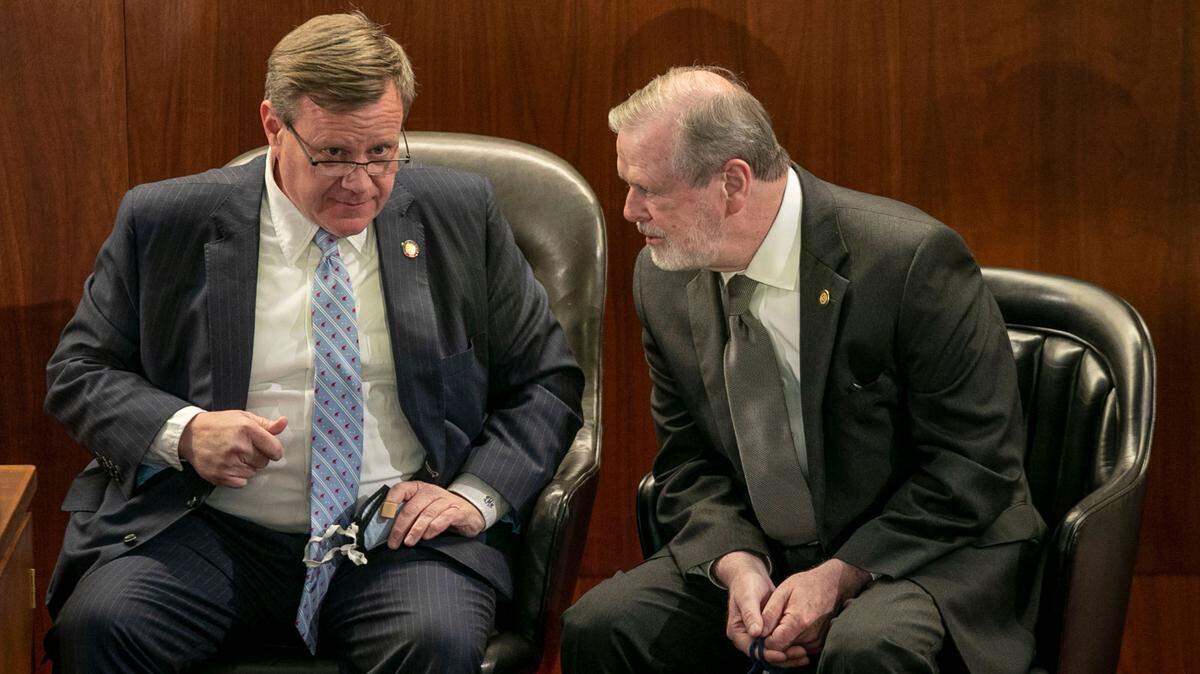
The North Carolina state legislature’s first budget battle is over: The House and Senate have agreed on how much they want state government to spend.
It is $25.72 billion for 2021-22 and $26.7 billion for 2022-23.
The decision followed months of negotiations and warnings in the past week that each Republican-led chamber would move ahead without agreement from the other. This is just round one, but an important one. Now the General Assembly is on track to send a budget to Gov. Roy Cooper by the end of July.
In a joint announcement Tuesday morning, Senate leader Phil Berger and House Speaker Tim Moore said that general-fund spending for the upcoming fiscal year would be increased by 3.45%, followed by a 3.65% increase the following year.
“This agreement builds on the last decade of responsible Republican-led budgets resulting in a boom decade that put North Carolina on a strong trajectory to recover from the recession,” Moore and Berger said in their joint statement. “As we work out the details of the budget, we intend to fulfill our commitment to balance the budget while saving for future needs and cutting taxes for the vast majority of residents.”
What now? What does the deal mean for raises? Tax cuts? A bond?
Construction projects
The budget agreement, as it stands now, does not include the amount of raises for teachers and other state employees. Nor does it include details on taxes, but the chambers did agree on wanting tax reductions.
Lawmakers agreed to spend money on unnamed construction projects, but not to borrow money for a bond.
“The agreement dedicates at least $4.2 billion in new capital spending funded through the State Capital and Infrastructure Fund to support critical needs across the state, including several transformational projects,” Berger and Moore said in their statement.
House Appropriations Chair Jason Saine, a Lincolnton Republican, told The News & Observer on Monday evening that with all the federal money coming to the state, they did not see a need for a bond.
Budget writers also decided the budget would not include Medicaid expansion, Moore and Berger said.
The latest projections from the legislature’s Fiscal Research Division estimate revenues of $27.4 billion next year, they said. They said the $25.7 billion in spending doesn’t include debt service payments. Those will come from the State Capital and Infrastructure Fund, they said.
The governor’s office indicated Tuesday this first round isn’t enough.
“Legislative leadership is well aware that this opening announcement falls far short of what our state needs,” Cooper spokesperson Ford Porter said in an email to The N&O.
“Real negotiations must occur and the Governor looks forward to working toward an agreement,” Porter said.
How much for raises?
One thing state employees can count on, if a budget becomes law, is raises.
“There’s raises, I can tell you that,” Saine said, adding that there is not a concrete amount yet.
With only a total spending number reached, the amount of raises in the budget is still to be determined. It was at the center of the 2019 budget battle between Cooper and the legislature, along with Medicaid expansion and taxes.
Cooper’s budget proposal calls for an average pay raise of 10% over two years for teachers and administrators, as well as restoring master’s degree pay. He also wants 7.5% raises for school districts’ central office staff and noncertified public school employees over two years.
Cooper’s proposal also calls for a $15-an-hour minimum wage for noncertified, public school employees including teaching assistants, cafeteria workers and bus drivers. And he wants to give $2,000 bonuses to teachers, principals, noncertified public school employees, university employees and community college employees the first year, followed by another $1,000 bonus the year after.
Cooper’s budget proposal also includes a 7.5% raise over two years for UNC and state-funded local community college employees, and 5% for other state employees. Retired state employee retirees would get cost-of-living adjustment raises of 2% each of the next two years under Cooper’s plan.
What about tax cuts?
The Senate revealed its tax plan a few weeks ago. Senate Finance Chair Paul Newton, a Mount Pleasant Republican, previously told reporters they proposed the tax cut because “we believe people spend their money better than government does.”
Newton’s bill passed the Senate Rules Committee on Tuesday. After the meeting, he told reporters that he expects the bill to go to the Senate floor as early as Wednesday and also become part of the budget.
On the chamber budget negotiations, he said:
“I think it’s better for everybody if we can reach an agreement. It’s even better for everyone if we have bipartisan agreement on that budget. And that’s certainly what we’re trying to do,” Newton said.
He expects some changes on the tax plan in the budget process, but doesn’t yet know what those will be.
House budget writers are generally on board with the Senate’s tax plan.
“We like their plan,” Saine said, adding that it will still come down to if the House agrees with the Senate’s budget. He said while the specifics are still fluid, there isn’t really anything in the Senate plan that has House opposition.
However, the Republican-proposed tax cuts in the Senate bill are unlikely to get support from the governor.
“The last thing we need is more sweeping tax breaks for corporations and the wealthiest among us instead of investments in our hard-working families and communities,” Porter said in an emailed statement when the plan was announced.
Budget negotiations between chambers
In every odd-numbered year, the General Assembly is tasked with passing a two-year budget. But if it fails, there won’t be a government shutdown like in the federal government. Failure would just mean state workers might not get raises, new programs won’t be created and departments could be stuck with funding levels from the past.
The legislature has not passed a full budget since the summer of 2018, the last time Republicans had a veto-proof supermajority. That year the budget they voted for spent $23.92 billion. So the numbers lawmakers are considering this year would represent an increase of around $1.8 billion since then.
That would be around 7.5% growth since 2018, meaning this year’s proposal is outpacing the roughly 6% national growth in inflation in the same period, without accounting for North Carolina’s growing population.
This year, the Republican-led Senate lobbed its first offer back in March, with $25.4 billion for 2021-22 and about $800 million more the second year of the budget cycle, according to a legislative document obtained by The News & Observer.
Cooper unveiled his budget proposal later that month, to spend $26.6 billion in 2021-22 and about $300 million more the second year.
The Republican-led House’s counter offer to the Senate, still in March, was $26.3 billion.
The fact that the budget plan from the Republican-led House was closer to the Democratic governor’s plan than to their own Republican colleagues’ plan in the Senate wasn’t entirely surprising to many political observers. Even though Republicans control both the House and Senate, the budget writers and other top leaders in the Senate, at least in recent years, have tended to have a more austere philosophy than their House counterparts.
After that, the Senate and House traded offers until they were just $300 million apart.
On June 3, Berger said that the Senate’s most recent offer — $25.6 billion — was the final offer for a comprehensive budget, and that he planned to put forth smaller, “mini” budget bills.
The House, still focused on an overall budget, said they would move forward without the Senate if needed.
Berger told reporters last week that the Republican chambers agreed previously that they would decided on a total spending number before releasing any budget proposals. That looked like it could have meant another drawn-out summer stalemate.
But over the weekend, the two sides left their trenches and came to a final agreement, which they announced Monday afternoon.
Now the work begins in a different way — laying out all the budget proposals for other lawmakers to debate and for the public to see.
What’s next
Just having an agreement on a total figure doesn’t necessarily mean the two sides will agree on the details of exactly how to spend that money. The News & Observer reported in 2018 that since 1985, there had only been three years in which one chamber passed the budget and then the other chamber passed the exact same plan with no revisions. Almost every year, there have been changes made, requiring negotiations behind closed doors to come to a final agreement.
There could be some differences between the chambers this year, too, though they appear to have agreed on the major issues.
The Senate could roll out its budget later this week or early next week, and pass it soon after.
The House would follow with its own budget process. Then both chambers must pass a final budget they agree on, called the conference budget.
Saine said because the process is about three weeks behind, he expects the legislature to pass the final budget three weeks after the start of the fiscal year, which is July 1. He said lawmakers will also take a brief break around the Fourth of July holiday.
For more North Carolina government and politics news, listen to the Under the Dome politics podcast from The News & Observer and the NC Insider. You can find it at link.chtbl.com/underthedomenc or wherever you get your podcasts.
This story was originally published June 8, 2021 at 9:44 AM.