
How NC’s Black caucus is trying to advance its goals in ‘a fairly conservative state’
History repeats itself.
Rep. Kelly Alexander, the chair of North Carolina’s Legislative Black Caucus, used the adage to explain what’s happening at the General Assembly.
When the North Carolina state legislature debated a bill about Critical Race Theory, all of the Black lawmakers sat on one side of the aisle. When it came time to decide if long-planned funding for the monument to African Americans on the state Capitol grounds would be in the budget, Black lawmakers were again sidelined.
But not being in the majority — in terms of both race and party — doesn’t mean they don’t have power.
Money for the monument, which is to be designed for the Capitol grounds’ most frequent visitors — schoolchildren, to educate them about African American history in North Carolina — has been stalled yet again. It is just one of the budget priorities of the Legislative Black Caucus which they say are going unmet. Others include funding for HBCUs and entrepreneurship programs.
The Legislative Black Caucus, which includes all the African American lawmakers as well as two Indian-American, one Latino and one Native American lawmaker, are all Democrats.
North Carolina is in the heat of the state budget battle. The Senate and House have each passed its own version of how to spend $25.7 billion of taxpayers’ money. They are now in the compromise part of the process working on the final budget bill. The only Democrats on that negotiating committee led by Republicans are the ones who voted for the budget. And on both the House and Senate committees, that includes members of the Legislative Black Caucus.
Teaching Black history
Democrats are the minority party in both chambers of the General Assembly. That meant when a bill to outlaw teaching Critical Race Theory in K-12 public schools passed the House, Republicans did not need any Democrats to vote with them.
In an interview with The N&O, Alexander, of Mecklenburg County, called the bill “a mistake.”
“My problem with [House Bill 324] is anything that we would do legislatively that makes it more difficult to teach history warts and all, I think is a mistake. America is a great country, but it is not a perfect country. If you take even a cursory glance of American history, you take the good and the bad at what we’ve done,” Alexander said.
Several House Democrats objected to the bill during floor debate. Republicans countered that the bill did not change what can and can’t be taught.
“It simply prevents schools from endorsing discriminatory concepts,” said Rep. John Torbett, a Gaston County Republican, The N&O previously reported.
Alexander, like his late father Kelly Alexander Sr., has been active in civil rights and served in state and national NAACP leadership roles. He said that younger North Carolinians need to understand what African Americans have achieved and overcome, where they’ve come from and future challenges “as we move toward equality. We’re not there yet.”
He said that anything that makes it more difficult to honestly discuss history “does us all a disservice.”
“I’ve been reading recently about the 1890s in North Carolina in the legislature and various debates,” Alexander said. “It’s very clear that this legislature I’m serving in, in that period of time, was full of folk who did not question the doctrine of white supremacy. ... Which is interesting when you fast forward to where we are now, and you have a Black man as lieutenant governor. Just about every legislator from the 1890s would be spinning in their coffins if they knew that was the case right now.”
Lt. Gov. Mark Robinson, elected in 2020, is the first Black lieutenant governor in the state. He is also a Republican.
The Legislative Black Caucus, who are all Democrats, met with Robinson this month at the Legislative Building, where he presides over the Senate. Alexander said the caucus invited Robinson to meet.
Robinson has been at the forefront of the Republican Party’s push to outlaw teaching Critical Race Theory in public schools. The House passed a bill earlier this summer and the Senate planned to take up its version this week. Robinson also planned to reveal complaints from parents and teachers Tuesday about cases of what he calls “indoctrination” of students.
Robinson said earlier this year that he has heard numerous complaints about indoctrination or “politicizing the classroom,” and wanted to make sure people are treated fairly in the classroom.
Rep. Amos Quick, of Guilford County, said the caucus talked about a variety of issues with Robinson.
“It’s always curious to me when the word indoctrination comes up — that we don’t want to indoctrinate our children. What do they think has happened to African American children all this time?” Quick said. “They’ve been fed a steady diet of nothing about their history.”
Quick said schools should provide a complete telling of North Carolina and all the contributions of Africans and African Americans to the state.
“Does anyone really think the true and accurate history of America has ever fully been told? And I think the reasonable answer would be no,” Quick said.
Quick served a dozen years on the Guilford County Board of Education and has worked with youth. He said an important question to ask when U.S. history is being taught is: “Well, what were African Americans doing at the time?”
“When we don’t ask that, it gets glossed over,” he said.
In North Carolina’s latest U.S. Census figures, 20% of the population is Black.
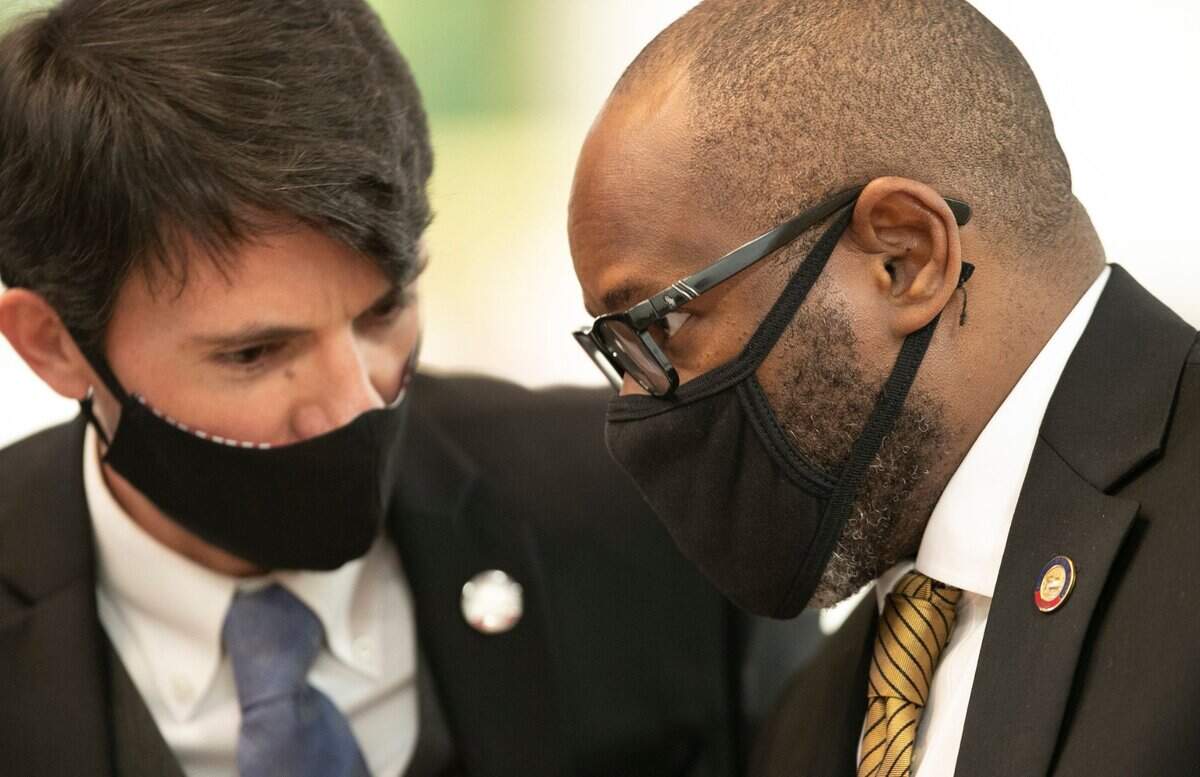
Alexander said the caucus invited Robinson to meet, which they did for more than an hour.
“The genesis of it was that I heard a comment that he had made, or lens that he made to the effect that he had not gotten the recognition in some quarters for his achievement,” Alexander said.
“And I happen to believe that because he is the highest elected Black official that it is appropriate that the caucus meet with him,” he said, as well as talk about priorities and have a “good back and forth.” That they did, he said.
“At the end of the allotted time, we still had folk who wanted to talk, and to me that’s the hallmark of a good meeting — people want to stay and talk,” Alexander said. He said the meeting was informal and a step in the right direction.
“One thing that sticks in my mind is he’s not an advocate of voting by mail and we are,” Alexander said.
About 40 caucus members came in at some point during the hourlong meeting with Robinson, Alexander said.
Robinson told The N&O on Monday that his meeting with the Legislative Black Caucus “was a step towards breaking down many of the barriers based simply on partisan politics.”
“While there are many policy issues that we won’t always agree on, this was a way to begin a conversation. When I was running for Lt. Governor, I said it wasn’t to play partisan games; it was to fight for the beliefs and values that North Carolinians hold dear. I hope that this meeting is only a start for conversations down the road,” Robinson said.
NC’s political makeup
Debate on Critical Race Theory on the floor of the House of Representatives was vigorous and at times emotional. Republicans have the numbers to pass a bill without any support from Democrats, though they do not have the ability to override a veto from the governor without Democrats if everyone votes.
“The [legislative] process doesn’t guarantee a result, it guarantees you can be heard,” Alexander said. “And being heard, you hope you can change the hearts and minds of some people and end up with a better result.”
“This is the same kind of debate that happened well over 100 years ago, and a handful of Black legislators would get up knowing that their motions would not get seconded ... but they kept getting up. They kept speaking. And ultimately things did change,” Alexander said.
He noted that North Carolina is a purple state, with a close to even distribution between Democrats and Republicans. North Carolinian voters chose both Barack Obama and Donald Trump as president.
“Ultimately here in this General Assembly, in this time, even though we are in the minority — we being the Democratic Party, particularly being Black folk — we still persist and ultimately I believe our positions, I believe at least half the people of North Carolina support,” he said.
“Never forget that North Carolina is at its base a fairly conservative state. So whether you’re talking about conservative Democrats or conservative Republicans, you’re talking about conservative people, and therefore there are certain things that resonate about the broader population here. Family resonates. Development of small business resonates. Religious values resonate. These are things I think are outside of party when you talk to just an average citizen,” Alexander said.
“At the same time the exact mix of conservative and liberal changes over time. We have more and more people who move into the state who have slightly different values, who are more open to discussions about change,” he said.
Freedom Park and the Capitol monument
After the Senate released a proposed budget in June, The N&O asked head budget writer Sen. Brent Jackson, an Autryville Republican, why the $2.5 million the Senate included previously for a monument to African Americans on the state Capitol grounds wasn’t there.
Jackson said that because the Confederate monuments were taken down at the Capitol, “we just felt like this was not the time to put something back up there of any type,” The N&O previously reported.
Sen. Gladys Robinson, a Guilford County Democrat and member of the Legislative Black Caucus, called the decision “an insult.”
The House likewise provided no funding for the Capitol monument in the version of the budget it released this month. However it did allocate money for a different downtown project that champions the Black experience in North Carolina.
Sen. Natalie Murdock said the people leading the Freedom Park project were surprised to find out that the House allocated $650,000 for it in this budget bill. The park did not request additional state funding, though it is appreciated, she said.
Murdock, the campaign coordinator for Freedom Park, said the group requested and just received $100,000 from the city of Raleigh and received $100,000 from Wake County, too. The project has had only a ceremonial groundbreaking in fall of 2020. Contractor discussions are still underway, she said.
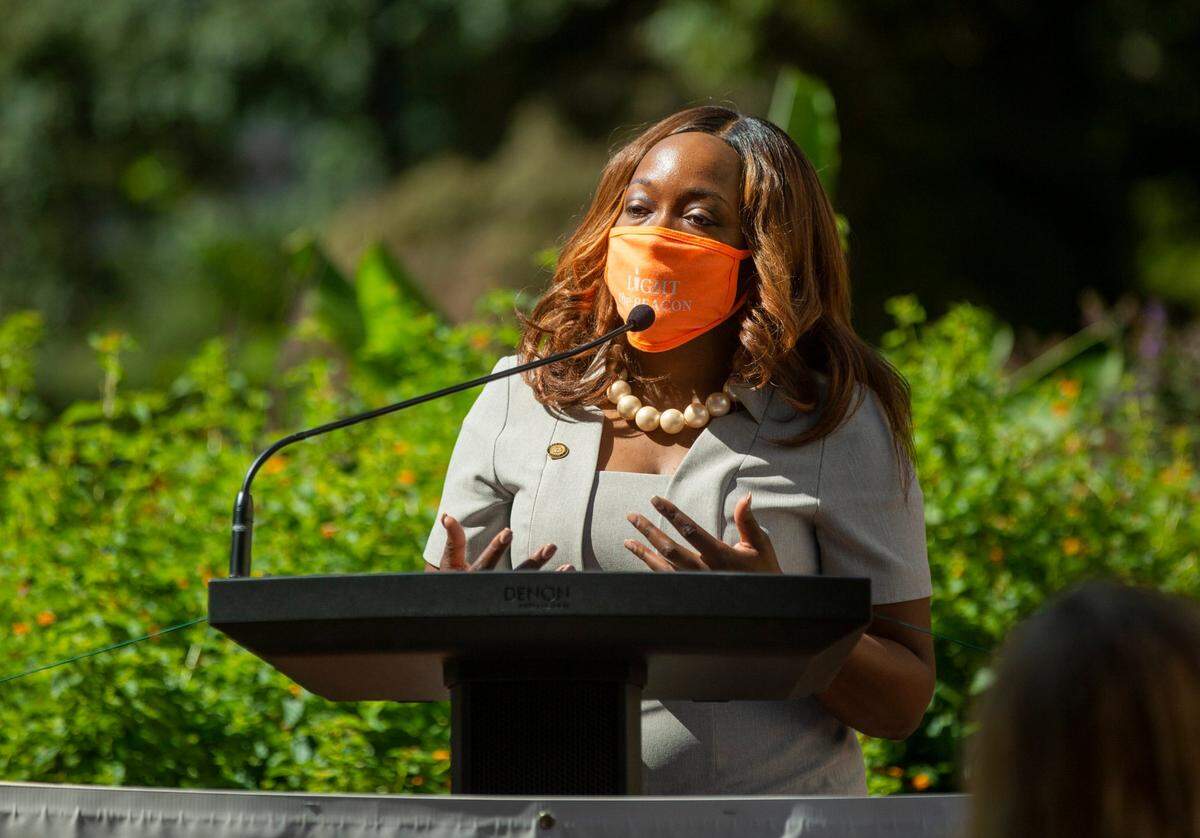
Freedom Park will feature public art and will be built on Lane Street on the block between the Executive Mansion and the Legislative Building. It is a completely separate project from the African Americans monument on the Capitol grounds a few blocks away, which the Department of Natural and Cultural Resources has said is just on hold, waiting for that $2.5 million in funding in order to move ahead.
Quick said a Republican lawmaker should champion the monument and see it through. He and a former Republican House member were behind an earlier bill for Freedom Park.
Rep. Jason Saine, a Lincolnton Republican and head budget writer, said the funding for the monument could still come through. He said that the conference process is a good time for the Legislative Black Caucus to reiterate what it wants to see in the final budget.
He said there may have been a miscommunication with bill drafters about where to allocate money — Freedom Park or the Capitol monument. He noted the House fully funded $1.5 million for Freedom Park in 2020 through a mini budget bill.
Saine said that Capitol monument funding could come in a technical correction or conference budget bill.
Alexander, the Legislative Black Caucus chair, said the lack of funding for an African American monument on the state Capitol grounds “speaks for itself for the priorities of the majority.”
“I think that’s a mistake, also think it’s a mistake not to include about $2.5 million for an incubator to help minority entrepreneurship development. The greater atrocity to me is not funding the incubator,” Alexander said.
Saine said that other organizations funded in the budget also focus on entrepreneurship, so “it’s not like we’d say no to something like that.”
“Nothing’s final,” Saine said.
The final budget
Alexander said the budget should have more funding for historically Black colleges and universities, and that when there is focus on rural areas, there is also a lack of funding for programs in the inner cities.
Eight members of the Legislative Black Caucus are serving on the committees that will hammer out a final budget. Their colleagues in the caucus are watching closely.
Quick said there are expectations for those members.
“We would hope that a seat at the table is not the ultimate goal, but having influence from that seat is the ultimate goal,” Quick said.
Saine noted the Democrats on the conference committee.
“We’re certainly glad to have those folks on there — by voting for the budget, it also means they have more of a voice in this process,” Saine said.
Saine said that beyond the conference committee, Democrats can also make their priorities known to Gov. Roy Cooper, a Democrat who is also part of the final negotiating process. He said a budget vote could come as soon as Sept. 9, and that now the chambers are negotiating the tax package.
Murdock, an officer in the Legislative Black Caucus, said its members will continue to advocate for their budget requests, including HBCU funding, minority businesses and health programs.
“The are definitely a lot of things left out that would benefit minorities,” Murdock said. She’ll continue to talk with Republican leadership about the final budget, which could be done in the next few weeks.
“It’s not too late,” she said.
This story was originally published August 23, 2021 at 3:23 PM.