
Gov. Cooper blocks latest legislative bill in NC on emergency powers
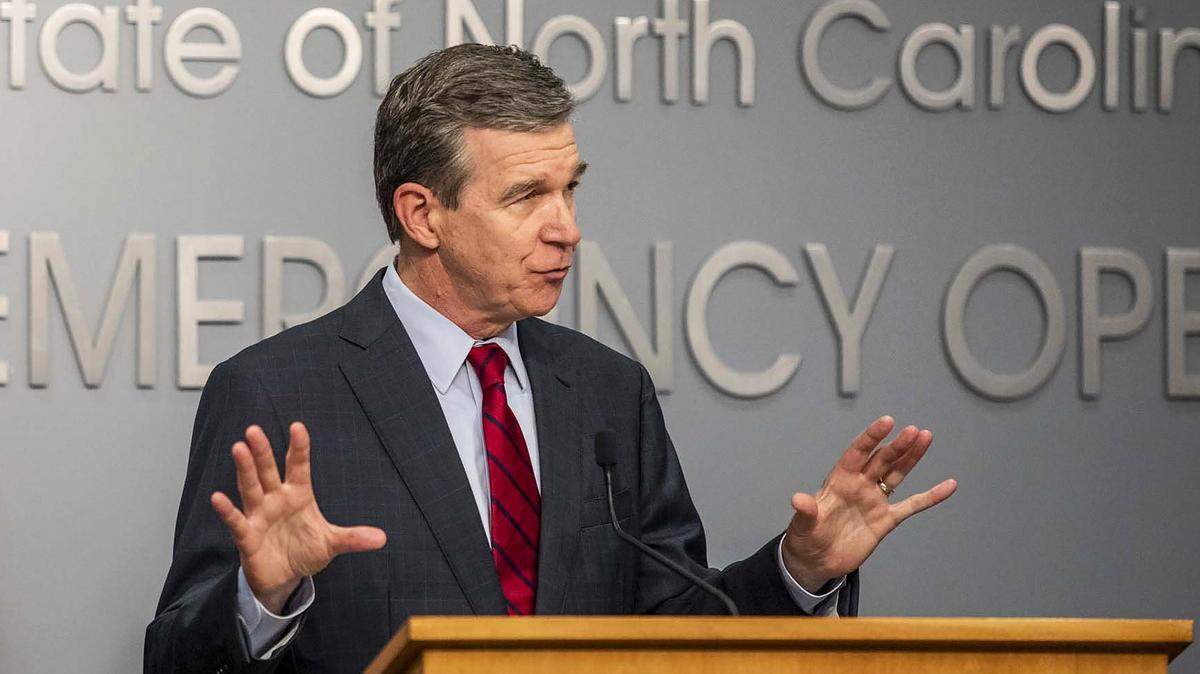
North Carolina Gov. Roy Cooper, a Democrat, vetoed a bill on Monday night, the latest attempt by the Republican-led General Assembly to take away some of his powers.
Cooper said in a statement that emergency decisions “should stay with experts in public health and safety, not a committee of partisan politicians.”
The veto on Monday night — the deadline to take action — comes during what appears to be the final days of state budget negotiations between Cooper and Republican legislative leaders.
The final vote on House Bill 264, called the “Emergency Powers Accountability Act,” had been delayed for weeks as lawmakers waited for lead sponsor Rep. Keith Kidwell, a Chocowinity Republican, to return. Kidwell and his wife had been sick with COVID-19.
The final debate was brief — just Kidwell deadpanning before the vote that it was a non-controversial bill. In fact, it has been a long-running, controversial topic at the legislature.
The House and Senate are majority Republican and can pass bills without Democratic support, but need them for veto overrides.
Almost 20 months into the pandemic, North Carolina is still under a state of emergency declared by Cooper. But there haven’t been any statewide restrictions since the last ones expired at the end of July.
“There is no emergency – none – that lasts for nearly two years. At that point, it’s no longer an ‘emergency’ – it’s the new status quo,” Sen. Bill Rabon, a Brunswick County Republican and the powerful Rules chair, said in a statement Monday night.
“Yet for 19 months the Governor has held onto every iota of unilateral authority he has. It’s unhealthy, unsafe and undemocratic.”
Republicans have proposed changing state law to put more limits on the governor’s powers in various bills, and this latest one required agreement from a majority of the Council of State to extend states of emergency beyond seven days. Beyond that, a state of emergency lasting more than 45 days would have to be approved by the legislature.
“North Carolina is emerging from a global pandemic with lives saved and a strong economy because of effective statewide measures to protect public health under the Emergency Management Act,” Cooper said in an emailed statement Monday night.
“We must be able to act quickly and thoroughly when deadly diseases, hurricanes, or any other dangers threaten people’s lives and jobs. An emergency needs decisive, quick and comprehensive action, not bureaucracy and politics.”
Checks and balances
But Republicans have framed the issue as checks and balances between the branches of government.
“House Bill 264 would have instituted common-sense checks and balances on the Governor’s executive authority, instead of consolidating power into one office,” Rabon said in a statement Monday night.
“Every passing day that the Governor refuses to relinquish his ‘emergency’ power is a day that harms our constitutional order.”
Republicans aren’t alone in passing legislation to limit executive branch powers. Across the country, state legislatures have pushed back against governors’ orders during the pandemic.
Democrats in the legislature continuously opposed this and prior bills, and support for the topic has fallen nearly completely along party lines. In the final vote on the bill, one House Democrat voted in favor.
Versions of it were also included in each of the House’s and Senate’s budget bills passed this summer. House Appropriations Chair Rep. Jason Saine, a Lincolnton Republican, told The N&O last week that the issue is something the Republican caucus is “very concerned about.”
“It’s certainly a point of contention with the governor. That’s pretty obvious,” he said.
In an interview with The N&O at the start of his second term in January, Cooper said that he had concerns about changing emergency management law during the pandemic.
“It may be as soon as we turn the corner on this pandemic, and later on in the summer and fall, that may be something we want to look at,” Cooper said in January.
But the initial spring and summer drop in COVID-19 metrics once vaccinations became readily available was short-lived as the delta variant emerged and led to a new surge.
Now, COVID-19 numbers have again dropped off significantly in North Carolina and across the United States. Vaccine booster shots are nearing wide availability, and vaccinations are soon to be available for children ages 5-11. More than 70% of North Carolinians have had at least one vaccine dose.
For more North Carolina government and politics news, listen to the Under the Dome politics podcast from The News & Observer and the NC Insider. You can find it at link.chtbl.com/underthedomenc or wherever you get your podcasts.
This story was originally published November 1, 2021 at 7:44 PM.
.jpg)