Lawyers ask NC Supreme Court Justices Berger, Earls to stay out of school funding case
Two North Carolina Supreme Court justices on opposite ends of the political spectrum are facing calls to step aside from a case that will decide how public schools are funded.
On July 13, attorneys for state Republican legislative leaders filed a motion asking Democratic Justice Anita Earls to recuse herself because of her previous involvement in the Leandro school funding case as a lawyer.
Two days later, attorneys for school districts seeking more funding filed a motion asking GOP Justice Phil Berger Jr. to recuse himself because his father, Senate leader Phil Berger, is appealing a judge’s order to increase education funding.
The motions come as the N.C. Supreme Court will hear oral arguments on Aug. 31 over whether it should order the transfer of $785 million from the treasury to fund the Leandro education plan.
“It’s more gamesmanship on each side, which doesn’t need to take to take place,” Bob Orr, who served as a N.C. Supreme Court justice from 1994 to 2004, said in an interview on Monday. “They need to get it right.”
The long-running Leandro school funding lawsuit was initially filed in 1994 by low-wealth school districts to get more state funding.
Over the years, the state Supreme Court has ruled that the state Constitution guarantees every child “an opportunity to receive a sound basic education” and that the state was failing to meet that obligation.
One of the questions facing the court’s 4-3 Democratic majority is how far to go to enforce the right to a sound basic education. GOP lawmakers argue only the General Assembly can appropriate money and not the courts.
Earls served as attorney in case
The motion from Berger and House Speaker Tim Moore points to how Earls served as an attorney in 2005 for Charlotte-Mecklenburg students who joined the case as plaintiffs. They also point to how in 2012, Earls signed on behalf of the Southern Coalition for Social Justice an amicus brief filed by 10 groups supporting the school districts.
“The North Carolina Code of Judicial Conduct provides that a judge should disqualify himself or herself when they previously participated in the case as a lawyer for the parties,” Matthew Tilley, the attorney for Berger and Moore, writes in the motion.
But Melanie Dubis, the attorney for the school districts, filed a response saying the 2005 filing dealt with student assignment issues in Charlotte-Mecklenburg that have nothing to do with the current appeal.
Dubis also says the plaintiffs don’t believe Earls’ participation in the 2012 brief will impact her ability to serve as an impartial justice.
Berger’s dad appealing court order
In the motion asking Berger to step aside, Dubis points to how Sen. Berger isn’t a named defendant in the case but is appealing the transfer of funds supported by Democratic Gov. Roy Cooper. Dubis cites several statements that Sen. Berger has made criticizing the courts for intervening.
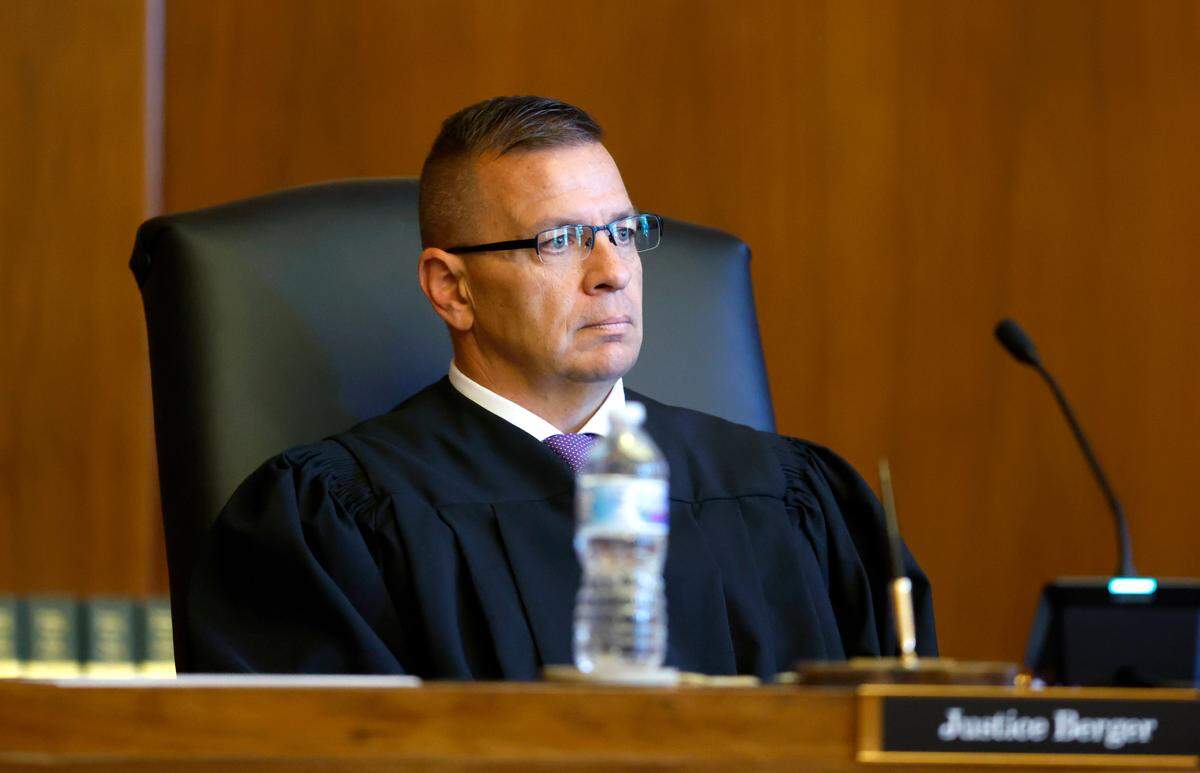
“N.C. Code of Judicial Conduct, Canon 3(C)(1) states “[o]n motion of any party, a judge should disqualify himself/herself in a proceeding in which the judge’s impartiality may reasonably be questioned[.]” Dubis writes.
In the legislative leaders’ response, Tilley writes that Sen. Berger can intervene in his official capacity in any case involving the state. Tilley says Sen. Berger’s intervention is no different from the other cases that Justice Berger has not recused himself from that involved his father.
Justices decide on their recusals
Over the past year, groups have tried to get Berger, Earls and other justices to recuse themselves in cases involving high-profile issues such as election redistricting and voter ID, but they have declined.
Under rules the court released in December, the individual justice identified in a recusal motion can either decide on their own whether to participate in a case or ask the rest of the court to do so, the Associated Press reported.
Despite the motions, it’s not expected that Berger or Earls will recuse themselves.
“Plaintiffs observe that, undoubtedly, Mr. Berger will assert that Justice Berger has the ability to remain impartial in this matter,” Dubis wrote in a court filing. “Should both Justice Berger and Justice Earls believe that they can, in fact, remain impartial, Plaintiffs suggest that the same course of action is appropriate for both.”
Orr, the former Supreme Court justice, said it’s unfortunate how politicized the Leandro case has gotten. in 2004, Orr persuaded his fellow justices to unanimously support the ruling he wrote that found the state must provide the resources necessary so that the educational needs of all children are met.
“It was never considered a partisan case,” Orr said. “It was considered a constitutional issue about a very important issue in North Carolina.
“That being public education and opportunities for all kids across the state to get an opportunity for an education. But like so much else in the nation, it’s become partisan.”
For more North Carolina government and politics news, listen to the Under the Dome politics podcast from The News & Observer and the NC Insider. You can find it at https://campsite.bio/underthedome or wherever you get your podcasts.
This story was originally published July 25, 2022 at 3:20 PM.