NC Republicans pass restrictions on gender identity discussion in schools
North Carolina House Republicans limited debate Wednesday before approving a bill that would restrict instruction on gender identity in elementary schools and could potentially “out” LGBTQ+ students to their parents.
The N.C. House voted 66-47 on Wednesday to pass the “Parents’ Bill of Rights,” which would bar curriculum on gender identity, sexual activity or sexuality in kindergarten through fourth grades in public schools. It went on to pass the N.C. Senate Thursday along party lines, and is headed to Gov. Roy Cooper’s desk.
Senate Bill 49 also would require teachers and other public school employees to notify parents if their children change their names or pronouns on school records.
House Republicans invoked a rule that restricted the number of amendments and limited the amount of time spent debating the bill. House Speaker Tim Moore cited how a deal had been reached on the bill with the Senate GOP following negotiations.
“It’s not bad faith,” said Moore, a Cleveland County Republican. “It’s not anything like that. It’s just a tool that the majority is choosing to use to progress the bill along. That’s it. That’s contemplated in our rules.”
But Democratic lawmakers complained they felt they were being silenced by the Republican majority.
“Just because you can do something doesn’t mean you should do something,” said Rep. Robert Reives, the Democratic leader from Chatham County. “Just because you can steamroll doesn’t mean you should steamroll.”
Veto of bill likely
After the Senate adopted an earlier version of the bill, the House made changes such as expanding the Senate’s ban on gender identity and sexuality instruction from grades K-3 to include fourth grade.
Republican lawmakers from both chambers had been working behind the scenes to reach a compromise.
“This is a bill that has been agreed upon with the Senate and negotiated,” Moore said.
Cooper, a Democrat, is expected to veto the legislation. But Republicans have large enough majorities to override Cooper after Rep. Tricia Cotham left the Democratic Party.
A similar bill passed the Senate in 2022 but wasn’t voted on in the House.
Contentious debate in Senate
During the brief House floor debate, Republicans said that the bill ensures that parental rights are respected by schools.
“This is saying that the foundations of our state and our country is based on the family,” said Rep. Brian Biggs, a Randolph County Republican. “We’re saying today that the family is first.”
But Democrats said it will weaken the relationship that students have with teachers.
“This bill creates more divisions between parents and teachers,” said Rep. Julie von Haefen, a Wake County Democrat. “It creates more division between our communities and our schools, and it’s absolutely the wrong way to go.”
Although it was limited in the House, there was no shortage of debate in the Senate. Senators from both parties spoke on the bill.
Democrats sought to characterize the bill as an attack on the LGBTQ+ community, and one that would prevent teachers from answering questions from curious children.
“I think what we’re seeing here is the last vestiges of efforts to erase the LGBTQ community,” said state Sen. Lisa Grafstein, a Wake County Democrat. “What I see in these bills is that some people just claim this mythological past where everyone lived in sort of a ‘Leave It to Beaver’ world — that was never really true.”
The Republicans responded by framing the bill as protective of parents’ rights to instill certain values in their children.
“The whole point of the bill is that parents in North Carolina should be empowered to raise their children the way that they see fit in their family without being questioned or interrogated or undermined by the state of North Carolina,” Galey said.
LGBTQ-related bills passed in legislature
The “Parents’ Bill of Rights” is among several bills affecting the LGBTQ+ community that are being advanced by Republican lawmakers in North Carolina and across the nation.

On Wednesday, the House backed a bill that would bar surgical gender transition procedures and puberty blockers for transgender minors, and penalize doctors who perform those treatments. House Bill 808 was already passed by the Senate and will go to the governor’s desk..
Last week, lawmakers passed a bill barring transgender female athletes from playing on women’s teams in middle schools, high schools and colleges. That bill also has gone to the governor’s desk for a likely veto.
Does bill protect rights of parents?
In addition to the wording on pronouns and gender identity, other parts of the “Parents’ Bill of Rights” would:
▪ Require schools to make textbooks and other materials available for parental review at the schools and online.
▪ Allow parents to withhold consent for participation in surveys discussing topics such as political beliefs and sexual behavior;
▪ Allow parents to see what books their child has borrowed from the school’s library.
During Wednesday’s House Rules Committee meeting, Sen. Amy Galey, an Alamance County Republican, said the wording on gender identity and pronouns is not the main thrust of the bill.
But when Rep. Allison Dahle, a Wake County Democrat, asked about dropping the wording, Galey said no. Galey said that some North Carolina school districts may be keeping information about pronoun changes from parents.
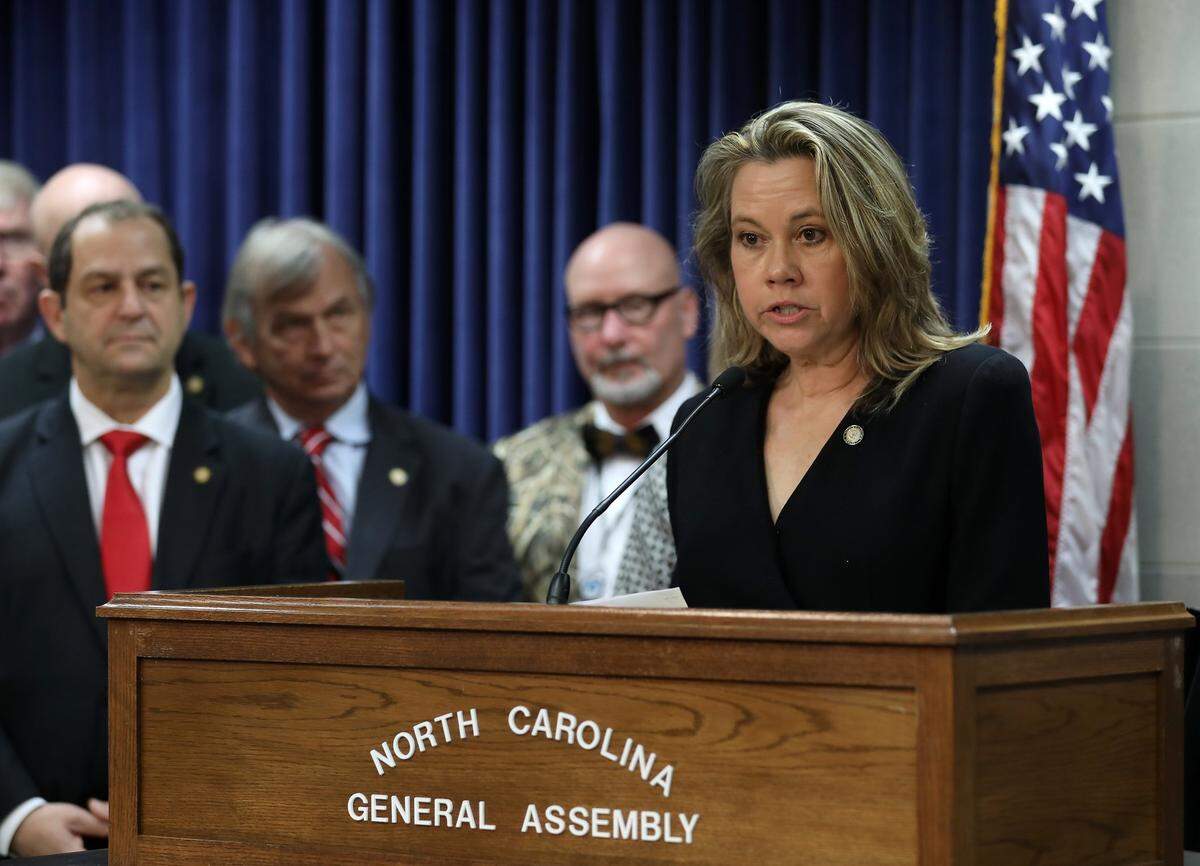
“What people are proposing is that parents lose the right to essential information about their child’s mental health on a mere suspicion that the parent might or might not do something,” Galey said. “That’s not fair to them That’s depriving them of their right to parent their own child.”
But Reives, the lawmaker, said the bill will make the environment more toxic in schools.
“All we’re doing is continuing to feed this story to people that they’re helpless, that they can’t protect themselves and we’re going after their most vulnerable — their children — by telling them you can’t even protect your children,” Reives said.
Democratic amendments not heard
Multiple Democratic amendments were filed on Wednesday.
For instance, Dahle wanted to introduce an amendment to remove the wording about gender identity and sexuality to say that only instruction on sexual activity would not be included in the K-4 curriculum.
Rep. Cynthia Ball, a Wake County Democrat, wanted to introduce an amendment removing the wording about parental notification of pronoun and name changes.
The only amendment heard on Wednesday was a technical one proposed by Rep. Jason Saine, a Lincoln County Republican. Moore said that some Republican lawmakers had also wanted to file amendments.
Public comments on bill
The vote came after public comment at Wednesday’s House Rules Committee meeting that consisted mainly of bill opponents. Multiple speakers said passing the bill would hurt LGBTQ+ students.
“The extremely upsetting reality for one in three students who identify as being queer, including myself at one point, is that they are not in homes that affirm their identity,” said Hannah Wilson, a teacher at the Durham School of Technology. “Although there are provided exceptions to reporting names and pronouns to parents, the reality is that we can not understand or guess what will happen when a student goes home.”
Dr. Margo Faulk, a family physician in Caswell County, said the legislation could have particularly negative mental health consequences on LGBTQ+ youth in rural counties.
“Their teachers are the only place they feel able to turn to find a safe lifeline,” Faulk said. “This bill will rip away that lifeline and will result in higher rates of suicide among our youth.”
But speakers from conservative groups said parental rights trump the wishes of students.
‘”We have compassion for individuals who are struggling with identity issues and gender dysphoria,” said John Rustin, president of the N.C. Family Policy Council. “However, for a school to willfully withhold this information from parents is a breach of trust and a violation of the parents’ right to know, especially when a student has publicly requested to be called by a different name or pronouns by their teachers and fellow students.”
This story was originally published June 28, 2023 at 6:42 PM.