NC Justice Berger won’t be recused from major cases involving his father, court rules
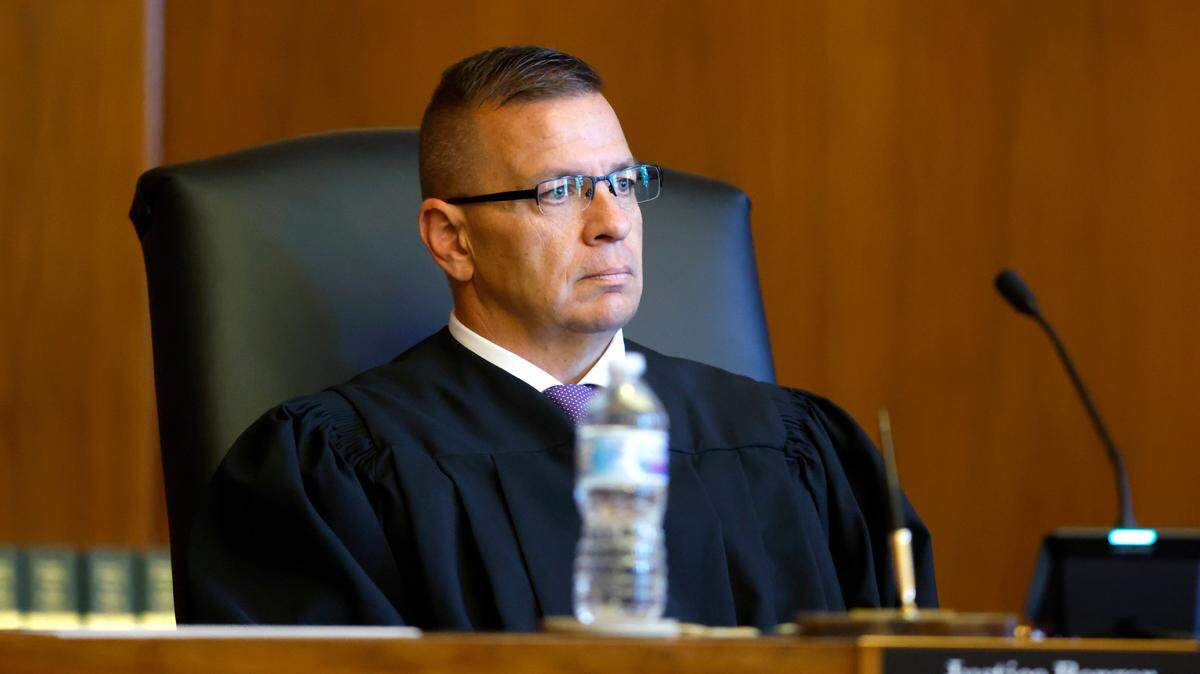
North Carolina Supreme Court Justice Phil Berger Jr. will not be recused from two high-profile cases involving his father, the Republican Senate leader.
The court’s Republican justices denied Democratic Gov. Roy Cooper’s motion requesting Berger Jr.’s recusal on Friday, writing that the Senate leader was involved in the case in an official capacity only — not a personal one.
“We believe that Justice Berger can and will execute his responsibilities in this case fairly and impartially,” the majority wrote.
Rather than deciding on recusal himself, Berger Jr. referred the motion to the full court to consider.
In a dissenting opinion, the court’s two Democrats noted that the Code of Judicial Conduct makes no distinction between family members acting in their official capacity and personal capacity in its rules around recusal. Justice Allison Riggs, who authored the dissent, noted that Justice Berger previously refused to recuse himself in another case involving his father that challenged the state’s voter ID law.
“To achieve the desired outcome in this case, members of this Court who typically ascribe to a strict textualist philosophy are eager to add words to the Code of Judicial Conduct,” Riggs wrote. “... I suspect the reason we have not changed these rules is simple — the optics of overhauling existing ethics standards to accommodate Justice Berger and Senator Berger are problematic, to put it mildly.”
In both cases, Cooper is challenging laws passed by the General Assembly that strip him of his appointments to various boards and commissions. One of those laws, which is currently blocked by a lower court’s order, would drastically restructure state and local election boards and give all appointments to legislative leaders — including Berger Jr.’s father, Senate leader Phil Berger, who is named as a defendant in both cases.
Even if Berger Jr. had recused himself from the cases, it would still have been heard by a majority of Republican justices given that the party currently holds a 5-2 majority on the high court.
Republican leaders sought to fast-track the cases by having the Supreme Court take them up before the Court of Appeals, but the justices denied that request on Friday.
This makes it less likely that either case will be decided in time for the 2024 election, potentially avoiding a hasty implementation of new laws just a few months before Election Day.
Election boards case could strip appointment power from governor, create bipartisan boards
The election boards case deals with a law passed last year that would strip Cooper of his appointments to state and local election boards and give the appointments to legislative leaders instead.
These boards, which currently have a 3-2 majority of the governor’s party, would shift to having even number of Republicans and Democrats — a change critics have charged could lead to deadlocked votes on crucial decisions.
Republicans have unsuccessfully attempted to make similar changes to election boards for years.
Shortly after Cooper was elected in 2016, Republican lawmakers put forward a similar bill — but the state Supreme Court struck it down, saying it violated the state constitution’s separation of powers clause.
In 2018, Republicans proposed the changes as a constitutional amendment, but over 61% of voters rejected it at the polls.
But last year, the GOP achieved a supermajority in both chambers and overturned Cooper’s veto to pass a bill restructuring the boards.
Cooper sued shortly after, arguing that the law violates the state’s separation of powers requirement. A bipartisan panel of Superior Court judges agreed in March, finding the law unconstitutional and calling it “the most stark and blatant removal of appointment power” in years. The court’s ruling blocked the law from taking effect.
Earlier this month, Cooper urged the Supreme Court to deny Republicans’ request to bypass the Court of Appeals.
“Legislative defendants invite this Court to ignore the public interest and the clear results of a recent public vote about amending our Constitution ... and reinterpret our Constitution ... so that separation of powers is no longer an enforceable constitutional limitation,” Cooper’s lawyers wrote. “This court should decline that dangerous invitation.”
Lawyers for the state joined Cooper’s calls for caution, writing in a court filing that a decision this close to an election could “sow confusion and undermine public confidence in the fairness and integrity of the election process.”
Appointments case involves governor’s power over various boards
The Supreme Court also declined to fast-track a case dealing with the governor’s appointments power to various boards and commissions.
Last year, Republican lawmakers passed Senate Bill 512, which removed some of Cooper’s appointments to the Economic Investment Committee, the Commission for Public Health, the Board of Transportation and more.
Cooper sued shortly after the bill was enacted, arguing that it violated the state constitution’s separation of powers clause by taking power away from the executive branch.
A bipartisan panel of Superior Court judges partially agreed with Cooper in February, finding that the General Assembly went too far with its restructuring of the EIC and BOT. Other changes, however, such as appointments to the Environmental Management Commission, the Commission for Public Health and the Wildlife Resources Commission, were upheld.
When will there be a ruling?
Since the Supreme Court declined to bypass the Court of Appeals and take them up early, it will take longer for the cases to be fully adjudicated.
The Court of Appeals allowed parties in each case to have an extended filing schedule while awaiting the Supreme Court’s order. Briefs are due in both cases by Sept. 19.
No arguments have been scheduled in either case.