
From asphalt to wetlands: Interior secretary announces parkland grants in Raleigh
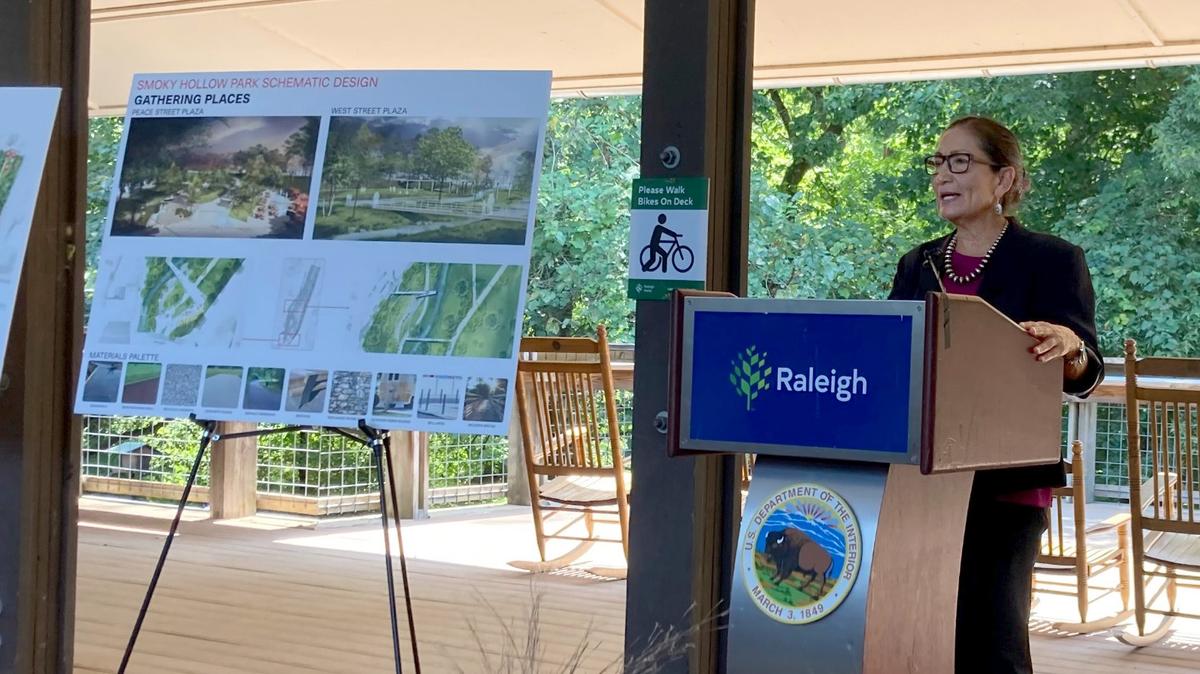
U.S. Secretary of the Interior Deb Haaland was visiting the future site of Smoky Hollow Park on Tuesday when someone told her there is a stream running under the asphalt lot she was standing on.
Converting the area near the intersections of Peace Street and Capital Boulevard to a park and restoring the section of Pigeon House Branch that runs through it is one of three parks projects the U.S. Department of the Interior has funded in Wake County in recent weeks.
“It’s a natural wetland, so nature doesn’t forget what it should be and we should help in every way that we can to return nature to the way it wants to be and the way it was meant to be,” Haaland said shortly after.
Earlier this month, Interior announced that Raleigh would receive nearly $8.68 million to build Smoky Hollow Park and restore the stream running through it. The same round of Outdoor Recreation Legacy Program funding also included $8.5 million for the Town of Garner to fund the first phase of Yeargan Park, which will include four multipurpose fields and a path to Garner’s downtown area, among other upgrades..
Haaland and Interior staff visited the site sf both projects as part of a two-day trip to North Carolina. They also visited several restoration projects on the Blue Ridge Parkway, which has received $253 million in Great American Outdoors Act funding to address deferred maintenance projects.
Cabinet secretaries have been frequent visitors to North Carolina in recent months, touting federal investments as the 2024 election draws closer.
Haaland’s tour ended Tuesday at Raleigh’s Norman and Betty Camp Education Center at Walnut Creek Wetland Park.
Raleigh received $845,000 from Interior in March to provide bicycle and pedestrian connections between Walnut Creek Wetland Park and the Biltmore Hills and Rochester Heights neighborhoods. The so-called Bailey Drive Gateway project involves reclaiming 10 acres on the park’s southern edge to help residents of Southeast Raleigh access green space more easily.
Shannon Estenoz, Interior’s assistant secretary for Fish and Wildlife and Parks, said the COVID-19 pandemic highlighted the importance of accessible outdoor space. Having safe outdoor space readily accessible was a matter of community resilience during the pandemic, Estenoz said, and it became clear that that many of the country’s most sought-after communities prioritized parks.
“People who have choices choose to have parks in their neighborhoods. So we want all Americans to have that choice. It shouldn’t matter what your ZIP code is, you should have access to places like this,” Estenoz said.
The Walnut Creek project merges environmental justice and conservation concerns, Gov. Roy Cooper said Tuesday
Cooper, a Democrat, said the park project bolsters a pair of his executive orders. In Executive Order 305, Cooper directed state agencies to conserve a million acres, restore a million acres and plant a million urban trees by 2040. And in Executive Order 292, Cooper directed every cabinet agency to consider environmental justice when making permitting decisions and awarding funds.
“What we want to do is combine our conservation efforts with environmental justice as was done with this area right here and to make sure that we are making opportunities for everyone, that everyone can enjoy the conservation and enjoy the outdoors and to participate,” Cooper said.
The Wake County park projects could play a role in climate resilience, Haaland added, pointing to the Smoky Hollow project. Right now, the future park site is 90% impervious surface, a site the city has used for decades as a lot for its dump trucks and garbage trucks.
Raleigh officials plan to replace that with walkable greenspace and a large wetland impoundment.
“It’s going to be cooler, there’s going to be animals, there’s going to be fish in that creek. It’s just going to be a more welcoming area. It’s going to be a place where people can cool off in the summer heat,” Haaland said.
This story was produced with financial support from the Hartfield Foundation and Green South Foundation, in partnership with Journalism Funding Partners, as part of an independent journalism fellowship program. The N&O maintains full editorial control of the work. If you would like to help support local journalism, please consider signing up for a digital subscription, which you can do here.
This story was originally published August 28, 2024 at 10:17 AM.