
With a week left, Congress hasn’t funded Helene disaster relief. Will NC get the money?
Rep. Chuck Edwards takes issue with his constituents being called “coastal elites.”
This week, North Carolina’s congressional delegation and leadership from the state legislature have been working together in Washington to ensure Congress passes disaster relief aid in the final days of session.
But they’ve faced backlash from members of the ultraconservative House Freedom Caucus who want to prevent disaster relief requested by President Joe Biden from being funded, and wait for President-elect Donald Trump.
“I heard one Freedom Caucus member in a budget hearing today railing against the disaster relief bill and calling the recipients of disaster relief, ‘coastal elites,’” Edwards, a Republican from Flat Rock in Henderson County, told McClatchy in an exclusive interview. “And I totally reject that notion.”
There is one week left of this session of Congress, and its members have yet to issue disaster relief aid to those affected by hurricanes Helene or Milton. Last month, Biden called on Congress to provide $100 billion in aid, saying it was “urgently needed.”
And while Biden’s full request is not expected to be funded in the final week of Congress, lawmakers do believe some form of disaster relief will be part of a continuing resolution that keeps the government funded, likely through March, which Congress plans to pass next week.
Several lawmakers from North Carolina, including Sen. Ted Budd, are also working on other forms of help to those impacted by the storm.
On Sept. 26, Helene made landfall as a Category 4 hurricane in the Big Bend area of Florida and made its way up the southeastern region of the United States before dissipating over Tennessee.
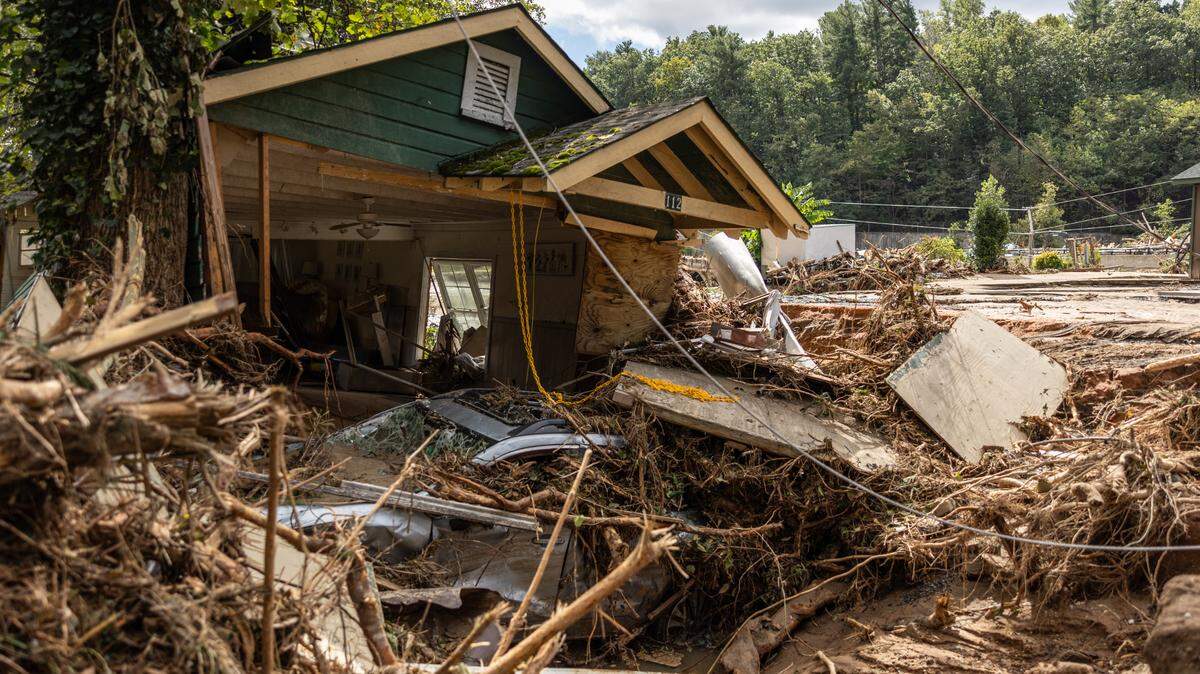
It wreaked havoc in 25 counties of Western North Carolina, with the majority of those being in Edwards’ area.
“I represent 763,000 people, all of which have been affected by Helene in some form or fashion,” Edwards said. “And these are hardworking Americans. Not one single one of them, would I consider a ‘coastal elite.’ And my job is to argue against those ridiculous notions and fight for Western North Carolina and help us recover, in spite of the ill-informed opposition we’re seeing up here.”
He added that these are people often in lower income brackets, living in trailer parks, who have worked their whole lives and not accumulated a lot, but continued to fight in wars, pay their taxes and by doing so helped other communities in their time of need when called upon. Now they’re asking for the same.
For those needing a geography lesson: Asheville is about 270 miles from the nearest coast, and even farther from North Carolina’s coast. Wrightsville Beach is around 350 miles away, or 75 miles more than a trip from Washington to Raleigh.
Several members of the state legislature made that latter trek Tuesday, to meet with members of North Carolina’s congressional delegation and the House Appropriations Committee asking for help.
“We’ve gotten lots of positive responses in terms of a recognition of the problems that we’ve got, and that everybody seems to be kind of working on the bill, and the question is not whether there ought to be a package, but the biggest question is how much and how do you pay for it,” Republican state Senate leader Phil Berger told McClatchy exclusively.
Berger said it was a worthwhile endeavor to come to Washington and meet with lawmakers. He said not only were they able to get assurances that something would be done before the end of session, but they were also able to talk about some of the “bureaucratic red tape” that has been burdening those affected by Helene.
State Sen. Ralph Hise of Spruce Pine in Mitchell County, another Republican who traveled to Washington, told McClatchy that victims of Helene are having a lot of problems with reimbursements being denied without any given reason. He said in rural areas of North Carolina there have been few federal representatives who can sit down with victims and walk them through the process for reimbursements.
“A lot of people with obvious damages are being denied in the system,” Hise said. “For FEMA, the counties find it very difficult to know how to pick contractors and others through the system based on the revenue they’re required to put up front or whether there is another form for payment to take care of that for them.”
Help for private roads, HOAs
Budd spent his week preparing two bills to try and help Western North Carolina tackle those issues. He introduced the bills Thursday.
The first, the Disaster Assistance Fairness Act, amends The Stafford Act to ensure that debris removal from private roads is deemed a public interest and eligible for reimbursement. He said it took over a month after Helene to get guidance on the eligibility.
The bill also amends the same law to allow shared common infrastructure in a homeowners’ association or condominium to be eligible for household repair cost assistance. Budd’s staff said FEMA interprets regulations inconsistently, causing delays for these types of reimbursements.
The Stafford Act is a federal law that directs the federal government in helping state and local governments provide assistance in disasters.
Budd also introduced a bill, the FinCEN Act, that would provide extensions for businesses impacted in federally declared disasters.
The Financial Crimes Enforcement Network of the U.S. Treasury requires businesses to submit Beneficial Ownership Information reports to combat financial crimes.
After Helene and Milton hit, Budd noticed that the treasury’s requirements don’t take into account the operational challenges and the limited resources businesses face after disasters that could make hitting deadlines difficult. And not meeting the treasury’s deadlines could lead to penalties for struggling small businesses.
To combat this, Budd’s bill would push the BOI deadlines in disaster areas to Jan. 1, 2026. Eligibility for the extended deadline would be determined by the treasury secretary.
“The scope of the devastation in Western North Carolina is unlike anything I have ever seen before,” Budd told McClatchy in a written statement. “Folks from the mountains are resilient and tough, but they need their government to work quickly for them in their time of need. These two pieces of legislation will cut through the red tape and get needed aid out the door. I will continue to work with my colleagues to get Congress to pass robust assistance that meets the moment.”
It’s not yet clear if Congress can move quickly enough to get Budd’s bills passed before Congress adjourns next week, though lawmakers were confident relief funding was on the way.
It had been a point of contention that Congress left earlier than expected for a pre-election recess knowing that Helene was about to make landfall in the United States. The lawmakers wanted to get home to their constituents without any problems from the storm, but that also meant the Southeast had to wait more than a month for lawmakers to return to Washington to help them.
The 118th session of Congress has been one of the least effective in history and has been punctuated with gridlock, often caused by the House Freedom Caucus exploiting Republicans’ slim majority in the House to try to bend the House speaker to their will.
“I’ve got my frustrations that people on the ground can’t get the assets they’re entitled to in a timely manner,” Hise said. “Did I suddenly expect Congress is going to change and move quickly and efficiently post-election? Not really. But even within the current system, they’re not saying this, but I feel like FEMA is slow because they don’t have the funds. But they say everything’s covered, but it’s really frustrating to be talking to somebody who’s seeing 6 feet of water flowing through their house. They went to FEMA and they said they qualify for $3,000. That’s absolutely frustrating.”
But Hise is aware that funding from Congress won’t address those needs immediately.
And Berger said they’re not even looking to have the money in hand in the next several weeks; they just need the knowledge that it’s there, and he believes it will be.
If Congress doesn’t pass disaster relief funding, Berger said his frustration will “go through the roof” and he’ll come back to Washington to continue fighting for funding.
But Edwards doesn’t think that will be necessary.
“I’m fully confident that we’re going to see something in the form of a disaster relief bill before we adjourn for Christmas,” Edwards told McClatchy. “It most likely is going to be attached to the CR. There was some discussion for a few weeks on whether it would be attached or whether it would run parallel. I’m hearing it’s most likely to be attached because the Senate might not have the capability to run two bills.”
House Speaker Mike Johnson announced Thursday that he expects a version of the continuing resolution to be released Sunday.
