Walls that will hold up I-40 through Pigeon River Gorge begin to take shape
AI-generated summary reviewed by our newsroom.
- Contractors are building roller compacted concrete walls 30 to 50 feet high.
- NCDOT estimates full eastbound I-40 restoration will cost $2 billion by end of 2028.
- Federal officials approved mining up to 3 million cubic yards from Pisgah National Forest.
Before they can rebuild the eastbound lanes of Interstate 40 through the Pigeon River Gorge, contractors must construct massive walls to hold up the highway and ensure the river doesn’t wash it away like it did after Hurricane Helene two years ago.
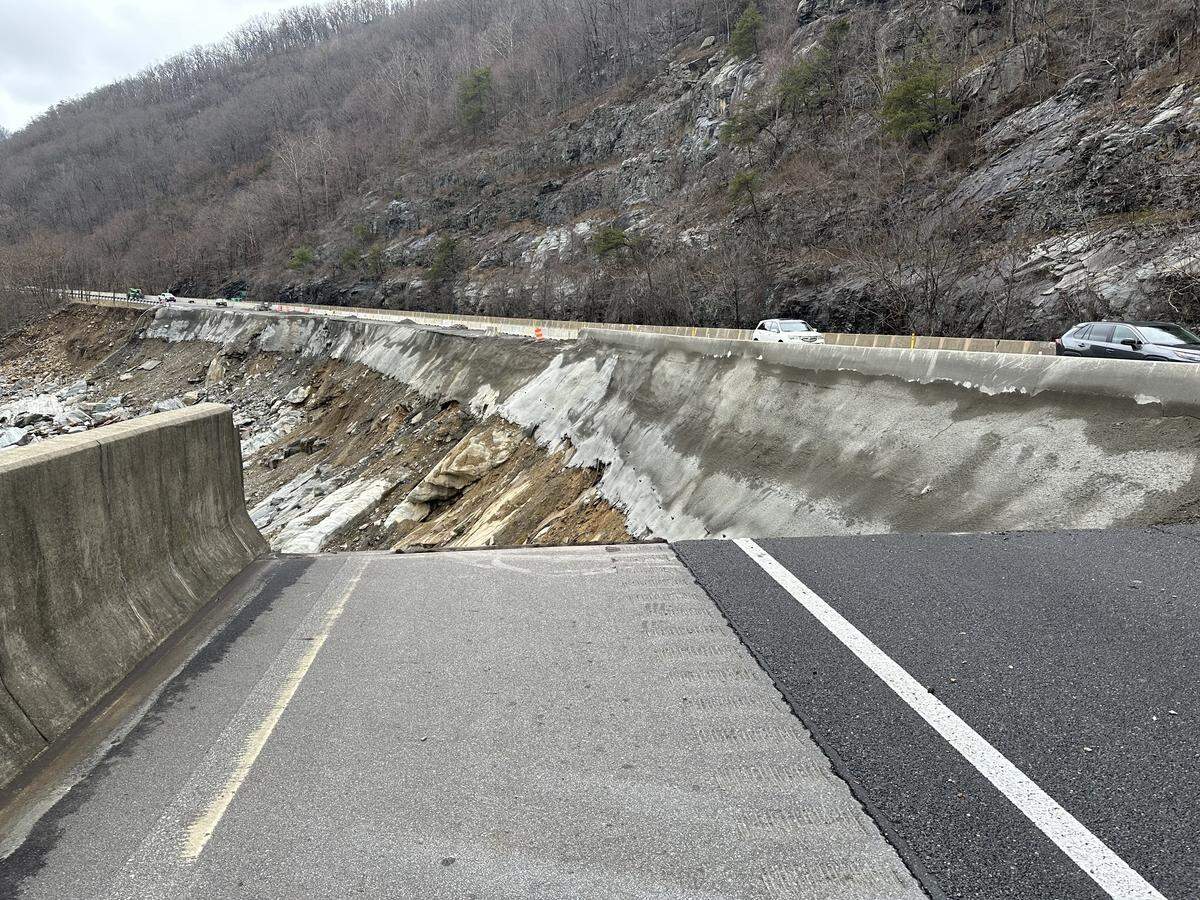
The flooding river took about 1 million cubic yards of earth and stone, causing the eastbound lanes of I-40 to collapse in 10 places in North Carolina and several others in Tennessee. Highway departments in both states reopened I-40 through the gorge more than a year ago by converting the surviving westbound lanes to two-way traffic at a reduced speed.
But restoring the eastbound lanes means re-establishing nearly five miles of roadbed on the North Carolina side. Fully reopening the highway will cost the N.C. Department of Transportation an estimated $2 billion and likely take until the end of 2028.
“We’ve never really faced anything like this in North Carolina before,” said Blake Soblesky, the contract resident engineer. “Quite an extensive repair.”
In late February, contractors began building the walls that will make up the highway’s foundation, using a technique more commonly found in dams. They’re made of roller compacted concrete, 30 feet thick, laid down in four-foot slabs that step back like an Egyptian pyramid.
The concrete walls will rise from 30 to 50 feet, high enough that a future Helene-like flood won’t top them. The concrete will then be covered with stone, sloping up to highway level, where eventually the pavement, shoulders and guardrails will be restored.
It’s a long process. Contractors have built about 31,000 cubic yards of concrete, only about 4% of the 800,000 cubic yards they expect to construct. Once the concrete is in place, contractors will drive steel piles down to the bedrock at the base of the wall to keep water from getting underneath.
“This design is very resilient,” Soblesky said. “It’s also a giant mass that can’t be washed out like a small boulder.”
Using stone from nearby keeps trucks off highway
Almost all the stone needed to make the concrete and build up the slope will come from a quarry across the river in Pisgah National Forest. Federal officials gave NCDOT permission to mine up to 3 million cubic yards of stone in the national forest and truck it across twin temporary bridges.
The contractor in charge of the project, Ames Construction of Minnesota, built a concrete plant between the highway and the river. Stone from the quarry is crushed to no more than 1.5 inch in diameter before being mixed with cement.
The formula calls for very little water, to create a thick concrete that workers can immediately run machines over, said Josh Deyton, NCDOT’s regional construction engineer.
“It just stays in place,” Deyton said. “It’s so stiff. That’s the reason you can put a dozer on top of it.”
As cars and trucks pass by on I-40, giant off-road dump trucks carry stone and concrete on a parallel road, down to a causeway along the river to the base of the cliff. Having access to the quarry across the river keeps those trucks off the highway and makes it much easier and cheaper to obtain the stone needed to rebuild I-40, Soblesky said.
“Because of the remote nature of the project, hauling in rock from the local quarries in Tennessee and North Carolina would be extremely expensive and time-consuming,” he said. “So we’re saving roughly 30% of the cost and time by getting local material on site, making it here and using it here.”