
‘Everybody wants to be a part of it.’ In speech, Cooper touts 20,000 new clean energy jobs.
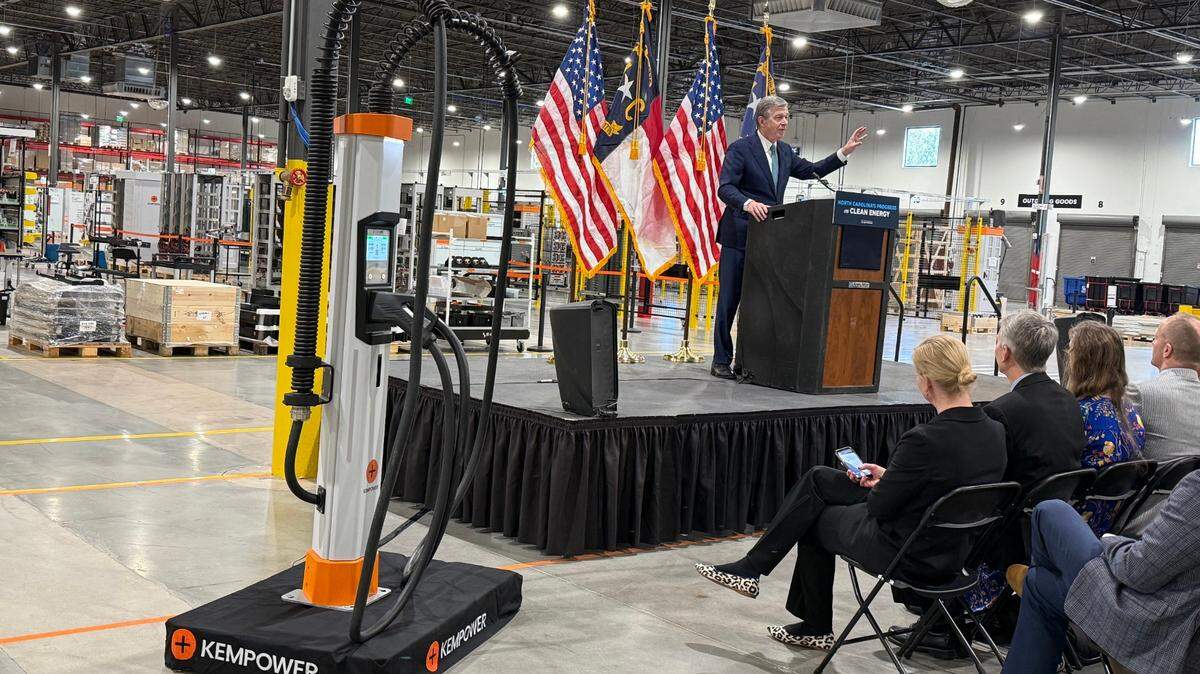
After taking the stage at Durham’s Kempower headquarters Friday, Gov. Roy Cooper joked that he hasn’t driven since taking office in 2017.
But, Cooper said, he’s taken steps to make sure that when he is behind the wheel again, it will be of an electric car. There’s now an electric vehicle charger installed at his private residence.
Cooper brought up his own impending changes while discussing North Carolina’s clean energy economy and how it has reshaped the state during his time as governor. Since Cooper was sworn into the office in 2017, companies associated with the clean energy economy have announced more than $24 billion in investments in North Carolina, bringing more than 20,300 jobs to the state.
“Once you become known as a hub for clean energy, everybody wants to be a part of it,” Cooper said.
Toyota highlights those investments, with the car manufacturer investing $13.9 billion in its Randolph County battery factory that will lead to more than 5,000 jobs. Other significant investments come from Wolfspeed, which is building a $5 billion materials factory in Chatham County; Natron, which is building a $1.4 billion sodium-ion battery factory in Edgecombe County; and Boom Supersonic, which is making a $500 million investment in Greensboro.
During his final weeks in office, Cooper has been making a series of speeches addressing what he sees as key themes of his two terms. Friday, he spoke to a group that included officials from Duke Energy, employees of the N.C. Department of Environmental Quality and advocates from environmental and energy organizations, among others.
He wound a narrative that started with the ideas behind 2018’s Executive Order 80, which was signed just weeks after Hurricane Florence devastated wide swaths of Eastern North Carolina.
“Progress isn’t promised. We have to work for it, we have to earn it. The urgency of the climate crisis is real, and we in North Carolina unfortunately have had a front-row seat to its devastating impacts. Storms continue to hit our state with more ferocity. Doing nothing is not an option,” Cooper said.
Executive Order 80 set a greenhouse gas reduction target for the state as well as a target of 80,000 zero-emission vehicles on the road by 2025. It called for the N.C. Department of Environmental Quality to lead an effort to write a clean energy plan, working with utilities and other stakeholders to describe how carbon-free resources like wind and solar could be integrated into North Carolina’s grid.
“This was good work, though, that had immediate positive effect with business recruitment — ‘Hey, this state is serious. This state wants to go somewhere with clean energy,’” Cooper said.
Next, Cooper and administration officials worked with the General Assembly to craft 2021’s House Bill 951, legislation that set a target for Duke Energy of a 70% reduction in carbon dioxide emissions by 2030 and net zero by 2050. The N.C. Utilities Commission would oversee the process, working with Duke and other interested groups to adjust the plan every two years.
“We had done the work, we knew where we wanted to go and we know how to get there when the opportunity came,” Cooper said.
Then, in early 2022, Cooper signed Executive Order 246, upping the state’s electric vehicle target to 1.25 million zero-emission vehicles by 2030 and making greenhouse gas reduction targets more ambitious.
“That has helped North Carolina attract many of these manufacturers in the EV supply chain,” Cooper said.
Machelle Baker Sanders, North Carolina’s Commerce secretary, said that in 2022 the department created an Office of Clean Energy Economic Development. While the most consequential risks of climate change may still lie in the future, Sanders said, North Carolina already faces threats from flooding, saltwater intrusion and beach erosion.
Still, Sanders said, economic development efforts under Cooper’s leadership have left North Carolina poised to take advantage of economic opportunities borne from efforts to move to a carbon-free economy.
“The numbers demonstrate the power of vision, the power of determination and the power that we will infuse into communities across North Carolina,” Sanders said.
Threats to clean energy economy?
Speaking to reporters after his formal remarks, Cooper addressed potential hazards to what he describes as progress in North Carolina’s transition.
The General Assembly, for instance, successfully overrode Cooper’s veto to Senate Bill 382, legislation that shifts a number of powers away from incoming Democrats on the Council of State. Among those are appointments to the Utilities Commission, whose membership has gradually been reshaped since House Bill 951 gave the commission increased power to shape the state’s energy future.
When the 2021 bill passed, the commission had seven governor-appointed members. A 2023 bill shifted the commission to five members, with three appointed by the governor and two by General Assembly leaders.
Senate Bill 382 shifts the balance, leaving two appointments with the governor and two with the General Assembly. But it gives appointment power of the fifth seat to the state treasurer, an office won by Brad Briner, a Republican, in November’s elections.
“I think it’s unconstitutional. I think the governor should have a majority of the members of the Utilities Commission and yes, I am concerned about that,” Cooper said. “They need to make these decisions about following the law and moving forward with renewable energy that is fair to consumers and that keeps rates low. There’s clearly a way to do that, and yeah, I’m concerned.”
Cooper also addressed fears that the incoming Trump administration could roll back large portions of the Inflation Reduction Act, the Biden administration’s hallmark climate legislation. In the year after the federal law passed, North Carolina made a bevy of clean energy economy announcements, including Toyota’s first investment in Randolph County, Wolfspeed’s new plant and the Kempower facility Cooper spoke in Friday.
Conservatives have expressed wariness about parts of the legislation, including subsidies for electric vehicles and direct grants to environmental nonprofits. Still, Cooper expressed hope Friday that the economic investments stemming from the bill would help give it durability during incoming President Donald Trump’s second term in office.
“I believe that a lot of the incentives and investment in clean energy will survive this next administration simply because of the economic impact they’re already having,” Cooper said.
This story was produced with financial support from the Hartfield Foundation and Green South Foundation, in partnership with Journalism Funding Partners, as part of an independent journalism fellowship program. The N&O maintains full editorial control of the work. If you would like to help support local journalism, please consider signing up for a digital subscription, which you can do here.
This story was originally published December 14, 2024 at 10:03 AM.