NC bill would order end of ‘offensive American Indian mascots’ in public schools
After years of unsuccessfully persuading some North Carolina schools to drop their American Indian mascots, a state lawmaker is now trying to make the change through the legislative power of the state.
The “Ending Offensive Indian Mascots” bill filed on Tuesday would give North Carolina K-12 public schools a two-year deadline to end the use of American Indian mascots or risk losing part of their state funding. The latest state report shows 34 schools have an American Indian themed mascot or logo.
House Bill 655 was sponsored by Rep. Jarrod Lowery, a Robeson County Republican and a member of the Lumbee Tribe. Lowery is the only Native American legislator in the General Assembly.
Lowery did not return a voicemail message and email Tuesday from The News & Observer requesting comment on the legislation. But Lowery is a member of the North Carolina State Advisory Council on Indian Education (SACIE), which for more than two decades has been trying to get schools to end the use of American Indian mascots.

American Indian mascot use declining
In 2002, SACIE passed a resolution calling for the elimination of American Indian mascots and related imagery in North Carolina’s public schools. In its resolution, SACIE stressed that American Indian descriptions, naming mascots, logos and sports team nicknames are detrimental to the self-identity, self-concept and self-esteem of American Indian students.
Since then, the number of schools using American Indian themed mascots or imagery has dropped by more than half from 73 in 2002 to 34 as of SACIE’s 2025 report.
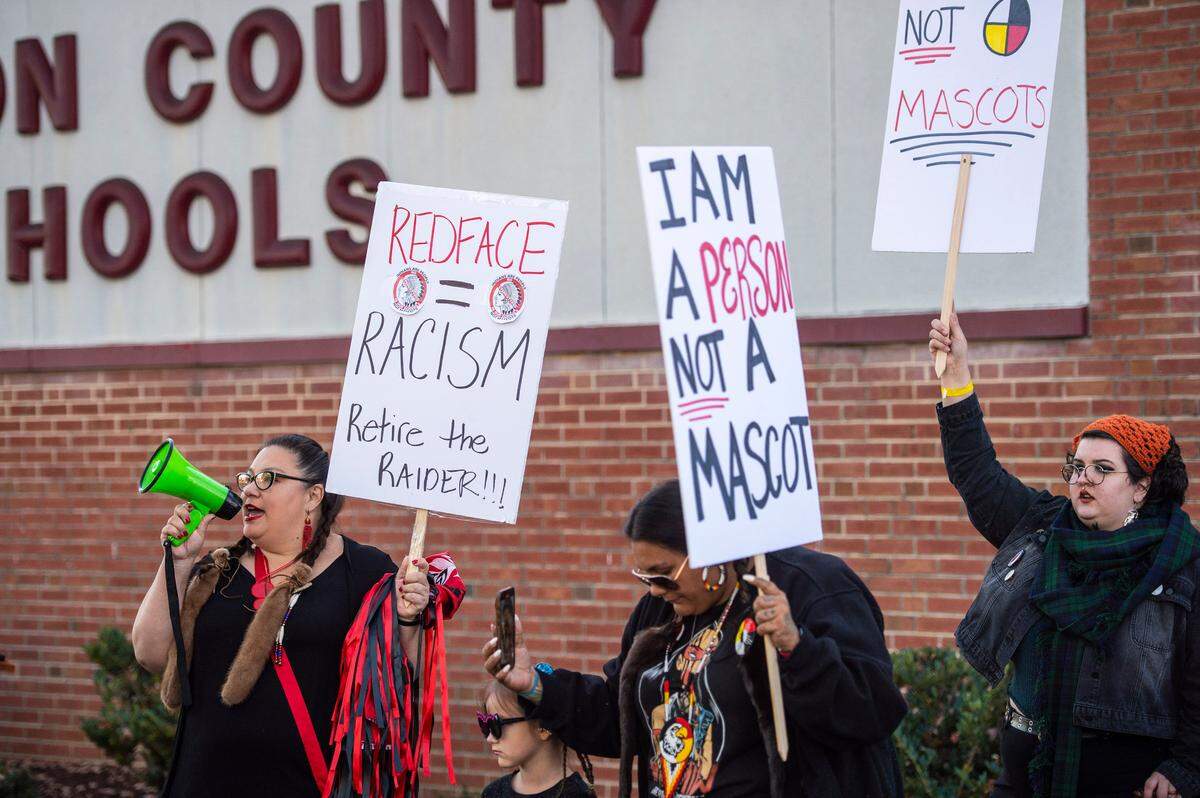
But some schools have resisted the change despite lobbying from Native American groups. For instance, South Point High School in Gaston County still uses the “Red Raider” as its mascot and Manteo High School in Dare County still calls itself the “Redskins.”
In the case of both high schools, some community members have opposed efforts to change mascots.
“The raider is a symbol of many things that we stand for here in Belmont and at SP,” Jan Turner wrote in a petition for keeping the “Red Raider,” The Charlotte Observer reported in 2020. “It isn’t meant to be anything derogatory but is an honored symbol of a tribe, unity, courage, strength, perseverance, strong and fierce, ready for battle.”
Schools could lose funding over mascots
Under the bill, SACIE would report annually to the State Board of Education which public schools are using an American Indian themed mascot. Within 30 days of getting the report, the state board would vote whether it concurs or objects with SACIE’s finding.
If the board concurs, the state board would give the local school board and superintendent of that school notice that it has two years to change the mascot. Failure to comply would result in the state Department of Public Instruction withholding state funding for the superintendent’s salary.
Failure to comply at a charter school would result in the state board withholding per pupil funding equivalent to the salary of the superintendent of the school district where the the charter is located.
This story was originally published April 1, 2025 at 5:10 PM.