Powerful NC lawmaker leads hemp firm as tighter rules face legislative gridlock
AI-generated summary reviewed by our newsroom.
- Rep. John Bell leads Asterra Labs while chairing NC House Rules Committee.
- Legislative gridlock stalls hemp regulations despite bipartisan safety concerns.
- Bell supports tighter hemp rules but warns against costly regulatory overreach.
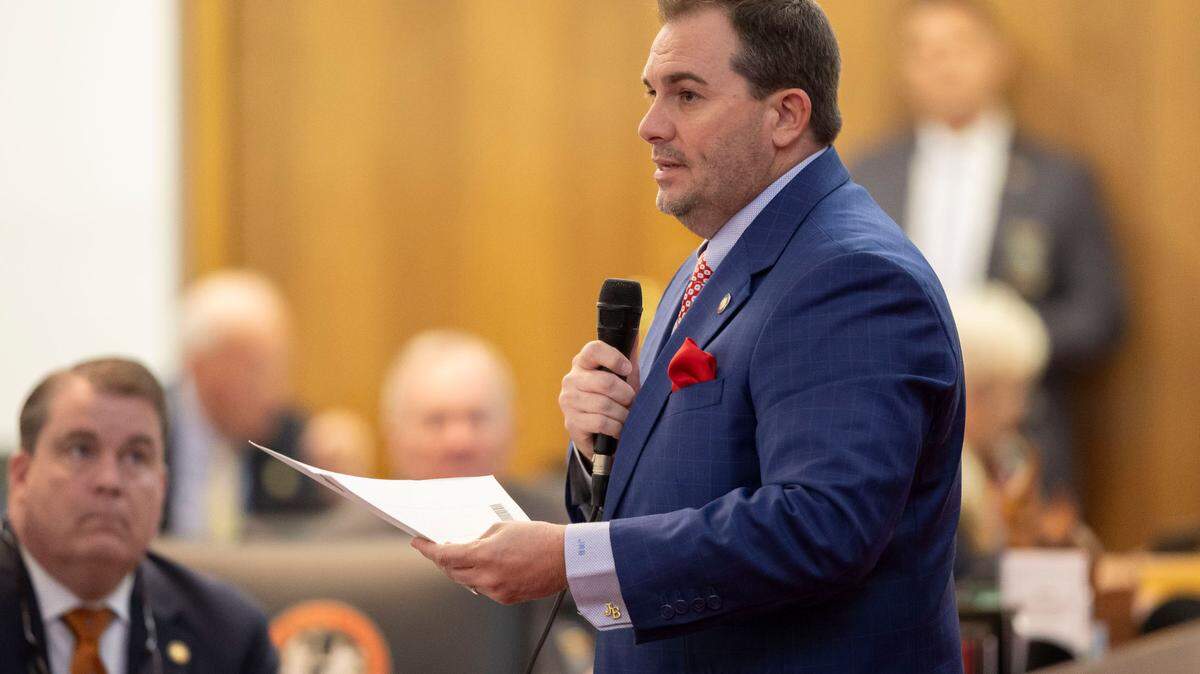
Rep. John Bell is one of the most powerful lawmakers in North Carolina. As House Rules Committee chair, the Wayne County Republican plays a key role in deciding which bills reach the floor and which die in committee.
But when he’s not at the legislature, Bell can often be found about an hour away, in a 10,000-square-foot building in Nashville. It’s the home of Asterra Labs — a fast-growing hemp manufacturing company where Bell became president in November 2023.
The off-white building doesn’t look like much from the outside. But inside are machines that can churn out gummies, fill vape cartridges, and roll thousands of hemp pre-rolls.
Both the company — and the hemp industry in North Carolina — are growing.
Farmers began cultivating hemp in the state in 2017 under a federal pilot program. The 2018 Farm Bill legalized hemp nationwide, distinguishing it from marijuana by limiting the psychoactive Delta-9 tetrahydrocannabinol (THC) content to 0.3% on a dry weight basis.
But hemp can still contain other cannabinoids like Delta-8, and in North Carolina, it’s legal to sell without age restrictions. Marijuana remains illegal in the state.
Bell took the job at Asterra after stepping down from the board of its subsidiary, The Rise Companies, a private equity firm founded in 2019 by former UNC Board of Governors chair Harry Smith. Bell had served there since 2020, according to the company’s website.
Rise’s portfolio includes Asterra and several other North Carolina-based businesses like Sheet Metal Technologies of Raleigh; Oak Ridge Industries, a metal works operator in Washington, N.C.; and Greenville-based Pitt Electric.
Bell, who started his career with the Boy Scouts and later worked in banking and commercial insurance, was first elected to the state House in 2012. He rose quickly, becoming House whip, majority leader and now rules chair.
And while he says he’s happy where he is, some are urging him to consider another move.
After U.S. Sen. Thom Tillis announced he wouldn’t seek reelection in 2026, Bell said his phone “blew up” with people asking if he’d consider running.
“I’m willing to have any conversation,” he said in an interview in early July. “Though right now I’m very happy in the House, very happy being in North Carolina.
“But I always want to listen to what others have to say, and if they think I’m a good candidate, I’ll take it into consideration,” he said.
An inside look at Asterra’s lab
While Bell is a fixture at the legislature, he also stays closely involved with Asterra’s operations. He often shuttles between the General Assembly and the lab — sometimes within the same day. That’s part of managing both roles, he said in early June during a tour given to The N&O.
Bell said members of Congress, U.S. Food and Drug Administration officials, and others have visited the facility, which was founded in 2019.
Since then, Asterra has aimed to become a “gold standard” in the hemp business, he said, highlighting the company’s strict hygiene protocols and routine third-party product testing.
Asterra doesn’t grow its own hemp. Instead, it uses hemp provided by its customers — other businesses — or purchases it on their behalf. Raw materials are inventoried, weighed, and tested when needed — unless, for instance, the client has already conducted the testing. The scope of that testing depends on what customers want and need, Bell said.
The company makes finished products, such as gummies, for its customers and handles their labeling, packaging and shipping. It also makes goods that are later sold by other companies under their brand names. That’s known as white-label customers.
In one packaging room, workers in early June were in hairnets and gloves operating in a humidity-controlled, sterile environment.
For pharmaceutical-grade production, a blue line marked across the floor signals areas where enhanced procedures are required, Bell said.
A separate part of the business involves supplying raw ingredients through partnerships.
In February 2024, the company launched its in-house brand, Southern Ease Trading Company, which sells gummies, pet products, drinks, pre-rolls, vapes and more.
All Southern Ease products are tested for metals and pesticides and labeled with nutrition facts and safety warnings. Each item includes a batch number, which allows law enforcement to identify whether an entire batch is safe, said Bell.
Bell and hemp legislation
As in past years, lawmakers this session again pushed for stricter hemp regulations — especially to ban sales to those under 21.
Bell said one piece of proposed legislation would have forced most hemp businesses to shut down.
“The Senate bill, instead of actually protecting our kids and regulating the industry, it annihilates the industry,” Bell told The N&O in late June, as the long session neared its end.
Sen. Amy Galey, a Burlington Republican, defended that Senate bill. It was not “written by the cannabinoid industry for the benefit of the cannabinoid industry,” Galey said. “This bill was written with public good front and center, and we’re going to make sure that what is being sold in our communities has no toxins, no synthetics, and keep them, and keep these products out of the possession of minors.”
The Senate sought sweeping regulations that could have effectively banned most hemp products currently on the market. The House took a more limited approach, aiming to prohibit sales or distribution to anyone under 21. Both versions emerged in the final days of the legislative long session, with each chamber passing its own bill but not taking up the other’s. Both chambers are led by Republicans.
Earlier in the session, lawmakers introduced other proposals — including two bills that featured broad product testing requirements. A third bill, filed shortly afterward, omitted the testing provisions but maintained restrictions on sales to minors.
Bell said during the lab tour in June that Asterra already meets many of the proposed testing requirements but warned against “overkill” in some of the proposed regulations that would cost “a bunch of money” by requiring testing for “like 99 things.”
Still, he emphasized that he supports regulations.
“To get the bad out of the industry, it is the right thing to do,” Bell said. “We don’t mind investing more to make sure we have a safe industry, and we’re doing it.”
He said some business owners make products “in their backyard, which should scare the hell out of people.”
Asterra, by contrast, represented about a $10 million investment, he said.
Bell said new rules wouldn’t shut down most legitimate small businesses.
“Some have small hand dispensers. They don’t do a lot. They don’t make 10,000 gummies. They might sell 100,000 a year. I’m making 100,000 a day. So it wouldn’t put them out of business — it would just hold them to a standard,” he said.
Small producers often use manual equipment like hand-pumps or tabletop dispensers for filling gummy molds.
Those affected, he said, would be the ones making products in unsanitary conditions without even basic safeguards.
“It’s just the way manufacturing is,” he said. “The products you’re buying should be safe and reliable and made in the correct environment.”
Ethics and legal disputes
When asked if his role at Asterra could affect his work as a lawmaker, Bell pointed to an ethics opinion by Erika Churchill, one of the legislature’s staff attorneys — which he shared with the N&0 — stating that his situation “does not raise red flags of required recusal, provided that legislative action is not in some way authorizing only the business with which you are associated to be the grower, producer, seller of the product. “
That exemption is a common feature of North Carolina ethics laws, which allow lawmakers to continue to participate in a legislative action that affects an entire industry or professional class — such as all hemp companies — so long as the action does not uniquely affect their own business.
“This is my job outside of the General Assembly. Just like everyone in that building has a job or is retired from a job,” Bell said in early July.
“I’m no different from anyone else,” he said.
Kedric Payne, vice president and general counsel at the Campaign Legal Center, said the general principle across ethics laws is that public officials should not use their position for personal financial gain and should avoid the appearance of a conflict of interest.
Payne, who leads the ethics program at CLC, said the exemption allowing lawmakers to participate in legislation affecting an entire industry is commonly applied and legally sound: “If you are a farmer, you can also vote on farm legislation.”
Still, Payne said, questions arise if a lawmaker does more than vote — especially if they help shape legislation that benefits their own company more than others, or “if you see that the lawmaker is going beyond just voting for this legislation but championing it.”
Simply talking to other lawmakers may not be enough to suggest a conflict. “There’s a difference between somebody saying, ‘Hey, how are you going to vote on this bill, etc.’ and whipping votes,” he said.
Even if a lawmaker were whipping votes, the concern would more so be whether it benefits them personally — not the broader industry. “It would be more of an indicator that it’s conflict, but not determinative,” he said.
“This leaves it up to the public and voters to determine if that’s something that they find to be inappropriate,” he said. “Voters have a right to know that their public officials are looking out for their interest and not the lawmakers’ own personal financial interests.”
The company’s political connections are also at the center of a growing legal dispute.
Texas-based hemp distributor MC Nutraceuticals is accusing Asterra Labs of using political influence to extract $1.6 million after a failed business deal, Axios and The Assembly first reported.
MC claims Asterra and its backers used political influence to enter the cannabinoid market but largely failed to turn a profit. Attracted by their financing and connections, MC partnered with Asterra to provide expertise while Asterra handled product fulfillment.
But when Asterra and Rise failed to hold up “their end of the bargain,” MC says it took over many of Asterra’s operations, boosting Asterra’s revenue. But after missing a payment around Memorial Day, MC alleges Asterra demanded $50,000 daily and threatened to jail its executives.
Asterra hasn’t responded to the lawsuit. Axios and The Assembly reported that documents provided by Asterra and Rise attorney Alicia Jurney show that MC agreed to the $50,000 payments but failed to follow through. Jurney has also provided those documents to the N&0.
“No one employed by or affiliated with Asterra or Rise used, attempted to use, or threatened to use any political influence to pressure MC’s executives,” Jurney said in an email to The N&0.
She said when Bell joined Asterra in 2023, the company was in “its growth phase” and “any contention that Asterra needed,” MC’s “business is false.”
She also said Asterra says it was unaware but it appears that MC was in poor financial condition — with negative cash flow for several months — when the two companies began working together. Had it known that MC was unprofitable and allegedly owed large past-due balances to other vendors, Jurney said, Asterra would never have entered into a business relationship with MC. She said MC “concealed” from Asterra a Colorado Attorney General’s investigation of MC’s business practices.
Still time for hemp regulation?
Bell said in June he hoped the hemp bills would start moving.
“It’s needed. Law enforcement is asking, the general public is asking. We’ve got shops selling this stuff to 14-year-olds, 12-year-olds,” he said. “We’ve got middle school kids showing up with vapes, elementary school kids showing up with vapes.”
“It’s a public safety concern. But also, for North Carolina to be the gold standard in hemp manufacturing, you’ve got to have those minimum regulations to start with,” he said.
Asked why this year might be different — given past failures to get hemp bills across the finish line — Bell said some of the delays were tied to politics and unrelated items tacked onto bills.
That happened last year, when a hemp bill had medical marijuana legalization legislation tacked on to it.
What “you’re seeing now is a big outcry from groups and organizations and schools, and law enforcement, which makes it a lot different,” he said.
He added that conversations around regulations are also emerging in other states, and North Carolina Gov. Josh Stein announced a task force to address these issues — not just on hemp and CBD, but on marijuana, too. Bell’s on that task force’s board.
No hemp regulation bill has passed and lawmakers have gone home for a break.
Bell said he still believed “we can get there. It’s a new industry.”
“We’ve only been talking for about two years now in North Carolina,” he said. “My hope is that we can have, continue to have, conversations on trying to do what’s right for the state. “
This story was originally published July 21, 2025 at 8:00 AM.