Voting plans in dispute for a few NC counties. Sunday hours are a sticking point.
AI-generated summary reviewed by our newsroom.
- State Board will likely approve early voting plans for 88 counties for 2026.
- Twelve counties dispute Sunday voting and campus sites; state will resolve.
- Some counties cut early voting sites or hours, reducing voter access in 2026.
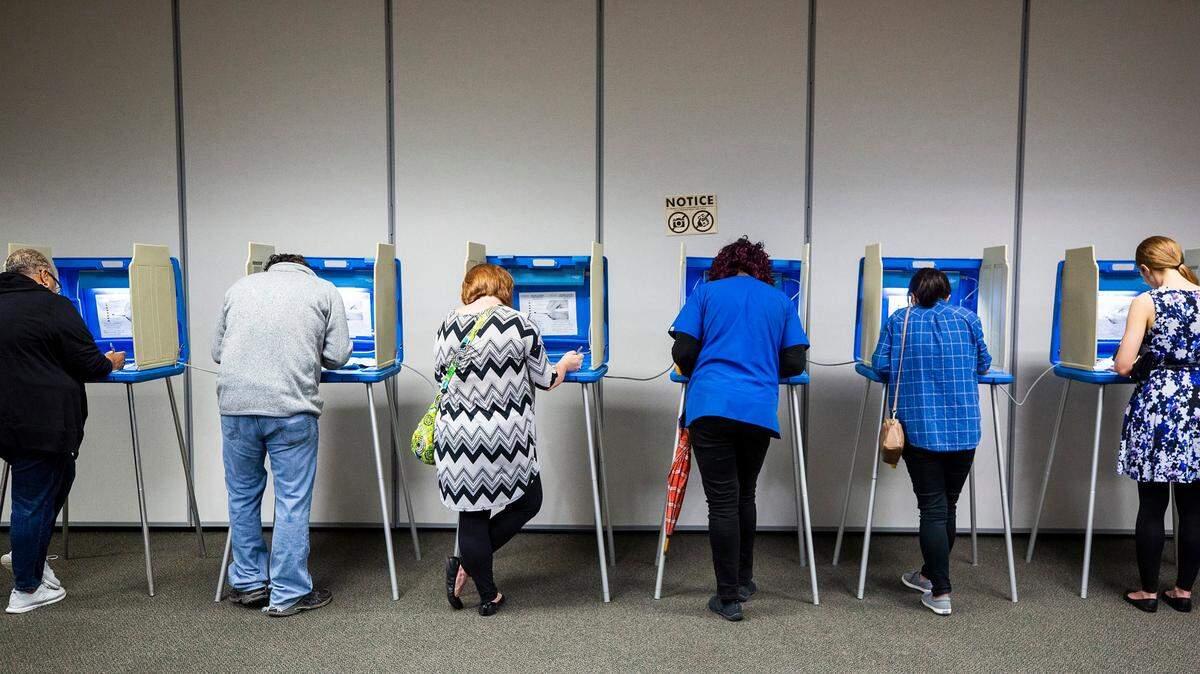
The North Carolina State Board of Elections approved early voting plans for the 2026 midterms for the vast majority of counties on Monday.
These 87 counties, each of which are led by an elections board composed of three Republicans and two Democrats, were able to reach a unanimous vote on a plan over the last few months.
Board members in 12 other counties, however, have clashed over Sunday voting, campus polling sites and more in disputes that will ultimately have to be resolved by the State Board of Elections next month.
These types of disagreements are common, and state law has long required that if county boards can’t reach a unanimous decision, the state will have the final say. But in the wake of a massive restructuring of North Carolina’s election apparatus earlier this year — which flipped all boards to Republican control — new leadership may handle such disputes differently than in the past.
Sunday voting divides counties
Seven of the 12 counties with nonunanimous early voting plans are divided over whether to allow voting on at least one Sunday.
Those counties are Brunswick, Columbus, Craven, Greene, Harnett, Pitt and Wayne.
Sunday voting has long been a subject of debate in North Carolina.
The practice has historically been popular among Black voters, having been featured in “souls to the polls” events in which churchgoers cast their ballots after services.
But Republicans have long sought to limit Sunday voting, sometimes for religious reasons and sometimes for financial ones.
For the majority of the past decade, Democrats held a 3-2 majority on the State Board of Elections. Under that makeup, the board generally sided with plans that included Sunday voting when the issue came before them.
But last year, Republican lawmakers stripped Democratic Gov. Josh Stein of his appointment power to the powerful board, transferring it instead to the newly elected Republican state auditor.
In deciding on early voting plans for municipal elections earlier this year, the newly constituted State Board of Elections allowed some counties to get rid of Sunday voting — a move that was met with sharp criticism from the board’s Democrats.
Now, they could vote to do it again for the midterms.
Polling site disputes
The other counties with nonunanimous plans were unable to reach agreements about which early voting sites to use.
Those counties were Alamance, Cumberland, Guilford, Jackson and Madison.
Three of these disputes dealt with contentious debates over whether to host early voting on college campuses.
In Jackson County, the board’s Republican majority voted to eliminate an early voting site at Western Carolina University that had been in use for nearly a decade.
The board’s chair, Bill Thompson, said the site was not accessible to all voters and was a waste of tax money, Blue Ridge Public Radio reported.
Evie Grey, a WCU student and vice president of the university’s Student Democracy Coalition, told The News & Observer that without the on-campus voting site, students would have to walk over 30 minutes and across a four-lane highway to get to the next closest polling place.
“WCU’s campus is already in an extremely rural area that is difficult to traverse without a vehicle,” Grey said in an email. “Students who do not have a car already struggle to consistently go to the store. Not having an on-campus voting site could completely remove not only students’ access to vote, but also faculty and staff who don’t have time to vote off campus between work.”
And in Guilford County, Republican board members rejected a proposal to include early voting sites at UNC Greensboro and North Carolina A&T State University.
“Voting is a privilege,” Board Chair Eugene Lester III said at a Nov. 18 meeting. “Voting requires the citizens to actually take some action, to do some things, to discharge a duty — and it may require some work on the citizens’ parts.”
UNCG and NC A&T both had early voting sites in the 2024 presidential primary election, but not in the 2022 midterm primary election.
In Alamance, Republicans opted to approve an early voting site at a senior center — rather than the site at Elon University that Democrats had proposed, The Alamance News reported.
Unanimous plans feature changes, too
Eighty-eight counties reached a unanimous agreement on an early voting plan, all but one of which were approved by the State Board of Elections on Monday (the other required a technical correction.)
Forty-five of the unanimous counties adopted the same plan used in the last midterm primary election, according to an analysis conducted by longtime government watchdog Bob Hall.
Twenty-four of them, however, reduced the number of voting sites or hours that those counties offered in 2022, according to Hall.
“It’s encouraging that members of election boards can work in a bipartisan manner to create their plans,” Bob Phillips, executive director of Common Cause NC, a voting rights group, said in a press release. “However, we are concerned that in too many cases, voters are losing opportunities they had four years ago.”
While many counties approved weekend voting in unanimous agreements, 19 of those unanimous plans involve dropping at least one of the Saturday or Sunday voting opportunities that the counties offered in 2022, according to Hall’s analysis.
Five of the counties with unanimous plans reduced the number of early voting locations from 2022, Hall found, while 10 others added more sites.
This story was originally published December 22, 2025 at 12:55 PM.