Memories shared at NC Gov. Jim Hunt’s funeral go well beyond political prowess
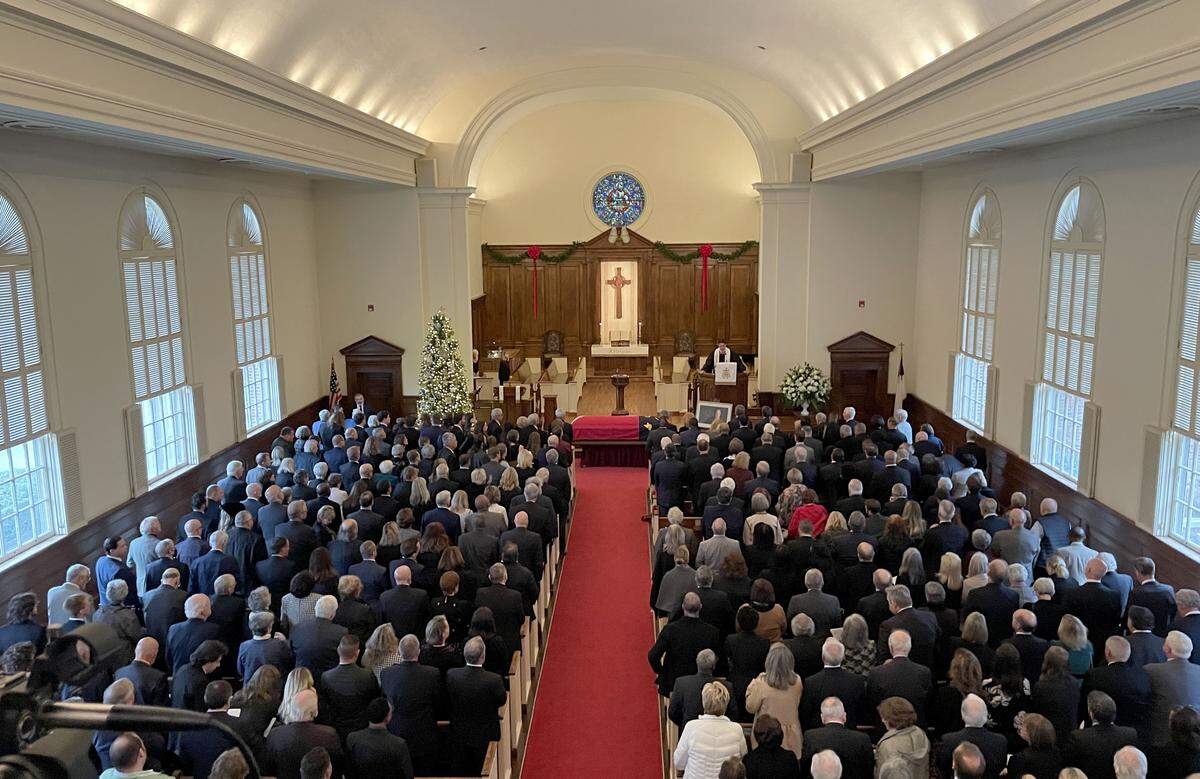
The pews inside First Presbyterian Church in Wilson were nearly full more than an hour before Friday’s service as people from across the state gathered to bid farewell to Jim Hunt, North Carolina’s only four-term governor and a force in politics.
Hunt died Dec. 18 at 88 at his Wilson County farm, where he was raised and still lived with his wife of 67 years, Carolyn Joyce Leonard Hunt, according to his obituary.
Before the service began, elected officials, former governors, longtime political allies and members of the public took their seats, chatting softly among themselves. Then, just before 1 p.m., the sanctuary grew quiet and the crowd rose to its feet.
Hunt’s family entered. His son, Baxter, and his daughter, Rachel — the state’s lieutenant governor — each held one of Carolyn Hunt’s hands as they walked down the aisle and took their seats on a front-row pew. In the background, a bagpiper played “Amazing Grace.”
At the front of the sanctuary stood Hunt’s coffin, draped with a North Carolina flag, and framed by a fully illuminated Christmas tree and a wreath.
On another bench at the front were the governors. Gov. Josh Stein and First Lady Anna Stein attended, as did former Gov. Roy Cooper and his wife, Kristin Cooper; former Gov. Bev Perdue and her husband, Bob Eaves; former Gov. Mike Easley and his wife, Mary Easley; former Gov. Pat McCrory and former Gov. Jim Martin. Easley, a Democrat, was seated beside Martin, a Republican, placing his arm around Martin as they settled in before the service.
For many, Hunt is remembered for his political prowess and the mark he left on the Old North State. But for those gathered Friday, the memories extended well beyond public office.
Those closest to Hunt said that, above all else, his greatest devotion was to his family — his wife, children, grandchildren and great-grandchildren.
Traveling, and eating, with Jim Hunt
Speaking to the crowd, Rachel Hunt said, “You are the people that helped make North Carolina the great place it is today, and along with my mother, he would never have been able to do the things that he did with the state and this country.”
Before turning to memories of her father, she paused to apologize to anyone who had ever been on the receiving end of Hunt’s late-night phone calls, a remark received with laughter. Hunt was known for his relentless work ethic, with aides, legislators and others often fielding calls late into the night or early morning.
Rachel Hunt relayed a story from her sister, Rebecca, about their father’s habit of pushing cars to their limits without paying much attention to the gas gauge. She said the family sometimes ran out of fuel — including on at least one occasion while driving another couple out to dinner. Hunt also “believed in handing his car keys to anyone at the airport ... and somehow that worked,” she said to laughs from the crowd.
That anecdote echoed a trait central to Hunt’s political success. He built broad coalitions — uniting conservative and moderate white voters while also appealing to a growing Black electorate — and relied on constant travel to take his ideas directly to voters, The News & Observer previously reported.
Another daughter, Elizabeth, shared her own airport tale through Rachel, recalling a trip with Hunt and his aides during which they stopped in Alabama. She was thrilled at the promise of an “airport steak,” only to learn it meant grabbing crackers, or Nabs, and a Pepsi.
Other memories centered on long-cherished family beach trips, where Hunt would eat “as much shrimp as humanly possible,” float for hours on a raft until someone had to retrieve him, and let his children bury him in the sand — head included — because, Rachel Hunt said, “he didn’t do anything halfway.”
Baxter Hunt also recalled his dad’s love of food, telling a story about a national governors’ conference in Maine where Hunt took full advantage of an all-you-can-eat lobster dinner, polishing off three lobsters in one sitting. Back home at the farm in Rock Ridge, Hunt made a weekly ritual of Friday seafood specials at a local restaurant, and in the final months of his life developed a daily craving for fried chicken and Diet Pepsi, Baxter said.
Hunt was a “voracious reader,” Rachel Hunt said, who read to his children from a young age. Elizabeth recalled one occasion when Hunt was reading the Sunday comics — such as “Blondie” — and would act out the voices as he read, Rachel said.
“One of my fondest memories was reading ‘Heidi’ with Dad,” Rachel Hunt said. “In the book, Heidi and her grandfather were toasting cheese over the fire, so Dad thought, ‘Maybe we should try that.’ Well, we had cheddar cheese, which does not melt over a fire, and we didn’t really have anything to hold it. We cobbled something together and stuck it in the fire. Forty minutes later, it was just a mess of grease in the fireplace — and we could eat some more cheese ... Mom did not appreciate that. But that was the thing about Dad: He wasn’t afraid to try anything he thought would be fun.”
Another memory involved riding horses. “We did that every Sunday afternoon, before he was governor,” Rachel Hunt said.
“We would ride for an hour — an hour and a half — and then as soon as we turned around to go home, Dad would say, ‘Do you want to race?’” Rachel said.
And so they would.
“Do you think he ever let me win?”
“No,” she said, laughing.
Baxter Hunt said their father could not have “done the many great things that he did without my mom.” He called their mother a hero in Hunt’s final years, allowing him to remain at home and be well cared for. “The best decision Dad ever made was marrying you,” he said.
Baxter also recalled his father’s love of the family farm, where Hunt believed in having “as many living creatures as possible,” at one point raising about 40 head of cattle. When Hunt later suggested adding a buffalo, Baxter said, his mother had to say no.
“I think you see a pattern here,” Baxter said. “Mom was the voice of reason.”
Jim Hunt’s legacy
Hunt earned his undergraduate degree at NC State University. He later earned his law degree from UNC-Chapel Hill.
Baxter Hunt spoke of his father’s love for NC State athletics, recalling trips to Reynolds Coliseum to watch Wolfpack basketball and games played together in the backyard.
Baxter Hunt said his father had two childhood ambitions: to be governor of North Carolina — which he achieved — and to be a point guard for NC State, a dream that ended after high school, though his passion for the Wolfpack never faded.
His other great passion — shared with many in his family — was public service, Baxter Hunt said.
James B. Hunt Jr. was born in Greensboro on May 16, 1937, and grew up on his family’s dairy and tobacco farm, graduating from Rock Ridge High School. After law school and public service in Nepal, he rose through Democratic Party leadership and chaired a reform commission that opened party leadership positions to racial minorities, women and young people.
In 1972, Hunt was elected lieutenant governor. He went on to win the governor’s office in 1976, at age 38, and again in 1980, before returning to office in 1992 and 1996. He guided North Carolina as it moved from a largely rural economy to one increasingly driven by education, research and private industry. That dominance was interrupted in 1984, when he lost a high-profile U.S. Senate race to Republican Jesse Helms, another defining North Carolina political figure of the era.
Hunt argued that public investment — especially in schools — was central to expanding opportunity and reducing poverty, The N&O previously reported. That philosophy was exemplified by Smart Start, the early childhood education initiative he championed. He also pushed for public spending to help develop new industries, backing major public-private partnerships in Research Triangle Park, including the Microelectronics Center of North Carolina and the N.C. Biotechnology Center. He later helped create NC State’s Centennial Campus, allowing private companies to locate research operations on state-owned land.
He secured expanded gubernatorial powers, including veto authority and the ability to serve consecutive terms.
The power of prayer
A final memory Rachel Hunt shared was watching the 1974 NCAA Final Four game between NC State and UCLA.
“All of us kids had a piece of red cloth in our hands,” she said, “and prayed on our knees in front of the television.”
The Wolfpack won in a legendary game.
“Mom and Dad have always been big believers in the power of prayer,” she said. “So my prayer for all of you all here today is that you have one person in your life who is your biggest cheerleader, as my dad was for me. I will never forget him.”
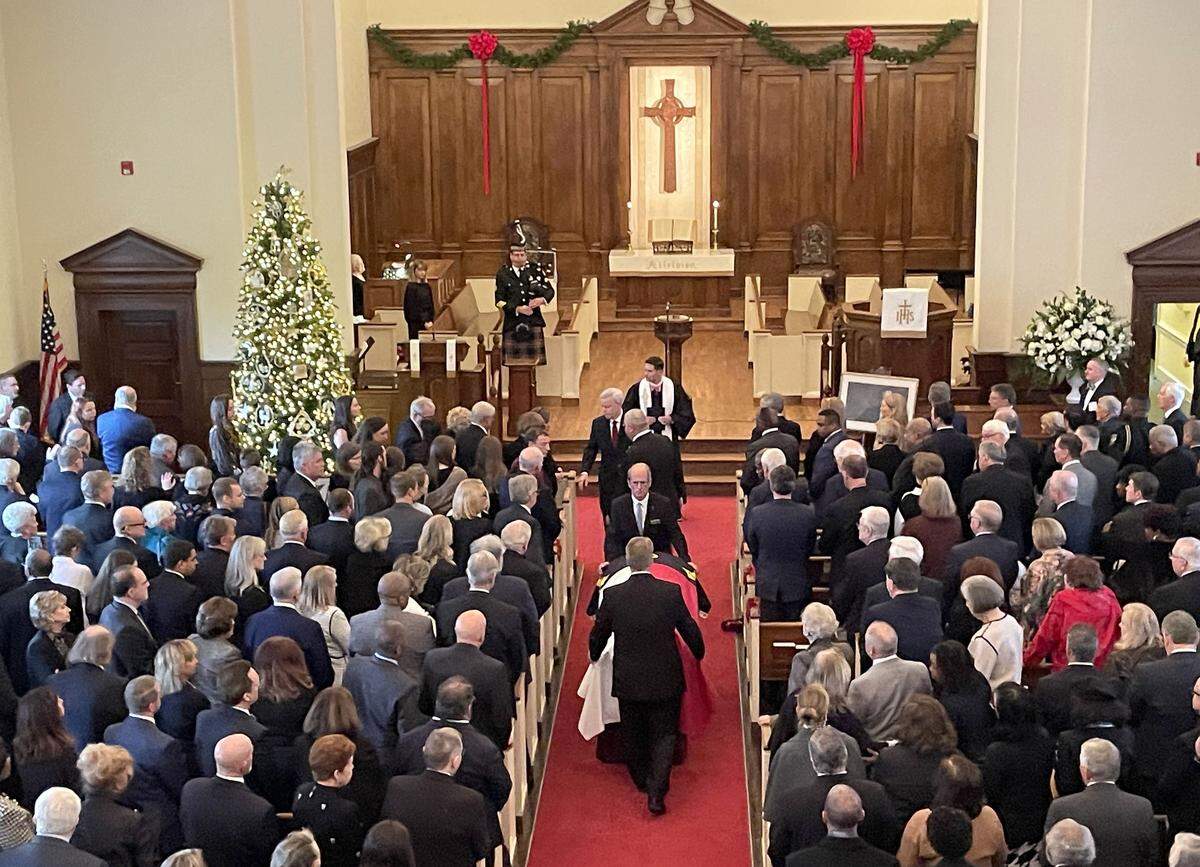
Rachel and Baxter Hunt escorted their mother out of the service and into the fellowship hall.
There, sandwiches, pimento cheese, chicken salad and lemonade were served as people gathered and reconnected. Carolyn sat, occasionally standing to greet and hug guests.
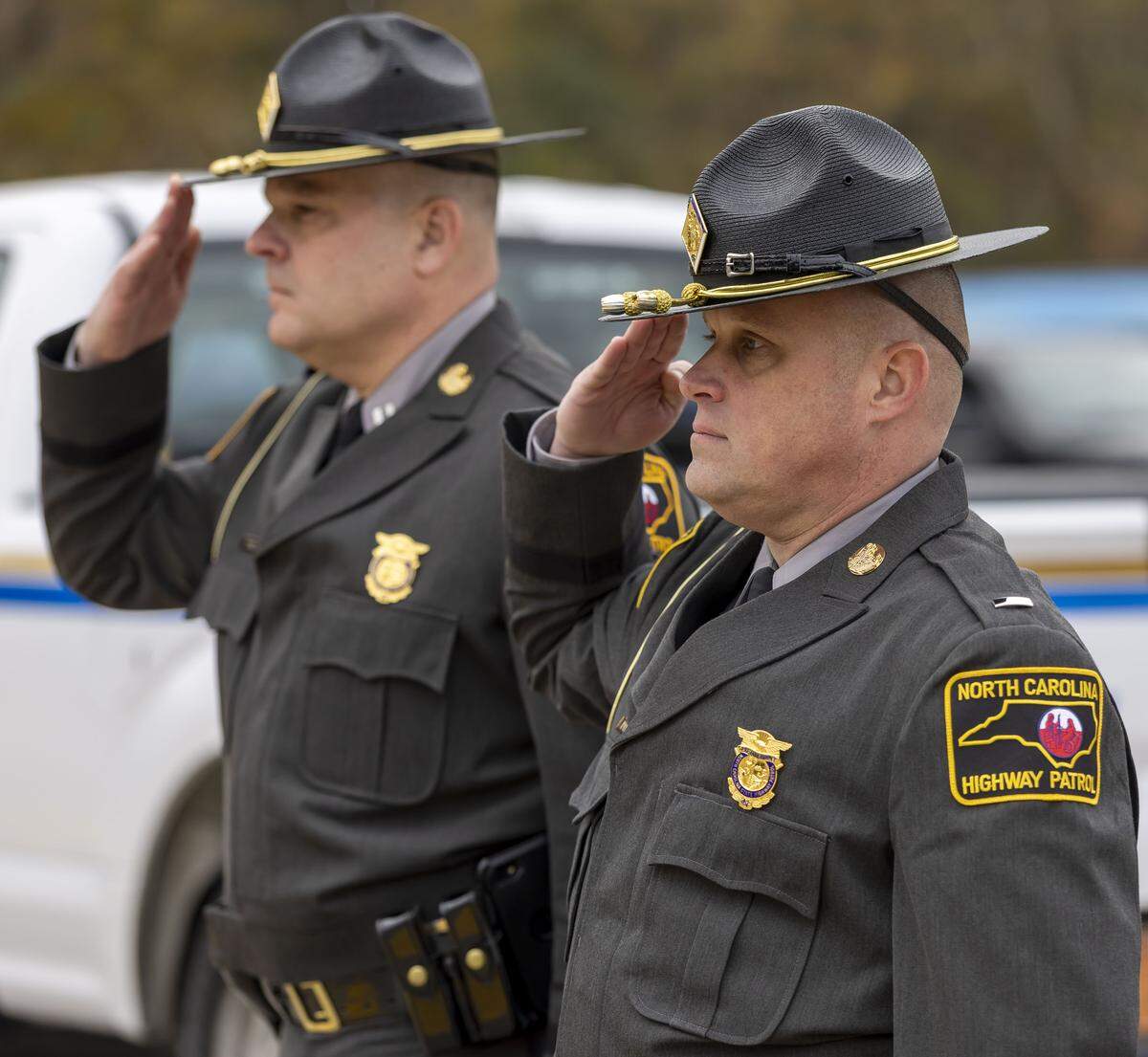
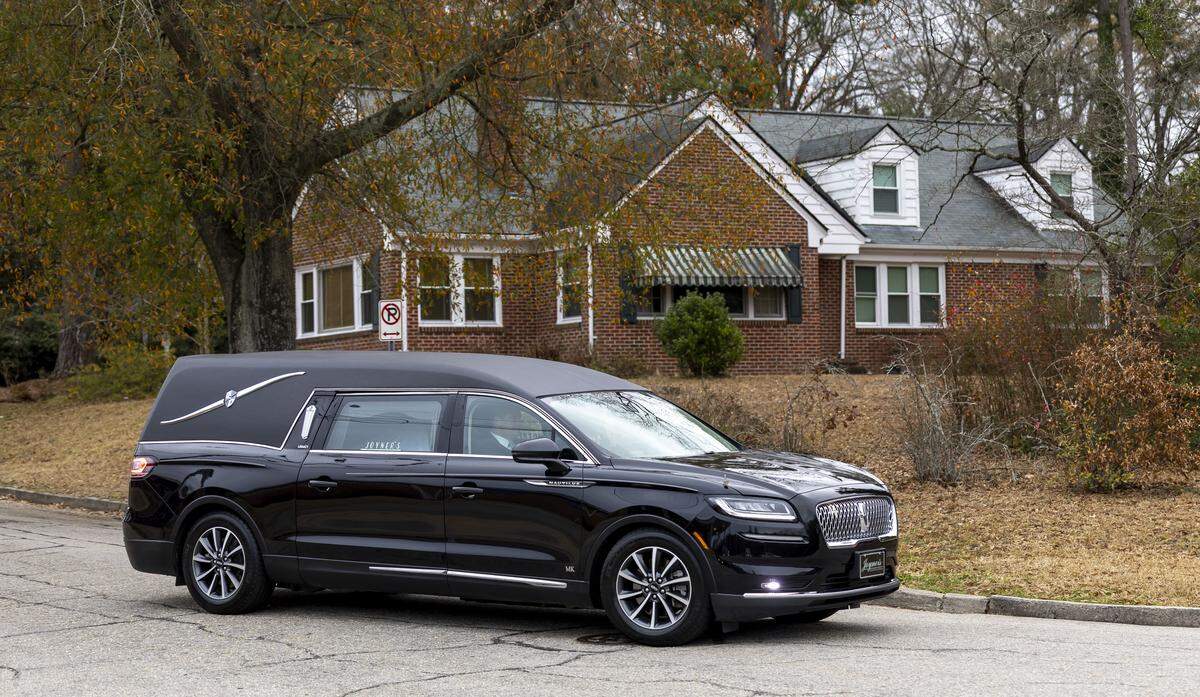
Shortly before 4 p.m., the family left the hall. The hearse made its way down Sunset Road in front of the church, with the family following in a car. Two state troopers saluted as the procession passed.
This story was originally published December 26, 2025 at 7:23 PM.