North Carolina wants to ban homeless camps statewide. Here’s what’s in the bill
AI-generated summary reviewed by our newsroom.
- The Senate amended HB 437 to prohibit public camping; House must concur.
- HB 437 makes selling, making, or delivering drugs in zones a Class E felony.
- The Senate approved the bill 26-16 along partisan lines with Republican support.
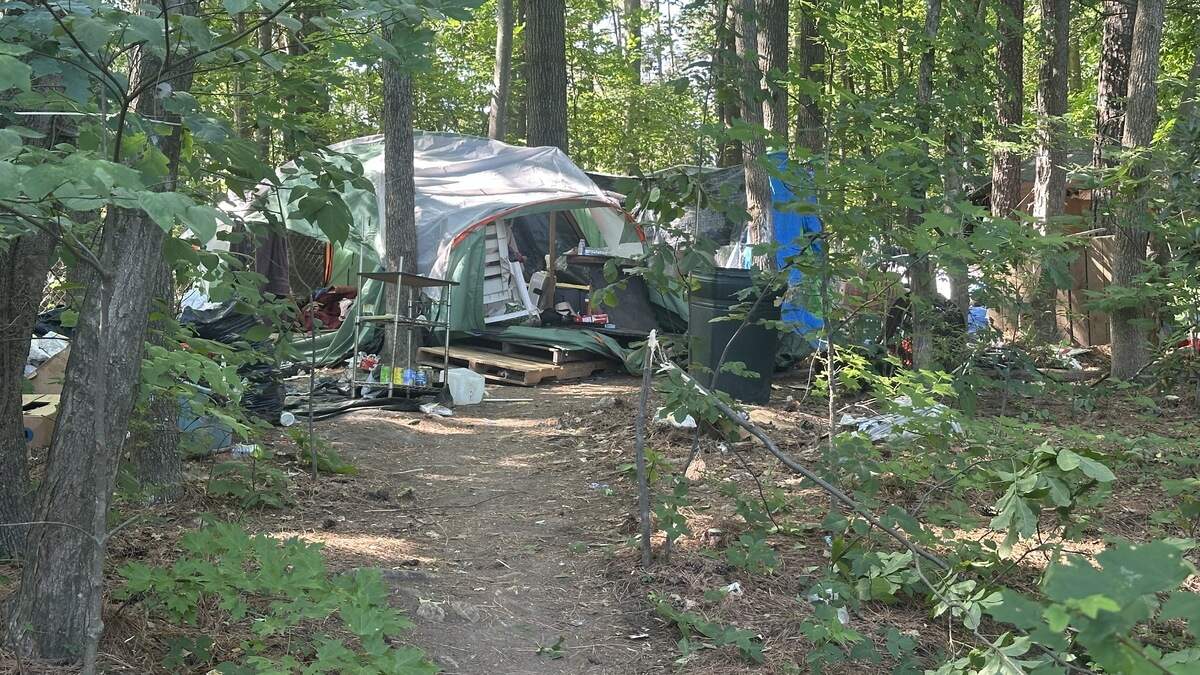
State lawmakers have advanced a bill that would ban homeless encampments across North Carolina.
Currently, encampments in the state are regulated through local laws. The City of Raleigh, for example, has banned homeless encampments on public property and has removed a few encampments over the past couple of years.
The bill, HB 437, would also establish drug-free service zones for people who are unhoused. Those who sell, make or deliver drugs within the zone would be considered a Class E felony.
The bill passed the state House without the statewide ban on homeless encampments. When it moved to the Senate, Belmont Republican Sen. Brad Overcash amended the bill to prohibit public camping, saying it will increase public safety and improve economic vitality for small businesses.
The bill does include an exception. Through a majority vote, local governments can designate property for public sleeping that has access to bathrooms, running water, mental health and substance abuse treatments and will prohibit drug use.
Overcash explained that local residents can petition their local government to comply with the provisions in the bill. If local officials fail to comply, the bill says, residents or business owners can petition North Carolina Superior Courts for an injunction to force compliance.
Democratic lawmakers and organizations working to end homelessness have criticized the bill, saying that banning encampments does not target the root causes of homelessness.
Those opposed also say the bill will put too much burden on municipal governments and public safety teams to enforce the ban and the drug-free service zones.
The state Senate advanced the bill with a vote of 26-16 on Wednesday — a complete partisan split with Republican support for the provisions and Democratic opposition.
Ending public camping
In committee last week, Sen. Julie Mayfield, a Buncombe Democrat, asked Overcash if Asheville would be required to “do anything else” since the city has an ordinance prohibiting public camping.
Overcash asked her if she was telling the committee that there were no encampments or “homeless folks sleeping in public” areas in the city.
He said he understands that Asheville has the ordinance, but “it has failed.”
“It has failed in the city of Asheville, senator. It has failed in the city of Gastonia. It has failed in Charlotte. It’s failed from Murphy to Manteo,” Overcash said. “This law will correct that.”
During the Senate discussion on Wednesday, Mayfield said “what we know from communities that have dealt with this issue for a long time is ... the most effective way to help our unhoused neighbors is a set of wraparound services.”
“I appreciate the intent of this bill to both improve public safety and enhance the dignity and respect of folks in our community who are unhoused, I just wish we were doing it a little bit differently,” she said.
Sen. Mujtaba Mohammed, a Mecklenburg Democrat, said the bill “is aimed at solving a real issue,” but “unfortunately offers the wrong solutions.”
“What troubles me most about this bill is it treats homelessness as something to be hidden rather to be solved,” he said. “The message of this legislation seems to be, if we can move homeless people somewhere else, then the problem is gone. ... But homelessness is not a tent. Homelessness is a person.”
Federal funding
Eric Tars, senior policy director the National Homelessness Law Center, said the bill “will not address the root causes of homelessness, and, in fact, will make it worse.”
Tars said the bill is modeled after legislation from the Cicero Institute, a Texas-based conservative think tank opposing “housing first” models that have traditional been federally funded in the U.S.
Rep. Brian Biggs, a Trinity Republican, has said the bill will address the root causes of homelessness, and that federal funding could help local governments with projects.
At the beginning of the month, the federal government announced a competitive funding program that criticizes the housing first model, saying that the “status quo perpetuates addiction in taxpayer-funded homelessness assistance programs in violation of Federal Law.” The Department of Housing and Human Development also encourages communities “to address the unsafe realities of encampments,” but does not specify how.
Tars said provisions like this leaves some people “with no alternative but end up in jail, and that’s what’s been happening in other states.” He said it is more expensive for North Carolina taxpayers to keep people in jail versus stable housing.
Stephanie Watkins-Cruz, the director of housing policy for the North Carolina Housing Coalition, told lawmakers in committee that the funding mentioned is “not only competitive, it’s uncertain.”
“Disbursement would be years away,” she said. “And historically, no matter the administration, it has been inconsistent.”
The House must now vote to concur with the Senate’s changes. If the House does not concur, members from both chambers will work to create a combined version.
Luciana Perez Uribe Guinassi of The News & Observer contributed to this report.